


This user has no status.

This user has no status.
🏆 Top 1% Commenter
Well-Known Member
Well-Known Member




The fastest blade in the world (?)
#1505 - 3+2 - OFF++
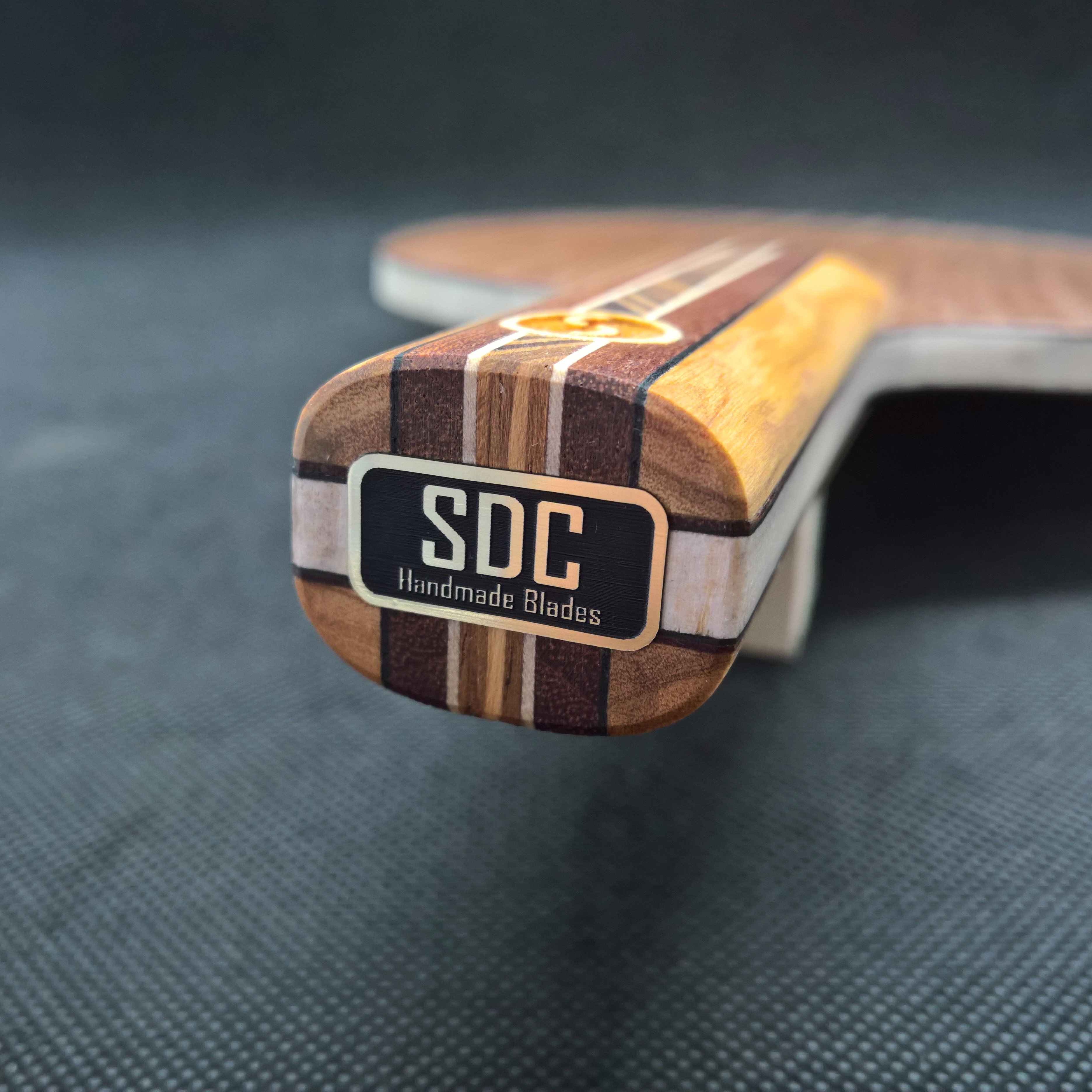
Behind this classic look, lies the fastest blade I've ever built. Is it the fastest one in the world? I have no idea, haven't tried all of them, but that is a never ending pursuit, and one that needs to be framed under certain restrictions, otherwise a comparison is not possible. This is what I mean, you can always make it faster by increasing the thickness, using more carbon, etc... so we need to establish certain limits, and most importantly, make it playable. In this case, I set out to make the fastest blade possible under 8mm and 90g. For example, I did build a couple of blades on par with this one before, but they were 10mm thick.
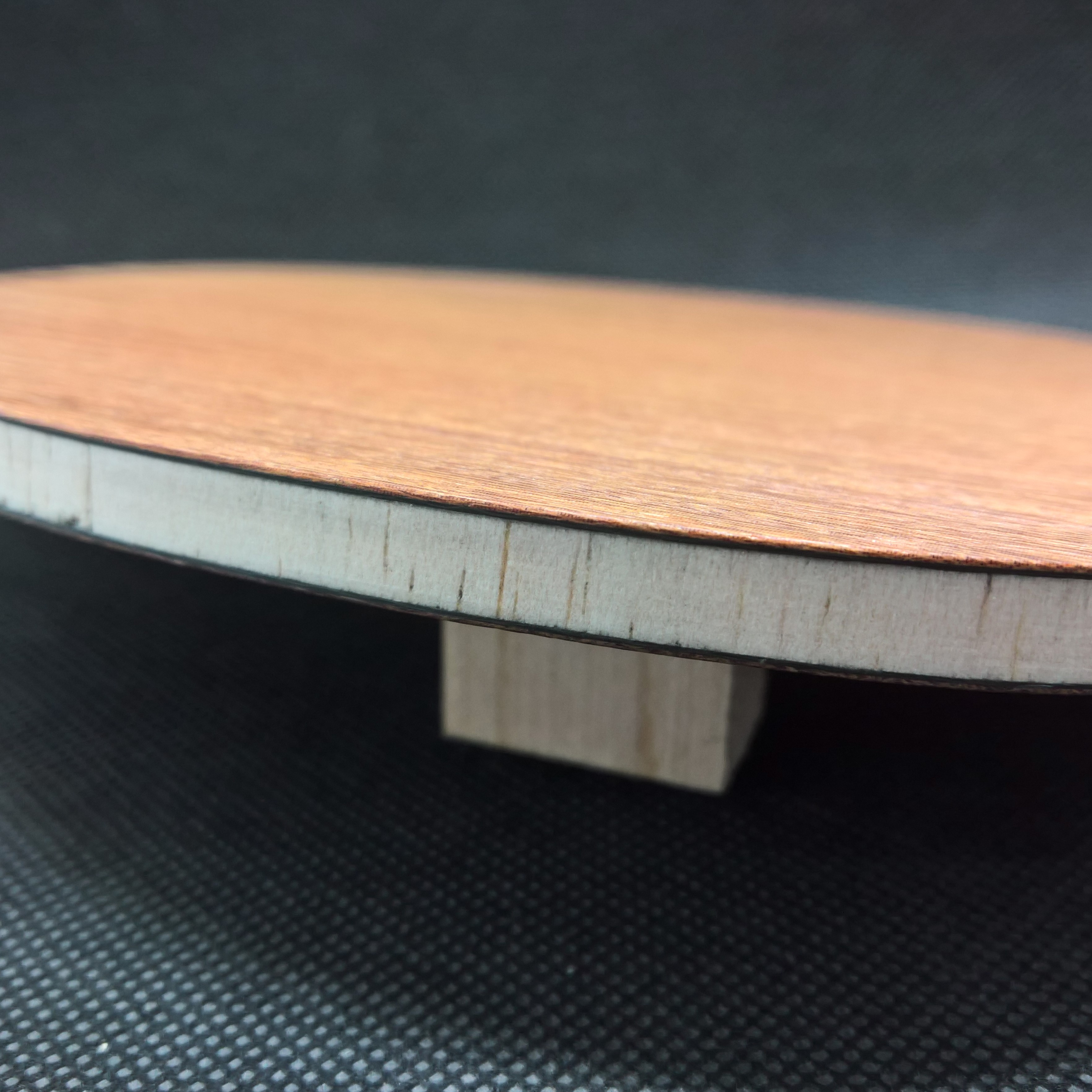
So, how do you build the fastest blade possible? The concept is very simple actually, you don't need super zlc or a ton of different fibers, you just need to maximize the stiffness and hardness of the blade, in order to decrease energy dissipation and increase its reaction. We maximize the stiffness by using the stiffest possible fiber (which is still carbon), and create the highest possible distance between those two layers. This means a really thick core and thin outer layers. The outer layers should also be as stiff and hard as possible, and in this case I used Indian Rosewood, which was the highest I had in stock. The carbon layer is also the thickest possible allowed by the ITTF, 0.35mm thick and super dense, in reality it's a combination of my 160 and 200g/m2 Carbon fabrics, so technically this is a 3+4 blade. But all of this comes with a problem, the weight, which leaves no option but to use a Balsa core. Even in the core we can tweak it to maximize the stiffness and hardness. The grain of the core does nos lie vertically or horizontally like usual, but it faces up, glued to the composite layer. The reason is that the endgrain is by far the hardest part of a wood board, however this is much harder to do of course.
The reaction of this blade is just ridiculous, like nothing I've ever seen. It has a peak frequency of 2433Hz, also the highest I've ever seen (on par with those two blades I mentioned earlier).
Just a final explanation: reaction doesn't mean power. Reaction is correlated to energy dissipation, less dissipation -> bigger reaction -> ball leaves faster. However, in TT we are governed by something called the Magnus effect, you need to apply spin in order to make the ball clear the net, and travel faster and longer. A ball with no spin just gets slowed down faster by air resistance and dips down. If a blade has virtually zero dwell time, you need to make up for this by opening up the racket angle and stroke up, instead of forward, which results in a less efficient movement. This is why very stiff blades are not suitable for playing further away from the table, and usually they have a soft outer ply like Hinoki, in order to create some "grab" and dwell.
Composition: Indian Rosewood / C360 / Balsa core
Weight: 89.4g
Thickness: 7.9mm
Head Size: 157x150mm
Handle: ST (23.0-28.5x100mm)
Balance: 3.1cm (Med)
Condition: New
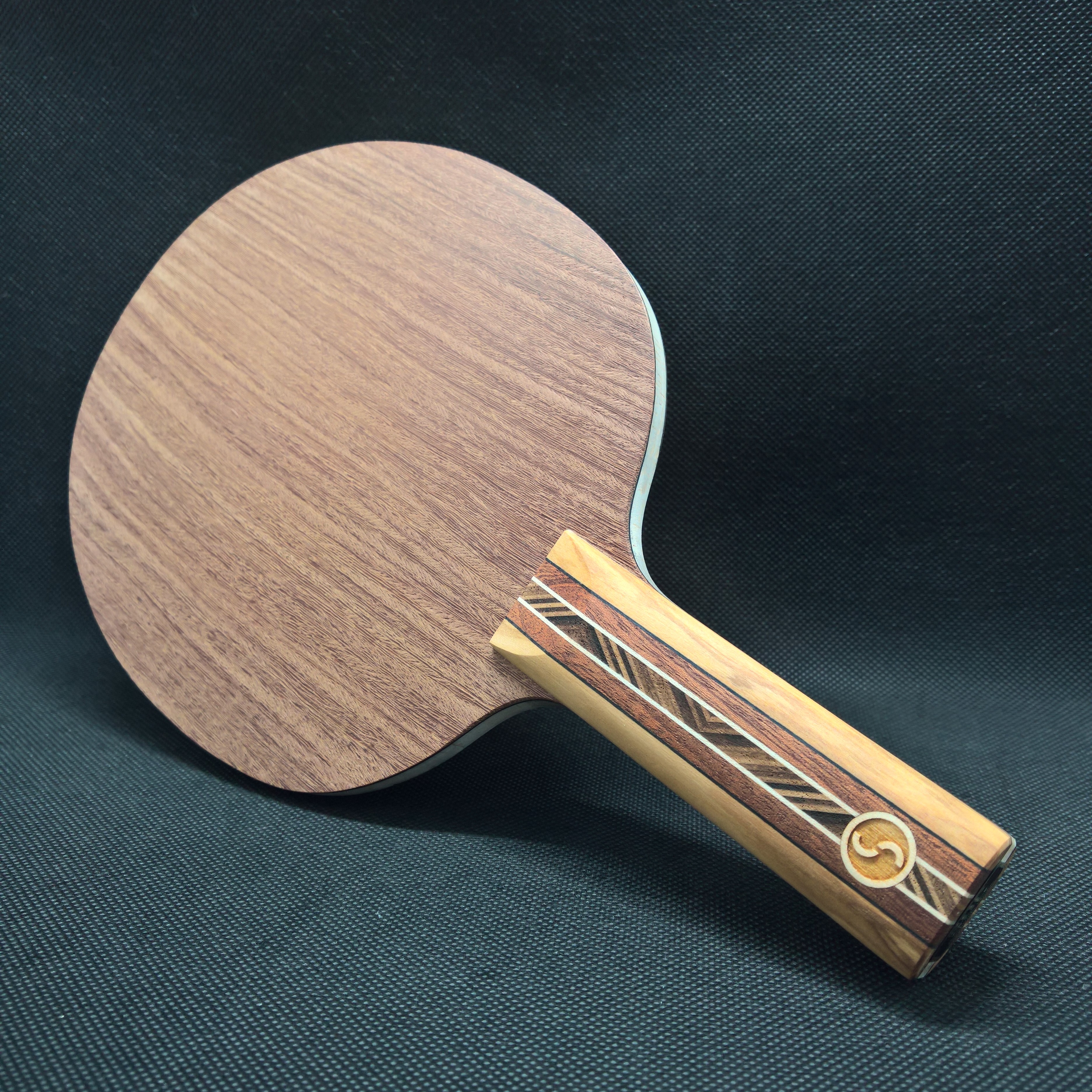
#1505 - 3+2 - OFF++
Behind this classic look, lies the fastest blade I've ever built. Is it the fastest one in the world? I have no idea, haven't tried all of them, but that is a never ending pursuit, and one that needs to be framed under certain restrictions, otherwise a comparison is not possible. This is what I mean, you can always make it faster by increasing the thickness, using more carbon, etc... so we need to establish certain limits, and most importantly, make it playable. In this case, I set out to make the fastest blade possible under 8mm and 90g. For example, I did build a couple of blades on par with this one before, but they were 10mm thick.
So, how do you build the fastest blade possible? The concept is very simple actually, you don't need super zlc or a ton of different fibers, you just need to maximize the stiffness and hardness of the blade, in order to decrease energy dissipation and increase its reaction. We maximize the stiffness by using the stiffest possible fiber (which is still carbon), and create the highest possible distance between those two layers. This means a really thick core and thin outer layers. The outer layers should also be as stiff and hard as possible, and in this case I used Indian Rosewood, which was the highest I had in stock. The carbon layer is also the thickest possible allowed by the ITTF, 0.35mm thick and super dense, in reality it's a combination of my 160 and 200g/m2 Carbon fabrics, so technically this is a 3+4 blade. But all of this comes with a problem, the weight, which leaves no option but to use a Balsa core. Even in the core we can tweak it to maximize the stiffness and hardness. The grain of the core does nos lie vertically or horizontally like usual, but it faces up, glued to the composite layer. The reason is that the endgrain is by far the hardest part of a wood board, however this is much harder to do of course.
The reaction of this blade is just ridiculous, like nothing I've ever seen. It has a peak frequency of 2433Hz, also the highest I've ever seen (on par with those two blades I mentioned earlier).
Just a final explanation: reaction doesn't mean power. Reaction is correlated to energy dissipation, less dissipation -> bigger reaction -> ball leaves faster. However, in TT we are governed by something called the Magnus effect, you need to apply spin in order to make the ball clear the net, and travel faster and longer. A ball with no spin just gets slowed down faster by air resistance and dips down. If a blade has virtually zero dwell time, you need to make up for this by opening up the racket angle and stroke up, instead of forward, which results in a less efficient movement. This is why very stiff blades are not suitable for playing further away from the table, and usually they have a soft outer ply like Hinoki, in order to create some "grab" and dwell.
Composition: Indian Rosewood / C360 / Balsa core
Weight: 89.4g
Thickness: 7.9mm
Head Size: 157x150mm
Handle: ST (23.0-28.5x100mm)
Balance: 3.1cm (Med)
Condition: New