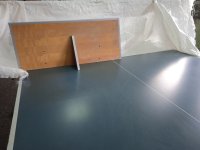
I've got a mini digital inclinometer by Allmeter, so my measurements are exact, with the table plane being at "0.00°" per definitionem. I could write novels about returnboards (and i did, on the
geman folum). For the past weeks or months i left the angle at 63.00-65.00°, let's say
~64°, i.e. it is missing 26° to be perpendicular to the table. And i placed my universal board right at the far side (edge) of the table (
0cm), i.e. the rubber touches the table edge. I am willing to claim that no other geman citizen has been spending more hours hitting the returnboard since xmas 2024 than me but that's off topique.
Anything lower angled, say 55°, gets into the super advanced category, because your shot must have high speed and high spin to clear the net. Very high speed AND very high spin, actually. With the returnboard, I mostly practice my backhand, and the 0cm/64°-combo allows me
both to bh-
loop against it
and to bh-
shoot against it (the latter of which is a special technique/shot not to be discussed here and not taught in courses/texts): if i bh-hit the ball at a low level, i choose to bh-loop it, and if i bh-hit it at a slightly higher level, then i am free to bh-loop it again or bh-shoot it, and ofc i try to bh-shoot it (because that's the new shot which i wanted to learn thru rbpon, and i did!). Bh-shooting is indeed the more fun shot.
The most important thing to know is: no matter how fast/hard AND how spinny AND how arched a topspin ball comes in, the returnboard is able to produce a rebound without error. There are only 2 essential settings, the distance from the net (in cm) and the angle (in °, measured from the horizontal not the vertical), while either is not entirely independent. Basically, the
distance, in the end, only determines how much
time the person gets between the shots. Nothing else. Whereas, the
angle determines the (range of) rebound
arch. In most/all youtube vids on returnboards you will witness angles much bigger than 64°, resulting in unrealistic high archs ("too easy shots for the person").
So the configuration procedure goes like this:
First, you need to determine which kind of hitting rhythm (frequency) you want to train with. Beginners want to have more time between shots, advanced users feel more comfortable at a natural high frequency. If you are advanced, typically you'd set the distance at 0cm not 15cm from the table edge.
Second, you need to determine at which height (height range) you expect the balls to come at you AND with which quality (speed AND spin) you wish to hit the ball, on average. For advanced users, setting the angle to 65.0° would be a good starting point. Now fh-loop hard/fast with high spin [if that's what you want to exercise then] against the 0cm/65°-combo and you will learn that the spinnier ones (or depending on the height of the rebound point

, if you "mishit" the ball) do get rebound into the far out, i.e. doht hit the player's table side. Then no problem, you would change only the angle (closing to say 62°) but not the distance.
Only in very extreme cases (i.e. super hard topspins at super high spins) would the 0cm distance setting not work. Then ofc one would increase the distance to 5cm, 10cm, or 15cm, and start over with the angle-finding procedure. The more one moves the returnboard away from the table edge, say 30cm, the more pointless the exercise becomes because the waiting time between the shots gets too long. Good for beginners, pointless for advanced users.
As opposed to those yt vids, doht accept balls which bounce high off your table side, i.e. clear the net with high clearance, these are unrealistic balls! Then simply close the board angle. Do it. Then if the new rebounding ball lands in the net, decrease the distance to the table edge (e.g. from 15cm to 5cm). As we can see, the distance and the angle
are interdependent if our goal is to produce a low arched rebounding ball!, and yes, that should be imho our goal when configuring the returnboard setup.
And yes, if your found setting works well with your fast hard spinny fh-loop but doesn't work with your bh-loop (i.e. the rebounding ball doesn't clear the net), then it means that your bh-loop isn't en par. Guess why i almost exclusively train my backhand with the returnboard? 🥹
I am happy enough with the hardness power spin consistency speed quality of my best fh-loops (little room for improvement 🤥), and to me it's more fun to practice shots which lack hardness power spin consistency speed quality (like my bh-loop) and learn new basic shots thru the returnboard (like the bh-shooting, bh-smash, banana flick).
For the upcoming year i've got a list of further new shots which i want to learn and practice. So now i am switching to the Powerpong robot because those shots are too difficult to practice with a returnboard. For the time being i regard my two returnboards as retired.