
Really nice shoes! Very good comfort, grip and they look good too, I have the white ones. Very satisfied!
Latest reviews


You are using an out of date browser. It may not display this or other websites correctly.
You should upgrade or use an alternative browser.
You should upgrade or use an alternative browser.

For Lezoline Sonic in Shoes
- Tompa8888
- 5.00 star(s)
Pros
- Super Comfort
- Super Grip
- Good looking
- Comfort
-
10
- Grip
-
9.5
- Durability
-
9
- Weight
-
2.5

For SHA 3 star 40+ in Balls
- jeyzonjay
- 4.00 star(s)
Pros
- Good durability
- Round
Cons
- Not perfect
I have tried many of the new plastic balls and find the Nittaku ones last longer than all the others. They are good quality, however not perfect just yet. But I hope soon they will be. They are good shape and feel slightly harder than the other plastic balls I have tried. Overall Nittaku seem to make the balls more round than other brands. Again it's not always perfectly round but most of them are.
- Roundness
-
8
- Hardness
-
8.2
- Speed
-
8.2
- Durability
-
8
For Wave Drive Ace 2 in Shoes
- jeyzonjay
- 5.00 star(s)
Pros
- Very comfortable
- Very light
- Excellent grip
These shoes are great, great quality and come at a very good price. They have excellent durability which is very important in table tennis due to the physical demand. They are better than any other TT shoe I have tried. They grip very well on all playing surfaces.
In my opinion id say Mizuno make the best table tennis shoes. They are very light, feels like i'm walking on a cloud lol
In my opinion id say Mizuno make the best table tennis shoes. They are very light, feels like i'm walking on a cloud lol
- Comfort
-
9.2
- Grip
-
9.2
- Durability
-
9.5
- Weight
-
4
For Bluefire M2 in Rubbers
- jeyzonjay
- 4.00 star(s)
Pros
- good spin
- good speed
- good quality
Cons
- little pricey
I'd say these rubbers come as close as you can to the butterfly rubbers. The spin/speed is quite good, they also last quite long, maybe a little too pricey for some but if you want to try out the donic rubbers, try the m1/m2 collection, deuces!
For Timo Boll Spirit in Blades
- jeyzonjay
- 5.00 star(s)
I'd say this blade is really, really good, it's quite popular around the world and I've just started playing with it and I can easily understand why, the touch feels really good, very compatible with the rubbers, it's a fast blade but fits a professional player as well as a non-professional player. It's not very heavy either, just about right, if there are people here looking to try out/buy a butterfly-blade, I'd definetly recommend this one, I'm out, peace.

- 3Ttabletennis
- 4.00 star(s)
Pros
- Control
- Price
Cons
- Speed
Vari Spin is rubber with low speed and much control. I think it's a good allround rubber for beginners or players with defensive/allround style. Every stroke or technique is possible with Varispin.
- Speed
-
4.9
- Spin
-
7.4
- Durability
-
8
- Control
-
9

For Carbonado 145 in Blades
- yogi_bear
- 5.00 star(s)
Stiga Carbonado 145 Review!
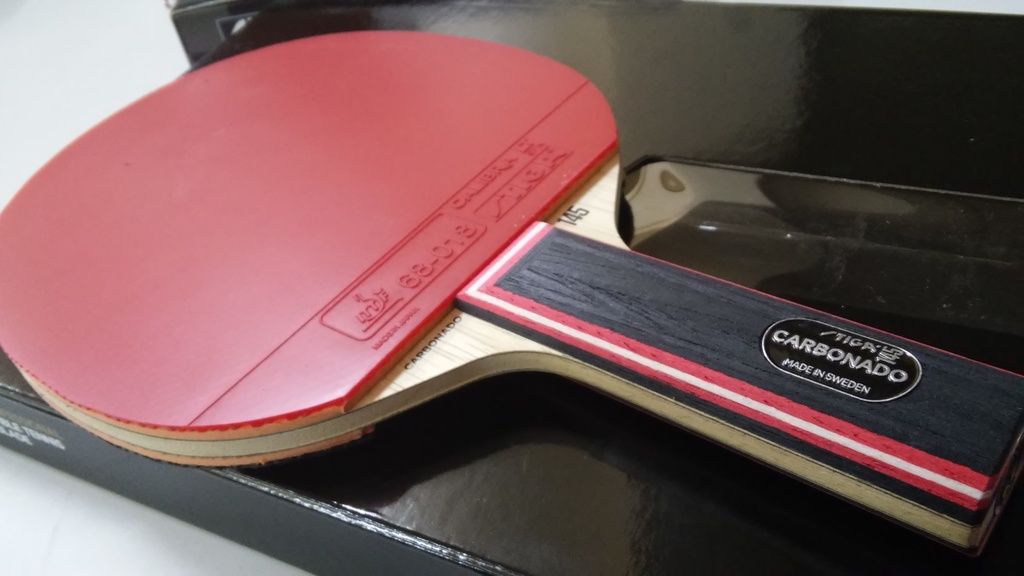
Carbonado 145
Head Size: 150 x 156mm
Thickness: 5.8 - 5.9mm
Weight: 88 grams
Handle: Straight
Hardness: Medium Stiff
Rubbers used: Calibra LT Sound max, LT Spin and Hurricane 3
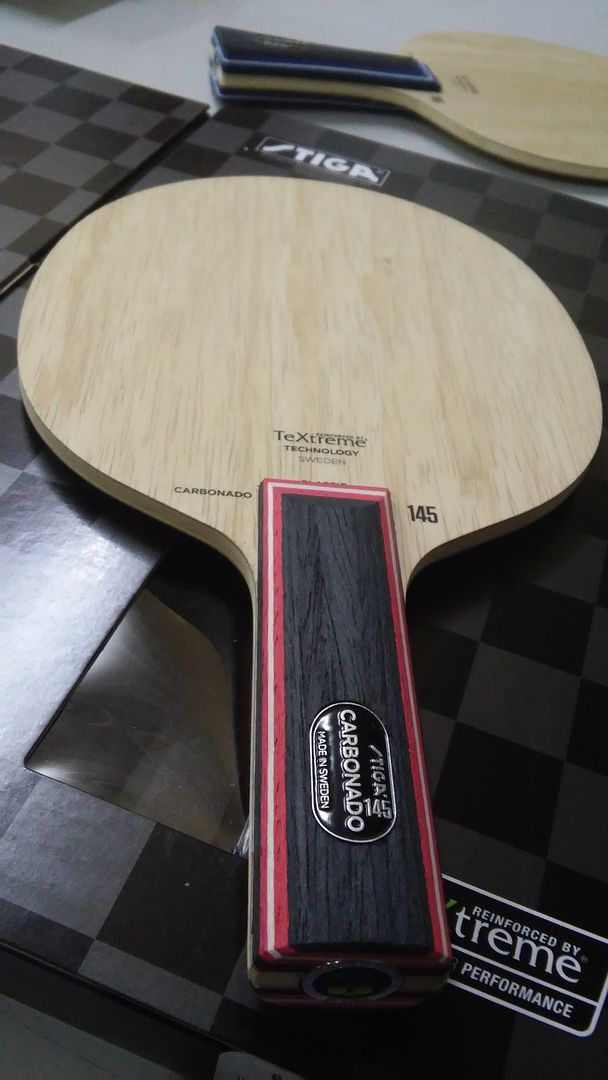
Finally, after months of anticipation and excitement the Carbonado 145 arrived at my door step. I wish I could have gotten this baby much, much earlier but then due to large volumes of orders I had to wait for a while. Stiga informed me that these 2 Carbonado blades are a result of a 3 year research and development using the high tech material Textreme. Textreme is a high tech carbon fiber used in making lightweight bikes, parts of a formula car and this is even used in Prince tennis rackets. Textreme boasts of a thinner carbon fiber layer compared to a traditional weaved carbon layer that is used mostly on conventional carbon blades in the market today.
The Carbonado 145 blade comes with a a very good finish on the blade surfaces. Unknown to many people, Stiga has been improving the quality finish of their blades. The blade comes with a metal tag which gives a much more better quality finish. Gone are the thick NCT coating on the blade surface. What remains now is a much thinner and barely noticeable coating on the surface. Before, you could see an obvious dividing line that separates the NCT coating between the blade head and the neck of the blade part.
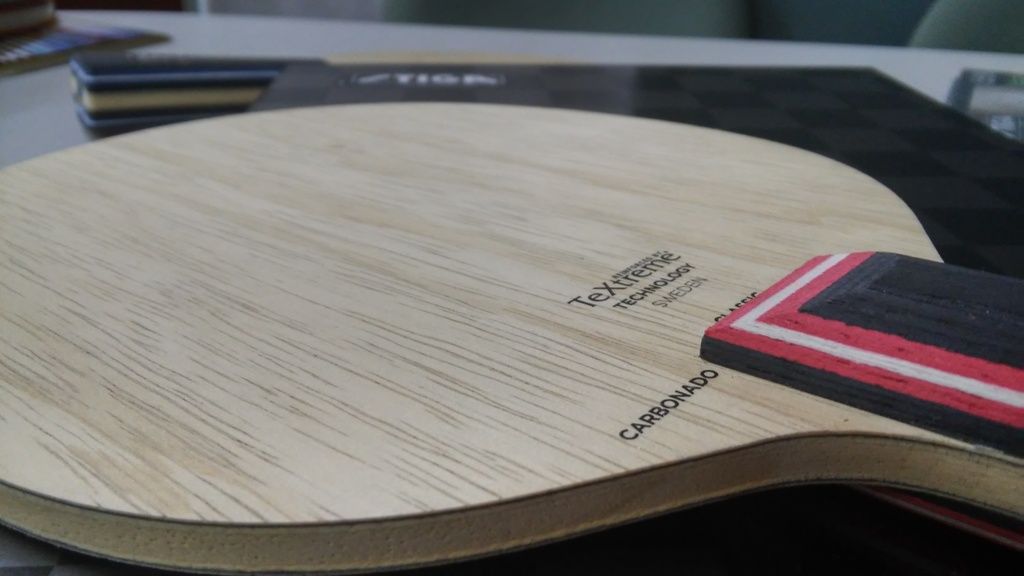
Before everything else, I would like to point out that the 2 Carbonado blades 145 and 190 have only slight differences in that they have the same construction and wood veneers (Limba-Textreme Carbon-Ayous-Ayous Core-Ayous-Textreme Carbon-Limba). Also, the orientation of their carbon weave is their distinguishing mark. The 145 having a slanted or diagonal orientation and the 190 which has perpendicular orientation. The 2 ayous layers before and after the central ayous core are a bit hard to see at first unless you look at them closely. The Textreme carbon layers are very thin. In fact much thinner than most carbon layers of other blades presently in the market.
Speed
The Carbonado 145 blade is not blazingly fast. I would rate it as Off to Off+ but more on the OFF side. In comparison to other Stiga blades, The Stiga Intensity Carbon is much faster. On other brands, the Carbonado blades at time can be faster than a TB ALC or at the same level of a primorac carbon at time. The Super MJ ZLC is much faster than the 2 Carbonados.
Feel
I thought the blade is very stiff but only mildly stiff. The 145 only felt a notch harder than a regular ZJK ZLC blade but feels more solid. It has this different carbon feel because every time you strike the ball with the Carbonados, the feel of being woody and carbon like alternates in my hand. It is a good thing actually because the 2 blades offer good feed back. The vibrations are minimal compared to the intensity carbon. Also, unlike conventional carbon blades, it doesn't feel that hard and ball feedback is slightly enhanced maybe due to the textreme carbon layers that are very thin.
Throw
Tried using both soft rubbers (LT Sound) and medium rubbers (LT SPIN) on the Carbonado 145 blade. In a way Stiga was right in claiming that the 145 has a higher throw but personally I would rate this 2 blades as having low throw heights but with the Carbonado 145 having a higher throw. The 190 has about 2-3 inches ball height from the net when doing spin drives or loops. The Carbonado 145 has about 3-4 inches of ball height using the same strokes and rubbers.
On close to the table attacks
The Carbonado 190 has this low, sharp trajectory when doing smashes and spin drives. Close to the table, the Carbonado 190 is much better than the 145. When you attack with loops you need a bit of adjustment for your ball arc especially when taking the ball on-the-rise against underspin. It takes a bit of practice, but when you get the hang of it you can adjust to it easily. When you use attacks on the ball that use more sponge compression and care for speed more than the spin then the 190 is much better.
On mid distance/far from the table
The 145 version easily outshines the 190 despite both having long trajectories, the 145 has a slightly higher arc when countering or spinning the ball mid distance. Through this slightly higher arc, the 145 is more forgiving than the 190 and offers more room for error on that distance.
Other strokes
Depending on the distance both blades are very good at blocking but the 145 blocks better at mid distance and the 190 close to the table. I have to say that both blades have high levels of control and are much user-friendly compared to other super-fast blades in the market. On short strokes, both are not that bouncy on drop shots and flicks but I would give the 190 as a better blade in doing drop shots because of its slightly lower arc than the 145.
My Personal Choice
I was more impressed with the 145 in comparison to the Carbonado 190. The arc was slightly better when I used a Hurricane 3 on the blade. The combination proved to be very good and balanced - the 145's speed + the H3's spin and control. The 190 was a better blade with a Chinese rubber on the forehand but I felt that the 145 is much better. I will not be surprised if people who wanted an alternative to composite blades and are looking for something with a different blade will get the 2 Carbonados while using an H3 or Globe 999 National.
Overall, I am greatly impressed by the Carbonados with much more partiality on the 145 version. I think that the trend of making a faster blade every time a new season for blades arrive is over. With all the very fast rubbers in the market right now you will not worry much about speed but rather on the feel and control of the blade. The speed itself can be partially compensated by the rubber you use. The Carbonado 145 blade is user friendly even to those players who are on their intermediate levels.

Carbonado 145
Head Size: 150 x 156mm
Thickness: 5.8 - 5.9mm
Weight: 88 grams
Handle: Straight
Hardness: Medium Stiff
Rubbers used: Calibra LT Sound max, LT Spin and Hurricane 3

Finally, after months of anticipation and excitement the Carbonado 145 arrived at my door step. I wish I could have gotten this baby much, much earlier but then due to large volumes of orders I had to wait for a while. Stiga informed me that these 2 Carbonado blades are a result of a 3 year research and development using the high tech material Textreme. Textreme is a high tech carbon fiber used in making lightweight bikes, parts of a formula car and this is even used in Prince tennis rackets. Textreme boasts of a thinner carbon fiber layer compared to a traditional weaved carbon layer that is used mostly on conventional carbon blades in the market today.
The Carbonado 145 blade comes with a a very good finish on the blade surfaces. Unknown to many people, Stiga has been improving the quality finish of their blades. The blade comes with a metal tag which gives a much more better quality finish. Gone are the thick NCT coating on the blade surface. What remains now is a much thinner and barely noticeable coating on the surface. Before, you could see an obvious dividing line that separates the NCT coating between the blade head and the neck of the blade part.
Before everything else, I would like to point out that the 2 Carbonado blades 145 and 190 have only slight differences in that they have the same construction and wood veneers (Limba-Textreme Carbon-Ayous-Ayous Core-Ayous-Textreme Carbon-Limba). Also, the orientation of their carbon weave is their distinguishing mark. The 145 having a slanted or diagonal orientation and the 190 which has perpendicular orientation. The 2 ayous layers before and after the central ayous core are a bit hard to see at first unless you look at them closely. The Textreme carbon layers are very thin. In fact much thinner than most carbon layers of other blades presently in the market.

Speed
The Carbonado 145 blade is not blazingly fast. I would rate it as Off to Off+ but more on the OFF side. In comparison to other Stiga blades, The Stiga Intensity Carbon is much faster. On other brands, the Carbonado blades at time can be faster than a TB ALC or at the same level of a primorac carbon at time. The Super MJ ZLC is much faster than the 2 Carbonados.
Feel
I thought the blade is very stiff but only mildly stiff. The 145 only felt a notch harder than a regular ZJK ZLC blade but feels more solid. It has this different carbon feel because every time you strike the ball with the Carbonados, the feel of being woody and carbon like alternates in my hand. It is a good thing actually because the 2 blades offer good feed back. The vibrations are minimal compared to the intensity carbon. Also, unlike conventional carbon blades, it doesn't feel that hard and ball feedback is slightly enhanced maybe due to the textreme carbon layers that are very thin.
Throw
Tried using both soft rubbers (LT Sound) and medium rubbers (LT SPIN) on the Carbonado 145 blade. In a way Stiga was right in claiming that the 145 has a higher throw but personally I would rate this 2 blades as having low throw heights but with the Carbonado 145 having a higher throw. The 190 has about 2-3 inches ball height from the net when doing spin drives or loops. The Carbonado 145 has about 3-4 inches of ball height using the same strokes and rubbers.
On close to the table attacks
The Carbonado 190 has this low, sharp trajectory when doing smashes and spin drives. Close to the table, the Carbonado 190 is much better than the 145. When you attack with loops you need a bit of adjustment for your ball arc especially when taking the ball on-the-rise against underspin. It takes a bit of practice, but when you get the hang of it you can adjust to it easily. When you use attacks on the ball that use more sponge compression and care for speed more than the spin then the 190 is much better.
On mid distance/far from the table
The 145 version easily outshines the 190 despite both having long trajectories, the 145 has a slightly higher arc when countering or spinning the ball mid distance. Through this slightly higher arc, the 145 is more forgiving than the 190 and offers more room for error on that distance.
Other strokes
Depending on the distance both blades are very good at blocking but the 145 blocks better at mid distance and the 190 close to the table. I have to say that both blades have high levels of control and are much user-friendly compared to other super-fast blades in the market. On short strokes, both are not that bouncy on drop shots and flicks but I would give the 190 as a better blade in doing drop shots because of its slightly lower arc than the 145.
My Personal Choice
I was more impressed with the 145 in comparison to the Carbonado 190. The arc was slightly better when I used a Hurricane 3 on the blade. The combination proved to be very good and balanced - the 145's speed + the H3's spin and control. The 190 was a better blade with a Chinese rubber on the forehand but I felt that the 145 is much better. I will not be surprised if people who wanted an alternative to composite blades and are looking for something with a different blade will get the 2 Carbonados while using an H3 or Globe 999 National.
Overall, I am greatly impressed by the Carbonados with much more partiality on the 145 version. I think that the trend of making a faster blade every time a new season for blades arrive is over. With all the very fast rubbers in the market right now you will not worry much about speed but rather on the feel and control of the blade. The speed itself can be partially compensated by the rubber you use. The Carbonado 145 blade is user friendly even to those players who are on their intermediate levels.

For Offensive Wood NCT in Blades
- LukasTT
- 5.00 star(s)
Pros
- Control
- Speed
- Price
Cons
- Hardness
I've only had this blade for a couple of months, but I can already say that I love it. The blade is quite cheap, but you get A LOT for the money. The blade has a balanced feel between speed and control, but I feel like there is more control to the blade. I have DHS Hurricane 3 on forhand (black) and Donic Akkadi Taichi on backhand (red), and this combination is very good for my style of play (Offensive). I'd recommend this blade to anyone who is ready for their first custom racket. The blade could have been a little harder though.
- Speed
-
8
- Control
-
8.9
- Hardness
-
5.6
- Durability
-
8
For Tenergy 05 in Rubbers
- aminuddinmadil
- 5.00 star(s)
Pros
- counterloop
- spinny
Cons
- expensive
- sensitive
Overall this is the best rubber out there.. I find it very good for counter loop and for getting lots of spin! Everyone should try this (If you have more budget that is)
- Speed
-
8
- Spin
-
9.2
- Durability
-
8.4
- Control
-
8.6
For Stratus Powerwood in Blades
- ejb
- 5.00 star(s)
Excellent blade. The feel and control is outstanding; makes you feel fearless when blocking. The speed isn't the fastest, but is more than enough to wallop the ball past your opponent. Mates well with medium tensor rubbers (T80, Razaka 7, Boost TX etc). It is also exceptionally good value, I pick up mine online for 32 Euros!
A slight snag is the softish wood makes it fragile. SPW chips easily and repeated gluing also caused the surface of the blade to splitter on mine. Lacquering the bat and using tape to protect the edges is recommended.
A slight snag is the softish wood makes it fragile. SPW chips easily and repeated gluing also caused the surface of the blade to splitter on mine. Lacquering the bat and using tape to protect the edges is recommended.
- Speed
-
8.9
- Control
-
9.6
- Hardness
-
5.1
- Durability
-
7.2
Quality rubber. Does almost everything well and has great control. But, for me, it was tough to generate sufficient spin when serving. Long fast backspin serves were easy to return for opponents, where as with Razaka 7 or Boost TX they are a handy way of picking up quick points. Shame. If it hadn't been for this I would have kept it.
- Speed
-
8.8
- Spin
-
8.6
- Durability
-
8.9
- Control
-
9.2

Pros
- Controlable
- durable
Cons
- too slow
I played with this rubber when i was beginner and now its on my spare blade. Pretty solid rubber for someone who is learning basic strokes. Controlable,medium- hard sponge and is slightly medium tacky rubber
- Speed
-
6.1
- Spin
-
8
- Durability
-
8.6
- Control
-
9.5

- UpSideDownCarl
- 4.00 star(s)
Pros
- A Ton of Dwell
- Great Spin
- Flex for Looping
Cons
- Could be Faster
This is an amazing blade for those interested in a controlled offensive (Off-) blade that has good flex and amazing feeling. I love this blade and am happy with it.
My Virtuoso Off-, I have to say, is pretty much the perfect blade. The blade is soft. It has a really high throw angle so it is really easy to loop backspin with this blade. It has a ton of dwell time. The ball stays on for long enough to really generate a lot of spin. It felt that way to me. But people who were on the other side of the table started asking, “how are you getting so much more spin?” The flex of the blade also helps with dwell time and extra spin. It loops like a dream. And to me, this is the biggest asset, it has the best wood feel and the most sensitive wood feel I have ever played with. The delicate, sensitive wood feel is there but there are no unwanted vibrations. You can easily feel different kinds of ball contact. It is like a fine tuned instrument.
Part of this has to do with the woods being used and the thickness of the different plies. Part of this has to do with the gluing process when OSP laminated the plies.
This particular blade has the plies: Limba-Limba-Ayous-Limba-Limba. The outer ply is very thin. that also goes into why the blade gives you such an ability to feel the ball so well.
In reviews I had read this blade is supposed to be very good at close to the table. I heard it loses something as you go farther back. I found this blade to be amazing close to the table. I know my level went up because of how well this blade performs in short game and over the table. I know this is not the fastest blade I have used. Not even close. And when I switched to it I was coming from a blade that is considerably faster. So for the first few days it felt on the slow side. But once I got used to it and really felt in sync with the blade, it felt to me like it performed quite well from all distances.
This blade also a really nice sound on contact which I love. It is a nice, fairly deep, snapping sound, almost a crunching sound when you get good solid contact. It is part of the feedback of the blade, but, to me the sound is important and affects to feel. I love the sound that you get from this blade. It gives so much feedback that it did take a few days for me to get used to it though. Then I fell in love with the feedback and the sound.
With this blade OSP offers a variety of head sizes. 150mm x 157mm (small), 150mm x 158mm (medium) or 150mm x 159mm (large). The medium and large head sizes are going to give you more wood feeling, a faster pace and a larger sweet spot. They are also going to perform better for backhand centered play. But they will also cause the blade to have a bit more weight in the head. I chose the “small” head size. Although they call 150mm x 157mm a small head size, that is a very standard head size. Some blades that have that head size are Stiga Clipper, Stiga Offensive Classic, Stiga Allround Evolution, Timo Boll ALC, ZLF, ZLC, Spirit, Viscaria. The list goes on.
My Virtuoso Off-, I have to say, is pretty much the perfect blade. The blade is soft. It has a really high throw angle so it is really easy to loop backspin with this blade. It has a ton of dwell time. The ball stays on for long enough to really generate a lot of spin. It felt that way to me. But people who were on the other side of the table started asking, “how are you getting so much more spin?” The flex of the blade also helps with dwell time and extra spin. It loops like a dream. And to me, this is the biggest asset, it has the best wood feel and the most sensitive wood feel I have ever played with. The delicate, sensitive wood feel is there but there are no unwanted vibrations. You can easily feel different kinds of ball contact. It is like a fine tuned instrument.
Part of this has to do with the woods being used and the thickness of the different plies. Part of this has to do with the gluing process when OSP laminated the plies.
This particular blade has the plies: Limba-Limba-Ayous-Limba-Limba. The outer ply is very thin. that also goes into why the blade gives you such an ability to feel the ball so well.
In reviews I had read this blade is supposed to be very good at close to the table. I heard it loses something as you go farther back. I found this blade to be amazing close to the table. I know my level went up because of how well this blade performs in short game and over the table. I know this is not the fastest blade I have used. Not even close. And when I switched to it I was coming from a blade that is considerably faster. So for the first few days it felt on the slow side. But once I got used to it and really felt in sync with the blade, it felt to me like it performed quite well from all distances.
This blade also a really nice sound on contact which I love. It is a nice, fairly deep, snapping sound, almost a crunching sound when you get good solid contact. It is part of the feedback of the blade, but, to me the sound is important and affects to feel. I love the sound that you get from this blade. It gives so much feedback that it did take a few days for me to get used to it though. Then I fell in love with the feedback and the sound.
With this blade OSP offers a variety of head sizes. 150mm x 157mm (small), 150mm x 158mm (medium) or 150mm x 159mm (large). The medium and large head sizes are going to give you more wood feeling, a faster pace and a larger sweet spot. They are also going to perform better for backhand centered play. But they will also cause the blade to have a bit more weight in the head. I chose the “small” head size. Although they call 150mm x 157mm a small head size, that is a very standard head size. Some blades that have that head size are Stiga Clipper, Stiga Offensive Classic, Stiga Allround Evolution, Timo Boll ALC, ZLF, ZLC, Spirit, Viscaria. The list goes on.
- Speed
-
6.5
- Control
-
9.5
- Hardness
-
4.4
- Durability
-
8.9


For Offensive Classic Carbon in Blades
- persistence
- 3.00 star(s)
Pros
- Control
Cons
- Speed
I used to use Stigma boost tc on both sides with this blade, the boost tc makes up for the lack of spin and it already has good control but there is a lack of speed in the hits of this blade. I could not generate as much power as I would have liked.
- Speed
-
5
- Control
-
7.5
- Hardness
-
4
- Durability
-
5

For 3 star 40+ in Balls
- Flash Gordon
- 2.00 star(s)
Pros
- nice logo
Cons
- bad durability
- not round
i just follow all the others reviews from the above. tried a friends butterfly ball and was very disapointed. i expected more from butterfly. maybe it was a bad ball that we tried but when reading the above statements i fell more convinced that it was not just our ball that was bad. ball was nice designed but that dont help when the durability is bad and the roundness.
- Roundness
-
3.2
- Hardness
-
2
- Speed
-
1
- Durability
-
2.1

For Evolution EL-P in Rubbers
- pipott
- 4.00 star(s)
Pros
- Very Fast
- Good spin
- Durable
Evolution EL-P is the most elastic rubber of the Evolution rubber series. EL-P with its medium sponge perfectly fits in between the harder MX-P and the softer FX-P.
I use this rubber on backhand is very precise and powerful strokes can be realised at half distance or at the table.
Evolution EL-P: chosen by most of the Topspin players for whom the MX version is too hard and the FX version too soft, however putting the emphasis on rotation and power]
I use this rubber on backhand is very precise and powerful strokes can be realised at half distance or at the table.
Evolution EL-P: chosen by most of the Topspin players for whom the MX version is too hard and the FX version too soft, however putting the emphasis on rotation and power]
- Speed
-
8.4
- Spin
-
9.2
- Durability
-
9
- Control
-
8.1
For Tenergy 64 in Rubbers
- pipott
- 4.00 star(s)
Pros
- Great spin
- Good control
Cons
- Slow
- Durability
- Price
I use this rubber a little time, has a good control and is fast but not fast enought, but has a great spin, is very good for counter.
]This rubber is for the attacker who plays for the offensive play in a middle distance.
]This rubber is for the attacker who plays for the offensive play in a middle distance.
- Speed
-
7.9
- Spin
-
8.9
- Durability
-
7.5
- Control
-
8.9
For Evolution MX-S in Rubbers
- AndySmith
- 5.00 star(s)
Pros
- Incredible grip
- Easy to use
- Non-bouncy
Cons
- Not the fastest
- Medium arc
- Heavy
Just had my sheet arrive - Black, Max, 73g uncut, 179x168mm (same vital stats as MX-P really) . Cut to 151x156 the weight is 48.88g, which is around the standard for max thickness, hard ESN rubbers these days. Many thanks to Matthias Landfried over at tt-shop.net for the help in getting a sheet sorted!
This is a different beast to the rest of the Evo range. The sponge is different - smaller-pored, and without the booster smell which was so obvious on the original Evolutions and Bluefire Ms. It's obviously still a hard sponge though. The topsheet is monstrously grippy when you run a finger down it, and reasonably stiff. It feels like the grippiest ESN topsheet I've ever experienced. For comparison, I have a sheet of Omega V Asia here which has a far softer topsheet, less grip to the finger, and feels softer than MX-S overall despite having a harder sponge. I guess it's going to be very stable.
Once on the blade, MX-S has a hard, definite feel when bouncing a ball, with a dull "thock" sound. It feels fairly fast without feeling overly bouncy. The spin test is the headline news though - massive. Small wrist movement = big reaction on the following bounce.
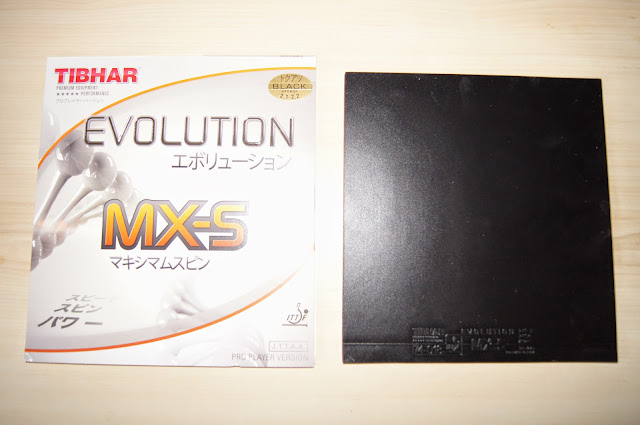
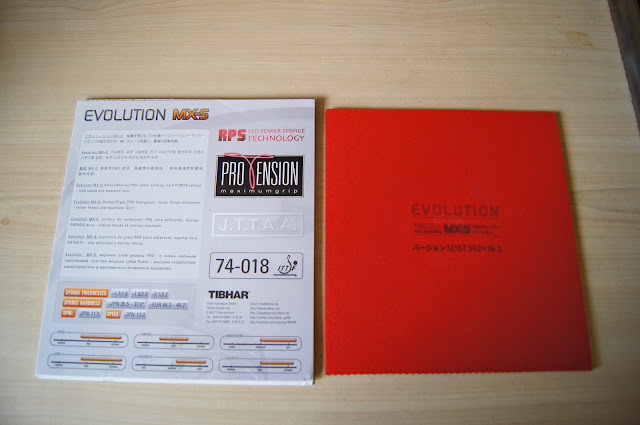
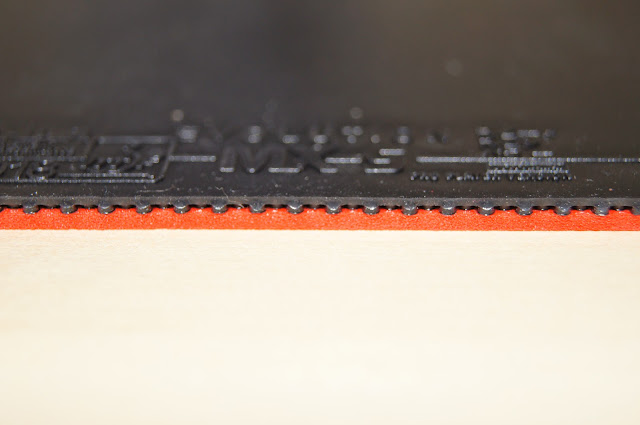

Full-size pics are available here.
I gave it the full 3 hour treatment last night with Stiga's 40+ seamed ball. It wasn't long enough for a full review because it was more of a coaching session and I didn't play a wide enough range of strokes in the depth I want. I'll be back with a more formal review next week, so I'll just give some rambling comments for now.
MX-S was on the FH side of my regular Samsonov Pure Wood blade, and on my backup Pure Woods I had Big Dipper and Tenzone Ultra (BH rubbers on all 3 are Airoc M).
Warm-Up
I was slightly disappointed for the first 10 minutes. During the initial loop-counterhit warm-up MX-S didn't feel particularly "special" at all (meaning that no overriding quality jumped out at me). It was incredibly stable and easy to use, the arc was medium and nothing dramatic happened. At this point the only thing that jumped out at me was how easy the counterhit was, even against heavy loop. For comparison, I had a higher arc with both BD and TZU on the backup blades, but counterhits and blocks were more difficult.
Serve, Loop Against Backspin, Loop against Block Exercise
I then switched to a serve, push long, loop against backspin, block, loop/drive against block, free exercise. This is where MX-S made a lot more sense.
On the serve, you notice a real lack of bounce. This helps to keep serves short and tight, and also encourages you to add a lot more wrist action, which in turn results in big spin. This is an excellent rubber for serving, and all the associated other short game bits.
Then the long push comes in, and you loop against backspin. I'm not overstating things here when I say that this is the easiest rubber for lifting backspin that I've ever tried. It absolutely eats pushes and chops alive. I usually have to warm up my backspin-lifting strokes for a few minutes to get my bat angles adjusted after a counterhit warm-up, but not this time. I genuinely didn't miss a single one during the exercise.
And then the loop/drive against block, which revealed another interesting point. Driving the ball is very easy with MX-S, but it is noticeably slower than hard ESN rubbers from previous generations (MX-P and M1 are the obvious touchstones). You have to generate some power yourself on basic drives or you can offer up an easy ball. There were times when I stepped around to use FH from the BH wing and I ran out of room to get a full stroke in. The drive produced was a bit weak, and the court was obviously totally opened up. You need to be fully committed to get the rewards in this scenario. However, looping the ball against block is easy and very effective. In fact, taking a more Chinese approach and loop-driving more often than not was the most efficient and consistent approach for me in general during the session.
I stuck with this exercise (and slight variations in placement) for a full hour. I felt that it was giving me a good insight into how MX-S was working. After that we did some matchplay...
Matchplay
The qualities I'd seen during the exercises stayed true during the match. Short game was truly great, counter hits and blocks excellent. The FH flick isn't my best shot (needs work), but MX-S seemed good here too, although the lack of extreme arc did mean that I needed to get to the peak of the bounce - there wasn't a lot of leeway if the ball dropped. The main points worth talking about were during open play. Basic topspin drives had a medium arc, and the arc then doesn't change much when you start to load the ball up with topspin. With this comes the ability to disguise the level of topspin to some degree - the arc doesn't give the game away. Adding wrist to a loop brings heavy spin with ease.
Summary so far
Positives? Solidity and control - it's very easy to use, predictable, low catapult and linear. Good (but not wild) pace. High spin potential. Zero feeling of slippage with 40+. Super easy to vary spin, depth and placement during loop-loop play. Autopilot when lifting backspin.
Downsides? The medium arc isn't forgiving of positional problems, so recovery strokes on the run aren't as easy as some rubbers. And it isn't the fastest rubber around, which makes drives a little weaker (although that will be related to my blade choice to some degree - a faster blade will make this less obvious). I'm nitpicking here though.
This is a different beast to the rest of the Evo range. The sponge is different - smaller-pored, and without the booster smell which was so obvious on the original Evolutions and Bluefire Ms. It's obviously still a hard sponge though. The topsheet is monstrously grippy when you run a finger down it, and reasonably stiff. It feels like the grippiest ESN topsheet I've ever experienced. For comparison, I have a sheet of Omega V Asia here which has a far softer topsheet, less grip to the finger, and feels softer than MX-S overall despite having a harder sponge. I guess it's going to be very stable.
Once on the blade, MX-S has a hard, definite feel when bouncing a ball, with a dull "thock" sound. It feels fairly fast without feeling overly bouncy. The spin test is the headline news though - massive. Small wrist movement = big reaction on the following bounce.
Full-size pics are available here.
I gave it the full 3 hour treatment last night with Stiga's 40+ seamed ball. It wasn't long enough for a full review because it was more of a coaching session and I didn't play a wide enough range of strokes in the depth I want. I'll be back with a more formal review next week, so I'll just give some rambling comments for now.
MX-S was on the FH side of my regular Samsonov Pure Wood blade, and on my backup Pure Woods I had Big Dipper and Tenzone Ultra (BH rubbers on all 3 are Airoc M).
Warm-Up
I was slightly disappointed for the first 10 minutes. During the initial loop-counterhit warm-up MX-S didn't feel particularly "special" at all (meaning that no overriding quality jumped out at me). It was incredibly stable and easy to use, the arc was medium and nothing dramatic happened. At this point the only thing that jumped out at me was how easy the counterhit was, even against heavy loop. For comparison, I had a higher arc with both BD and TZU on the backup blades, but counterhits and blocks were more difficult.
Serve, Loop Against Backspin, Loop against Block Exercise
I then switched to a serve, push long, loop against backspin, block, loop/drive against block, free exercise. This is where MX-S made a lot more sense.
On the serve, you notice a real lack of bounce. This helps to keep serves short and tight, and also encourages you to add a lot more wrist action, which in turn results in big spin. This is an excellent rubber for serving, and all the associated other short game bits.
Then the long push comes in, and you loop against backspin. I'm not overstating things here when I say that this is the easiest rubber for lifting backspin that I've ever tried. It absolutely eats pushes and chops alive. I usually have to warm up my backspin-lifting strokes for a few minutes to get my bat angles adjusted after a counterhit warm-up, but not this time. I genuinely didn't miss a single one during the exercise.
And then the loop/drive against block, which revealed another interesting point. Driving the ball is very easy with MX-S, but it is noticeably slower than hard ESN rubbers from previous generations (MX-P and M1 are the obvious touchstones). You have to generate some power yourself on basic drives or you can offer up an easy ball. There were times when I stepped around to use FH from the BH wing and I ran out of room to get a full stroke in. The drive produced was a bit weak, and the court was obviously totally opened up. You need to be fully committed to get the rewards in this scenario. However, looping the ball against block is easy and very effective. In fact, taking a more Chinese approach and loop-driving more often than not was the most efficient and consistent approach for me in general during the session.
I stuck with this exercise (and slight variations in placement) for a full hour. I felt that it was giving me a good insight into how MX-S was working. After that we did some matchplay...
Matchplay
The qualities I'd seen during the exercises stayed true during the match. Short game was truly great, counter hits and blocks excellent. The FH flick isn't my best shot (needs work), but MX-S seemed good here too, although the lack of extreme arc did mean that I needed to get to the peak of the bounce - there wasn't a lot of leeway if the ball dropped. The main points worth talking about were during open play. Basic topspin drives had a medium arc, and the arc then doesn't change much when you start to load the ball up with topspin. With this comes the ability to disguise the level of topspin to some degree - the arc doesn't give the game away. Adding wrist to a loop brings heavy spin with ease.
Summary so far
Positives? Solidity and control - it's very easy to use, predictable, low catapult and linear. Good (but not wild) pace. High spin potential. Zero feeling of slippage with 40+. Super easy to vary spin, depth and placement during loop-loop play. Autopilot when lifting backspin.
Downsides? The medium arc isn't forgiving of positional problems, so recovery strokes on the run aren't as easy as some rubbers. And it isn't the fastest rubber around, which makes drives a little weaker (although that will be related to my blade choice to some degree - a faster blade will make this less obvious). I'm nitpicking here though.
- Speed
-
8
- Spin
-
9.2
- Durability
-
9
- Control
-
9.7

For 3 star 40+ in Balls
- TTHopeful
- 3.00 star(s)
Pros
- Design
- Beautiful
Cons
- Soft
- Slow
- Consistency
Okay, so I bought a pack of these balls. Visually they look very good, nice pink logo, cool design. However when I tried the Butterfly balls they felt a lot softer than other plastic balls I have tried. Also the speed was not up to scratch either. I tried my friends Butterfly Plastic ball and his felt okay so perhaps I had a bad batch. Not to sure how the plastic balls are regulated but I much prefer balls without a seam. They are faster and break less.
Lets hope these balls get better fast!
They are using this Butterfly plastic ball at the World Championships this month...
Lets hope these balls get better fast!
They are using this Butterfly plastic ball at the World Championships this month...
- Roundness
-
4
- Hardness
-
4
- Speed
-
5
- Durability
-
4

For 3 star 40+ in Balls
- foz
- 2.00 star(s)
Pros
- Looks
- Durability
Cons
- Slow
- Floats
- Wobbles
OMG ! I really don't like this ball, you just don't know where you are with it, after trying the DHS plastic ball and being quite happy with it , I thought I'd try a quality butterfly ball, as this , I thought, must be even better! WRONG! It floats something terrible and in a warm room wobbles like a returned ball from Lentec swing!( Not many that remember that nasty piece of lp I bet ) it seems to take an age to come down, making timing your loop shot very tricky, it's wierd! Hope I've just got a bad box, please let me know if anyone else has the same issues 😣😣
- Roundness
-
8.7
- Hardness
-
8.6
- Speed
-
4.4
- Durability
-
8.8
