

Daily Table Tennis Chit Chat

This user has no status.
🏆 Top 1% Commenter
Well-Known Member
Moderator
Oct 2014
19,984
26,546
70,909
Read 17 reviews
Just to add, and you guys probably already know this, but the first thing you should do when playing a forehand topspin, and one of the most important, is to ensure your right foot is slightly behind your left foot (opposite for left handers).You should turn your shoulders as you move to this position. This allows for more power when playing the stroke as it forces you to turn you hips/shoulders as you play the stroke (to play the ball in the right direction), as well as improving balance. :)

Im sure you guys will be aware of this, but just want to make sure no-one is underestimating the importance of footwork and positioning :)

Yes, but very often, you may have to play a forehand topspin before the feet are ideally set. If you have to do this, which foot should be where first?
 
  • Like
Reactions: OldschoolPenholder
This user has no status.
Yes, but very often, you may have to play a forehand topspin before the feet are ideally set. If you have to do this, which foot should be where first?


The feet should always be ideally set if you move your right foot back at the same time as back swinging (rotating shoulders), there is no delay. If you have time to backswing, you have time to set your feet, its all about coordination.

If you don't have time to set your feet, you should be playing a block instead.
 
This user has no status.
What if your feet are more or less squared, and you could rotate from the core to perform a topspin? Do you block then?

It is possible to play a topspin, of course. However this is not the "ideal" scenario to play one as the rotation and weight transfer required won't come from a square stance.
 
This user has no status.
🏆 Top 1% Commenter
Well-Known Member
Aug 2016
1,845
2,820
13,714
This is what I'm talking about!

Dear Daily Table Tennis Chit Chat thread usual suspects and especially lurkers:


EXHIBIT "A" (FRAT: Post video of yourself to this thread if you want advice)


IMO if a person is asking for help from people, free help at that, via an Internet forum ... then don't come across as a troll first of all ... you will not be taken seriously, and get ignored ... it may take time for the people to forgive you and turn around to help you

Secondly, if people are willing to help and all they ask for is video, not money, and nothing in return other than the sastisfaction of helping a fellow player out ... then by all means supply video ... especially if you, the one asking for help, is not in the same part of the world of the one who is willing to help

Other members have travelled to meet up other members ... but for those asking for help and aren't able to travel to meet the members that are willing to help, it should be a no brainer

To go on about how one is a very, very high-level player and would beat many of those that did post video of themselves, well, I for one would understand how the ones willing to help will ignore that one asking for help

Props and Respect to Carl, Suga D, and Shuki for helping a recent member where others have already pegged him as a troll and on ignore

Props and Respect to NextLevel, Der_Echte, Carl, Suga D, Shuki, Takkyu_wa_inochi and others who continually help others out with nothing I return other than heartfelt appreciation.

EXHIBIT "B" (FWAT [frag watching all that]: Posted video of myself and mentioned i felt shoulder pain)


EXHIBIT "C" (FRAT: ttmonster offered advice)

@OSPH : I saw your post at the time but did not have time to respond. My two cents ... Normally when my shoulder starts hurting I focus on the following areas , whether I am holding the paddle too tight , I am using my core/legs, I am moving to the ball . Your video definitely shows that you are rusty but I was thinking that if you spend some time practicing footwork may be it will help you take some load off your shoulder , also rethink the shoes you are using ... and definitely make some time to meet with Carl and get some of the secret sauce ..

EXHIBIT "D" (FRAT: NextLevel posted an observation)

Shoulder pain is almost always from overusing the upper arm. Hard but fixable with improved technique.

EXHIBIT "E" (FRAT: UpSideDownCarl offered advice)

If you watch OSPH's most recent video and ignore everything else and just watch his shoulder, not even the arm, he is elevating the shoulder on most FH strokes and on some he is elevating it and rotating it.

What I was going to show him is getting him to try to learn to isolate the elbow/forearm while keeping the elbow a stable pivot.

That is what some people may call the Timo Boll technique. But it will help him hit while putting much less stress on his shoulder. When the shoulder is fully better he will likely be able to add some upper arm without stressing the shoulder since the lower arm will be part of the stroke as well. But right now, he is even replacing upper arm/gleno-humeral movement with replacement movements from the acromio-clavicular and stereo-clavicular joints.

The movements look like how someone in their 40s-50s starts moving their arm in the first stages as frozen shoulder syndrome starts to develop. Not to date you or scare you OSPH.

From the video, all I can see is that your humorus (upper arm bone) may not be moving in the gleno-humeral joint (main joint of the shoulder) the way it should.


Sent from The Subterranean Workshop by Telepathy


And ttmonster, NextLevel and SchemeSC offered further advice ... I POSTED MULTIPLE THANK YOU POSTS.


Your Honor, I rest my case.

Very truly yours in Table Tennis,

~osph
 
Last edited:
says what [IMG]
says what [IMG]
🏆 Top 1% Commenter
Well-Known Member
Feb 2016
2,470
1,521
5,099
Read 2 reviews
It is possible to play a topspin, of course. However this is not the "ideal" scenario to play one as the rotation and weight transfer required won't come from a square stance.

example.jpg

I ask because I see a lot of stuff like this from pro players and good amateurs.

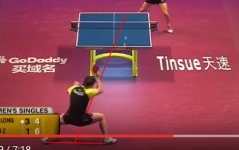
I googled "Table tennis fan zhendong", took the first video I found and looked around until I could find what I mean. Then I drew a line from one foot to the other. (Picture is after impact but he didn't really move around from the impact to this point in time.) Then I looked where the ball lands and I drew a line from roughly the middle of the foot-line along the line of play, ending roughly where the ball lands. Now we can compare the line of play to the feet position.

It's not perfect, but you can see from this that it's a topspin more or less from a squared off position. At least to me it doesn't look like the right foot is very much behind the left. This is the kind of shot I mean.

What is happening here? I don't think you mean to say this is incorrect. At least I believe FZD plays a pretty correct game. :rolleyes:


Here is the video btw.

4:27 to 4:29 or so is the shot.
 
This user has no status.
🏆 Top 1% Commenter
Well-Known Member
Moderator
Oct 2014
19,984
26,546
70,909
Read 17 reviews
  • Like
Reactions: OldschoolPenholder
This user has no status.
Okay, let me explain.

You can play FH topspins from a practically (not fully) square position, but in order to do this you must get low to the ground and have very strong legs, as perfectly demonstrated by our lovely assistant FZD. It also takes a lot of practice to do this at a high level. Top professionals, and arguably mostly the Chinese, do this a lot. In fact, ZJK does it more than most in my opinion.

If you are still a developing/amateur player, and do not practice 6 hours a day or have the powerful legs of FZD, It Is better to have one leg slightly behind the other to give you that power and weight transfer.

HOWEVER, What I think we will see, and are starting to see (as you pointed out) is a move towards a squarer stance and increased need to be physically fit and strong as playing square FH's means you are perfectly set up to play a BH, a shot which as you all know is massively increasing in popularity at the moment! :)

I hope this makes sense.
 
This user has no status.
🏆 Top 1% Commenter
Active Member
Jun 2015
986
1,373
3,883
Read 3 reviews
View attachment 11748

I ask because I see a lot of stuff like this from pro players and good amateurs.

I googled "Table tennis fan zhendong", took the first video I found and looked around until I could find what I mean. Then I drew a line from one foot to the other. (Picture is after impact but he didn't really move around from the impact to this point in time.) Then I looked where the ball lands and I drew a line from roughly the middle of the foot-line along the line of play, ending roughly where the ball lands. Now we can compare the line of play to the feet position.

It's not perfect, but you can see from this that it's a topspin more or less from a squared off position. At least to me it doesn't look like the right foot is very much behind the left. This is the kind of shot I mean.

What is happening here? I don't think you mean to say this is incorrect. At least I believe FZD plays a pretty correct game. :rolleyes:


Here is the video btw.

4:27 to 4:29 or so is the shot.

What I heard in my Trainer seminar about that is as follows:
The optimal footwork coordination for a amateur would be to take a backstep together with the backswing. However the pros use frontal stances much more. My guess at this is that the backhand has gained more importance. If you watch players like ZY,FZ and Dima you will see this a lot.

EDIT: I posted at the same time as Lawrence. He explains it better :) basically the same point
 
Last edited:
This user has no status.
🏆 Top 1% Commenter
Well-Known Member
Moderator
Oct 2014
19,984
26,546
70,909
Read 17 reviews
I always liked the idea of keeping your feet squared, but with your body facing the opposite corner of the table. this makes it appear that the right foot would be behind the left but your body is just faced slightly that direction.

There is no one-size fits all to table tennis - there are generally accepted ways of doing things and wrong ways of doing things in the context of shot quality. But there is no single way to do something right - each technique comes with advantages and disadvantages and are tied to the goals of the shot and the individual. What Yecats and you are is saying is very much right. But what I and Archo are saying is also right.
 
This user has no status.
🏆 Top 1% Commenter
Well-Known Member
Moderator
Oct 2014
19,984
26,546
70,909
Read 17 reviews
What I heard in my Trainer seminar about that is as follows:
The optimal footwork coordination for a amateur would be to take a backstep together with the backswing. However the pros use frontal stances much more. My guess at this is that the backhand has gained more importance. If you watch players like ZY,FZ and Dima you will see this a lot.

Depends on how you define "amateur". I always wanted to play like a pro but my coach wanted me to play like an amateur, quite correctly because I didn't want to bend my knees as much, but quite wrongly because the real issue was I didn't point my feet outwards enough. The most important thing is to have the feet pointing outwards with knees slightly bent. If you do that consistently and learn to rotate over bent knees and a wide enough base, you can basically play any stroke you want. But again, there is no one size fits all. What I was saying in my original post was tailored to someone at the 1700 level who is beginning to play much faster players and will need to play quality shots against faster balls, not someone who will have time to move into position a slow long push.
 
  • Like
Reactions: OldschoolPenholder
This user has no status.
Member
Dec 2011
169
351
721
The feet should always be ideally set if you move your right foot back at the same time as back swinging (rotating shoulders), there is no delay. If you have time to backswing, you have time to set your feet, its all about coordination.

If you don't have time to set your feet, you should be playing a block instead.

But I would also point out that there are many players that play their backhands out of a forehand dominant position (right foot behind left). If you watch Ma Long's instructional when he does FH to BH transition, he has no need to move his right foot back while backswinging. It's already back.

Like NL is talking about above, he mostly just points his foot outward on the FH.
 
Last edited:
This user has no status.
🏆 Top 1% Commenter
Well-Known Member
Moderator
Oct 2014
19,984
26,546
70,909
Read 17 reviews
But I would also point out that there are many players that play their backhands out of a forehand dominant position (right foot behind left). If you watch Ma Long's instructional when he does FH to BH transition, he has no need to move his right foot back while backswinging. It's already back.

Like NL is talking about above, he mostly just points his foot outward on the FH.

For backhands, this is generally accepted. I guess because I had my issues with moving, I played out of an extreme backhand stance but my real issue as I figured out later in part thanks to Larry's blog was that I wasn't pointing my feet outwards and staying on the balls of my feet. but the pointing feet outwards helps a lot and is not trivial. Balls of feet helps as well. But it took me a long time to adapt as I was so used to pointing my feet as I was standing regularly. But once you fix that part about pointing the feet outwards, it almost doesn't matter where your feet are, the real limit is the ability of your body to rotate.

The body rotation adds power through circular motion. How the feet are placed can limit your ability to rotate and backswing depending on your strength. But the fact it is a circle means that literally, you can hit almost any shot you want to if you have adequate rotation and whip on the backswing.
 
This user has no status.
Technique is subjective, even each member of the CNT have different techniques. It Is hard to say what is right and what Is wrong, and so It is very much a personal thing. Look at Werner Shlager and how he played his FH with a super straight arm and very little elbow movement, and yet became the 2003 WTTC :)

There are certain areas of the physics of TT that make sense, like weight transfer, rotation, getting power from legs etc, but nothing is set in stone as the perfect technique. There are trends, and the "common standard" is always changing. Every coach will have their differences in how they teach technique.

:)
 
says Spin and more spin.
🏆 Top 1% Commenter
Well-Known Member
Moderator
Dec 2010
16,640
18,535
56,964
Read 11 reviews
Forgive me for being ridiculous because I think I know what you guys mean, but:

c9dda16ccc0ebf0bfa866c5839c1d444.jpg


0d529ea0fe49c52b731ffa6e2e3fc248.jpg


From an anatomical perspective shoulder rotation is actually a specific movement.

If the upper torso was rotating but the hips were not that would be spinal rotation. And if the pelvic structure turns so the whole torso (upper and lower) turns together, that would be from movements in the legs: the hip, knee and ankle joints.

Okay, finished with being an insufferable know-it-all.

In any case, based on looking at OSPH's FH, what I was talking about yesterday is that there is the potential that there is a real shoulder injury. Because OSPH is not simply using too much upper arm and not enough forearm and turning of the torso from the pelvic structure.

When OSPH is moving his upper arm, the main shoulder joint (the joint where the upper arm [humerus, not to be confused with humorous] meets the scapula [glenoid cavity] [that is the gleno-humeral joint] IS NOT doing enough of the moving so the movements are being transferred to the other two joints of the shoulder girdle [acromio-clavicular joint and sterno-clavicular joint]).

34d2f7113c203ed7b6f5b305b3e65089.jpg


cc77c1287a4937058f210289c63247b5.jpg


In simple terms, I am actually going to do an assessment of ranges of motion in the main shoulder joint because OSPH may have a larger shoulder condition.

Sorry OSPH. I didn't want to say it on line and in public. But I think we may want to rule out something worse before you start learning how to hit a FH without involving too much movement of the shoulder.


Sent from The Subterranean Workshop by Telepathy
 
Last edited:
says Spin and more spin.
🏆 Top 1% Commenter
Well-Known Member
Moderator
Dec 2010
16,640
18,535
56,964
Read 11 reviews
By the way, all I will show OSPH, if his shoulder is okay to play, and he does not need a doctor or a few months of rest, is a way of hitting the FH that does not involve anywhere near as much movement from his shoulder joints. It would have nothing to do with correct or incorrect or even better or worse. It would simply be safer for his shoulder until his shoulder is REALLY better.

One thing I know is that, after 3 weeks rest, playing table tennis for a few hours should not make a healthy shoulder sore in a way that anyone would think to mention it. And based on the way OSPH's whole shoulder girdle was moving around on his FH strokes, it may be worth being cautious.


Sent from The Subterranean Workshop by Telepathy
 
This user has no status.
🏆 Top 1% Commenter
Well-Known Member
Moderator
Oct 2014
19,984
26,546
70,909
Read 17 reviews
Forgive me for being ridiculous because I think I know what you guys mean, but:

cache.php


cache.php


From an anatomical perspective shoulder rotation is actually a specific movement.

If the upper torso was rotating but the hips were not that would be spinal rotation. And if the pelvic structure turns so the whole torso (upper and lower) turns together, that would be from movements in the legs: the hip, knee and ankle joints.

Okay, finished with being an insufferable know-it-all.

In any case, based on looking at OSPH's FH, what I was talking about yesterday is that there is the potential that there is a real shoulder injury. Because OSPH is not simply using too much upper arm and not enough forearm and turning of the torso from the pelvic structure.

When OSPH is moving his upper arm, the main shoulder joint (the joint where the upper arm [humerus, not to be confused with humorous] meets the scapula [glenoid cavity] [that is the gleno-humeral joint] IS NOT doing enough of the moving so the movements are being transferred to the other two joints of the shoulder girdle [acromio-clavicular joint and sterno-clavicular joint]).

cache.php


cache.php


In simple terms, I am actually going to do an assessment of ranges of motion in the main shoulder joint because OSPH may have a larger shoulder condition.

Sorry OSPH. I didn't want to say it on line and in public. But I think we may want to rule out something worse before you start learning how to hit a FH without involving too much movement of the shoulder.


Sent from The Subterranean Workshop by Telepathy

If we want to get that technical, why talk about rotating a joint? You should be rotating the bones that meet at the joint...
 
Top