

New serve rule 2.6. No hidden balls anymore.

says Fair Play First
🏆 Top 1% Commenter
Well-Known Member
Jan 2012
2,193
727
3,077
Some important improvement to the serve rule 2.6 is expected soon. No hidden balls anymore.

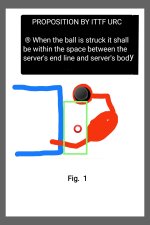
PROPOSITION BY ITTF URC.
📛 2.6.4 [..... ] When the ball is struck it shall be within the space between the server's end line and server's body other than leg and head.

2023 ITTF Statuses Page 69

2.6 THE SERVICE
2.6.1 Service shall start with the ball resting freely on the open palm of the server's stationary free hand.
2.6.2 The server shall then project the ball near vertically upwards, without imparting spin, so that it rises at least 16cm after leaving the palm of the free hand and then falls without touching anything before being struck.
2.6.3 As the ball is falling the server shall strike it so that it touches first his or her court and then touches directly the receiver's court; in doubles, the ball shall touch successively the right half court of server and receiver.
2.6.4 From the start of service until it is struck, the ball shall be above the level of the playing surface and behind the server's end line. 🆕When the ball is struck it shall be within the space between the server's end line and server's body other than leg and head.
2.6.5 As soon as the ball has been projected, the server’s free arm and hand shall be removed from the space between the ball and the net.
*The space between the ball and the net is defined by the ball, the net and its indefinite upward extension.
🆕 ** The term of Body implies a whole torso between the hip and the neck.

RATIONALE.

This present amendment to Service Rule 2.6 is foremost designed to dissipate the vexed issue of the hidden balls once and for all. In the event that we have enacted the amendment there is no practical way for a server to shield the ball unless he (she) performing some acrobatic distortion of one's body 🤩

IMG_20241021_015005.jpg
 
Last edited:
  • Like
Reactions: riemsesy
This user has no status.
Member
Mar 2014
226
140
548
I don’t think it’s what you interpret. The space between the server’s end line and the server’s body is quite vague. It doesn’t say the body must be directed toward the table or something. Serving a usual FH serve and it’d still meet the requirements.
 
This user has no status.
🏆 Top 1% Commenter
Well-Known Member
Nov 2022
2,022
3,248
7,959
Rule doesn't make much sense. I guess it's supposed to prevent the super hidden hook serves where the ball is thrown and contacted behind your body.

But your racket arm and hand is technically part of your body so it's impossible to not contact the ball in between those body parts and the end line.

Also don't see how mentioning the leg and head as exceptions helps clarify the rule either.

Maybe a better rule is that the ball you can't toss the ball a certain distance backwards away from the table into your body. For ball hiding in a hook serve you have to toss the ball from your tossing hand backwards across your body. For most people this means the ball travels the length of one shoulder to the other. That's a couple of feet and something you can easily see if you've got a ref or camera parallel to the table end line.

Probably would be easy to set up a camera and computer track the ball and calculate
faults automatically even.

Doesn't affect any current serves if done legally. Pendulum, tomahawk, lollipop, backhand etc still all fine. Just the ones that are intentionally thrown into the body like hook. Maybe some players using reverse pendulum may need to adjust their serve though.
 
This user has no status.
Member
Aug 2021
329
318
699
Read 1 reviews
I think it's not only the rule that can enforce clean visible serve.

The most important thing is the position of the umpire.

From the side of the table, umpire certainly can see the ball being struck (and if ball is tossed toward the body, he/she can't really see). Ask the umpire to position himself/herself next to the receiver, then he/she can really see whether the ball is visible or not.

Or better yet, everybody must serve like Samsonov did !!! No other style of serves allowed. 🤪 🤪
 
  • Like
Reactions: turbozed
says Table Tennis - the sport for life.
Member
Jan 2013
413
448
1,984
The most important thing is the position of the umpire.
I agree, and the rules are really made for international competition which has an umpire on both sides, so a fault can be detected much more easily.

The rules also state that it's the player's responsibility to ensure that the umpire can ensure that your serve is legal. This is rather silly to enforce when there's only one umpire, because you simple can't do some serves, like ones where your back is turned towards the umpire.
 
This user has no status.
Member
Jan 2021
330
269
731
The whole body (except maybe legs and head) should be BEHIND the ball. That would be the best rule. Works with one umpire and it wouldn't matter if the players are left- or right handed. It would affect the most common way of serving very much though. But the sport could handle it, I'm sure.
 
says Table Tennis - the sport for life.
Member
Jan 2013
413
448
1,984
The whole body (except maybe legs and head) should be BEHIND the ball. That would be the best rule. Works with one umpire and it wouldn't matter if the players are left- or right handed. It would affect the most common way of serving very much though. But the sport could handle it, I'm sure.
While that's true, it would remove some of the really cool looking serves, serves that are perfectly legal currently, which I feel would diminish the sport somewhat if we made them illegal.
 
This user has no status.
Active Member
Jul 2017
838
456
1,404
If you want to enforce the hidden serve completely you would have to basically enforce BH serve.

The rule would be no part of the body above the waist can be closer to the net than bat, hitting arm and ball at impact.


ebay auto на русском


I don't believe enforcing the rules on a pendulum serve is really possible because the contact will always be behind the body and whether the other guy can see contact or not depends on the angles where you and the other guy is standing and how much the body is turned (hard to see from the umpire perspective).


Not sure the ittf wants to go there.
 
Last edited:
  • Like
Reactions: haggisv
This user has no status.
Member
Nov 2023
141
138
305
If the aim to clamp down on 'hidden balls', then I don't think this new proposed rule adjustment is particularly helpful. Why isn't the rule changed such that it literally rules out hiding the ball? For example, why don't they change 2.6.4 to read as follows:

2.6.4 From the start of service until it is struck, the ball shall be above the level of the playing surface and behind the server's end line. From the start of the service until the ball is struck, the ball must not be hidden from the receiving player by any part of the servers body, clothing, or racket.
 
  • Like
Reactions: haggisv
This user has no status.
Member
Jan 2024
81
120
209
Because it's difficult to enforce from the umpire's position. It's much easier to enforce the proposed rule as the umpire has a perfect view of it. It guarantees non-hidden serves (almost).

I doubt it will be implemented though. Too many people have invested too much time in the old serves and the mistakes their hidden serves draw. Almost everyone would need to develop new serves, and with this new rule implemented, it will be harder to generate pure heavy underspin without sidespin.
 
  • Like
Reactions: haggisv
This user has no status.
Member
Nov 2023
141
138
305
Because it's difficult to enforce from the umpire's position. It's much easier to enforce the proposed rule as the umpire has a perfect view of it. It guarantees non-hidden serves (almost).

I doubt it will be implemented though. Too many people have invested too much time in the old serves and the mistakes their hidden serves draw. Almost everyone would need to develop new serves, and with this new rule implemented, it will be harder to generate pure heavy underspin without sidespin.

But the problem there is that what is or isn't visible from the umpire's position isn't necessarily what's visible from the receiving players position. If the umpire is not in the right position to properly assess whether or not a service action hides the ball from the receiver, then perhaps it shouldn't be the umpire that has primary responsibility for calling an illegal serve.
 
  • Like
Reactions: haggisv
This user has no status.
Member
Jan 2021
330
269
731
But the problem there is that what is or isn't visible from the umpire's position isn't necessarily what's visible from the receiving players position. If the umpire is not in the right position to properly assess whether or not a service action hides the ball from the receiver, then perhaps it shouldn't be the umpire that has primary responsibility for calling an illegal serve.
Or the rule should be changed so that the umpire always can do that.

And of course there must be (perhaps already is) rules regarding the placement of umpires.
 
This user has no status.
Member
Jan 2021
330
269
731
While that's true, it would remove some of the really cool looking serves, serves that are perfectly legal currently, which I feel would diminish the sport somewhat if we made them illegal.

I think it would be good for the sport if the service part of the game were less pronounced so to speak. If reading serves were made easier. I think it would be more rallies and less crying kids.
 
This user has no status.
Member
Jan 2024
81
120
209
The umpire is always sitting at a side-view to the table. Even in local games. It's very easy to see whether the ball is between the player and the table. If the ball is between the player and the table, how can the player hide the serve? To hide a serve, the player needs a part of his body between the ball and the table.
 
Top