Boosting Hurricane 3

This user has no status.
Hello everyone !

Wishing everyone a happy new year and lots of fun playing our beloved sport !
I'm preparing my next rubbers, two DHS Hurricane 3 Neo Provincial Blue Sponge and two DHS Hurricane 3 Neo.
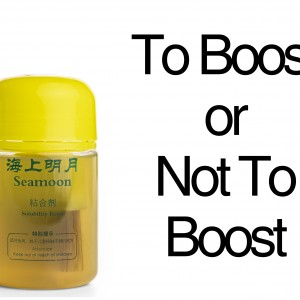
I've boosted them with Haifu, two thin layers on each rubber. Now, I'm waiting for my new blades to come in, so the rubbers still have some time to dry.
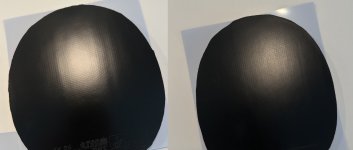
I was wondering how much flatter the rubbers will become. They were curling up a bit when I first applied the booster two days ago, but since yesterday late afternoon, they haven't really changed that much anymore. They're not completely flat, they still have a very slight curve to it.
I have boosted H3s before, and I never waited any longer than this before gluing them. Am I going too fast with the gluing process or is it okay if the still curve a little bit when applying them on the blade ?
 
This user has no status.
🏆 Top 1% Commenter
Well-Known Member
Jan 2021
3,921
2,873
8,096
Read 1 reviews
Hello everyone !

Wishing everyone a happy new year and lots of fun playing our beloved sport !
I'm preparing my next rubbers, two DHS Hurricane 3 Neo Provincial Blue Sponge and two DHS Hurricane 3 Neo.
I've boosted them with Haifu, two thin layers on each rubber. Now, I'm waiting for my new blades to come in, so the rubbers still have some time to dry.
I was wondering how much flatter the rubbers will become. They were curling up a bit when I first applied the booster two days ago, but since yesterday late afternoon, they haven't really changed that much anymore. They're not completely flat, they still have a very slight curve to it.
I have boosted H3s before, and I never waited any longer than this before gluing them. Am I going too fast with the gluing process or is it okay if the still curve a little bit when applying them on the blade ?

I wait for -24 hrs hrs, then glue regardless of the curve. Sometimes I have to put then in a press to straighten them out a little. You don’t seem to get much curve…
I’d say glue them ASAP, if you have to wait put them in a plastic bag and squeeze put as much air as possible. Most chemicals reacts to oxygen…

Cheers
L-zr
 
This user has no status.
Interesting. Thanks for your input.
I'm boosting my Hurricanes to get them softer. I'm not really interested for the speed it provides.
As long as they stay soft, I'm happy.
The blades should arrive tomorrow or the day after at the latest anyway.

What would happen if the chemicals reacted before I glue ?
 
This user has no status.
🏆 Top 1% Commenter
Well-Known Member
Jan 2021
3,921
2,873
8,096
Read 1 reviews
Interesting. Thanks for your input.
I'm boosting my Hurricanes to get them softer. I'm not really interested for the speed it provides.
As long as they stay soft, I'm happy.
The blades should arrive tomorrow or the day after at the latest anyway.

What would happen if the chemicals reacted before I glue ?
Boosting is really destroying the sponge., the first thing one should know. The chemical reaction that starts will generate gases. That makes the sponge get filled with gas pockets. This makes the sponge expand and bend. But the sponge can’t hold the gas for very long, this is why it bends back. The pressure make the sponge more bouncy, but his effect disdapears quickly. One or a couple of weeks. It dossapears even if you don’t play, but significantly slower. Part of the expansion remains and is only effected by mechanical excercise (playing).
But the process is far far away from the gases that speed gluing caused.

I usually don’t wait long before gluing, Then I have a honeymoon of about one week, after this the effect slowly decreases. Now I’m at the end of the season ~5months and most tackiness is gone but the grip is still excellent and I am used to how it performes and I am not convinced it needs changing yet… I use H3 provincial 39 Orange (not Neo).

Cheers
L-zr
 
  • Like
Reactions: SenseiJM
This user has no status.
Boosting is really destroying the sponge., the first thing one should know. The chemical reaction that starts will generate gases. That makes the sponge get filled with gas pockets. This makes the sponge expand and bend. But the sponge can’t hold the gas for very long, this is why it bends back. The pressure make the sponge more bouncy, but his effect disdapears quickly. One or a couple of weeks. It dossapears even if you don’t play, but significantly slower. Part of the expansion remains and is only effected by mechanical excercise (playing).
But the process is far far away from the gases that speed gluing caused.

I usually don’t wait long before gluing, Then I have a honeymoon of about one week, after this the effect slowly decreases. Now I’m at the end of the season ~5months and most tackiness is gone but the grip is still excellent and I am used to how it performes and I am not convinced it needs changing yet… I use H3 provincial 39 Orange (not Neo).

Cheers
L-zr
Thank you for your thorough explanation !
I didn't know it was filling the sponge pores with gas. I'm super into everything science related in table tennis, so knowing this is a great discovery for me.
 
  • Like
Reactions: Lazer
This user has no status.
🏆 Top 1% Commenter
Well-Known Member
Jan 2021
3,921
2,873
8,096
Read 1 reviews
Are you sure about the formation of gases?
Yes, chemical reactions almost always produce gases. It’s a petroleum product so it may be carbon dioxide, methane or something like this, but nothing nasty like when using super glue.

Cheers
L-zr
 
says my wife is better married than me.
Member
Nov 2024
309
216
590
Still, I disagree. I am a Chemist and in all modesty I don't see how a thick oil in a chemical reaction should form gases. There is nothing in both the booster and the rubber that would give substance to the formation of gases. Still, I might be wrong as well but I just don't see it.

Do you have sources that state gas formation?

The softening and the extension of the rubber purely is a result of the absorption of the oil by the rubber.
 
Last edited:
  • Like
Reactions: thisisit and ttarc
This user has no status.
🏆 Top 1% Commenter
Well-Known Member
Jan 2021
3,921
2,873
8,096
Read 1 reviews
Still, I disagree. I am a Chemist and in all modesty I don't see how a thick oil in a chemical reaction should form gases. There is nothing in both the booster and the rubber that would give substance to the formation of gases. Still, I might be wrong as well but I just don't see it.

Do you have sources that state gas formation?

The softening and the extension of the rubber purely is a result of the absorption of the oil by the rubber.
Only common sense. And almost all chemical reaction generates some kind of gas.

Cheers
L-zr
 
says my wife is better married than me.
Member
Nov 2024
309
216
590
With boostering a rubber to me there is no chemical reactions at all - no formation of gas, no nothing. Everything can be explained by changes of physical properties.

Just assume there was a chemical reaction with formation of gases ... Then either the rubber or the top sheet or the booster need to change their chemical structure. If one reaction partner changes the structure, then also any other partner's chemical structure must change - that is clear and common sense.

If CO2 or any other gas is built, then the chemical structure of the rubber and/or the top sheet must change as well. And if that happens then for sure the colour of the top sheet and/or the rubber would change.

On boosting has anyone observed the colours of top sheets or rubbers getting pale, fading out significantly or even changing colours completely? I'd rather say, no, this is not happening; so no chemical reaction.
 
says my wife is better married than me.
Member
Nov 2024
309
216
590
And almost all chemical reaction generates some kind of gas.
Correct. But you say it: not all chemical reactions build gases. Typically, gases are built with strong oxidising or reducing agents like acids or bases. Booster oil and rubbers are chemically very stable and are not such agents.

If a rubber gets stiff over time, then it is because over time the softener/plasticizer evaporates. Evaporation again is physical, not chemical.
 
This user has no status.
🏆 Top 1% Commenter
Well-Known Member
Jan 2021
3,921
2,873
8,096
Read 1 reviews
Correct. But you say it: not all chemical reactions build gases. Typically, gases are built with strong oxidising or reducing agents like acids or bases. Booster oil and rubbers are chemically very stable and are not such agents.

If a rubber gets stiff over time, then it is because over time the softener/plasticizer evaporates. Evaporation again is physical, not chemical.
But do believe this reaction is generating gas. The evidence (not prof though) is the relatively rapid expansion followed by a (less rapid) retraction. Also the fact that the initial characteristics wear off relatively rapidly (~one week)…

Cheer
L-zr
 
This user has no status.
Active Member
Nov 2019
837
757
3,040
Read 1 reviews
To quote a well-known table tennis playing chemist (PhD):
"There are two main types of non-VOC boosters, i.e., paraffin/mineral oil-based boosters like the Haifu Seamoon booster (very popular in Asia) or Falco Tempo Long Booster (popular in Europe/US) or limonene-based boosters."
Yasaka once filed a patent which compared different swelling agents:
"Four types of dibasic acid esters, tributyl acetyl citrate (sample A), diisononyl adipate (sample B), dibutyl sebacate (sample C), dioctyl adipate (sample D) were used as swelling agents..."
https://patents.google.com/patent/JP2008049094A/en / https://en.wikipedia.org/wiki/Dibutyl_sebacate

Now we only need to figure out how these substances/plasticizers react with the sponge...
 
This user has no status.
But do believe this reaction is generating gas. The evidence (not prof though) is the relatively rapid expansion followed by a (less rapid) retraction. Also the fact that the initial characteristics wear off relatively rapidly (~one week)…

Cheer
L-zr
Could this be explained by the rapid absorption of the oil and slow evaporation of it ?
 
This user has no status.
🏆 Top 1% Commenter
Well-Known Member
Jan 2021
3,921
2,873
8,096
Read 1 reviews
To quote a well-known table tennis playing chemist (PhD):
"There are two main types of non-VOC boosters, i.e., paraffin/mineral oil-based boosters like the Haifu Seamoon booster (very popular in Asia) or Falco Tempo Long Booster (popular in Europe/US) or limonene-based boosters."
Yasaka once filed a patent which compared different swelling agents:
"Four types of dibasic acid esters, tributyl acetyl citrate (sample A), diisononyl adipate (sample B), dibutyl sebacate (sample C), dioctyl adipate (sample D) were used as swelling agents..."
https://patents.google.com/patent/JP2008049094A/en / https://en.wikipedia.org/wiki/Dibutyl_sebacate

Now we only need to figure out how these substances/plasticizers react with the sponge...
I doesn’t need to be VOC’s…

Cheers
L-zr
 
Top