
Plus, chemical reactions always go hand in hand with decomposition of the impacted materials.
Sure, but an argument could be made that the decomposition would be minimal and badly visible.
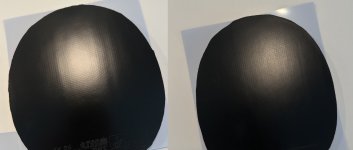
I do think the whole reaction is as simple as you propose:
You slather the oil on the sponge
Sponge absorbs, and by definition *has* to expand because material has been taken in
Internal air pockets will get less space, thus have more pressure inside
The expansion of the sponge itself is what causes the curling effect
... And my theory is that this stretches the topsheet and completing the stretch is what makes the dome go back down.
Why not evaporation? Because the result is an enlarged sheet of rubber and sponge.
The result is, quite literally, a tensioned topsheet, as well as an enlarged sponge and more pressure in the air pockets.
The air pressure will fade quickly, but the tension in the topsheet will remain as long as the sponge is enlarged.
The composition of the sponge will become softer (but still elastic) simply due to absorbing liquid.
If the liquid gets worked out of the sponge, it will be measurable. I don't know if there are tests done in that area, even if common sense does tell me that there will be some evaporation.
A good experiment would be to weigh a cut sheet before boosting and after boosting, apply using a glue sheet for minimal disturbance, play it until the effect seems to be worn off, take off the sheet and weigh it again.