This user has no status.

This user has no status.
🏆 Top 1% Commenter
Well-Known Member
Well-Known Member




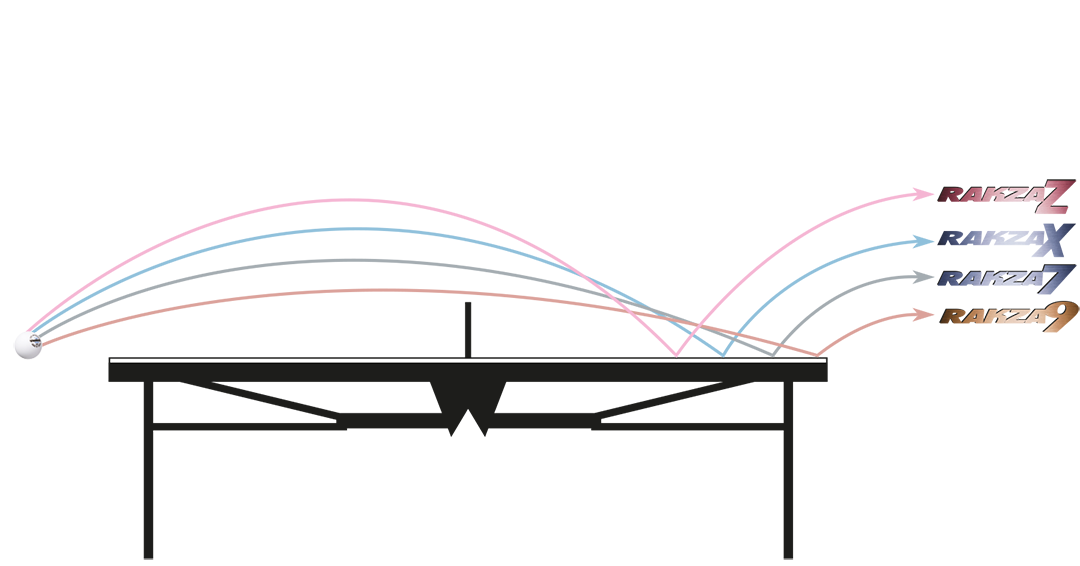
Here's a controversial statement. Throw angle is not a rubber property!
Let me tell you why "throw angle" is one of the most useless things to talk about in table tennis rubbers.
Part 1: It's not the rubber, it's you.
Almost every single post that contains the words "throw angle" is someone talking about not clearing the net on their loops, and blaming their rubber for it. Simultaneously, hundreds of players around the globe are using the exact same rubber and looping the ball just fine. It must be the rubber's fault, right? No. It's you.
Not saying you're bad (you might be, but I honestly can't tell from here) but what I am saying is that if you aren't clearing the net, you aren't doing it correctly.
Think about it, if any popular rubber actually had problems clearing the net, why would it be popular?
A staple skill of any half decent table tennis player is the ability to quickly adjust to changing circumstances. You HAVE to be able to change up your stroke between looping a backspin ball, dead ball, topspin ball, all coming at different speeds and angles. Likewise, it is an essential skill to adjust to the equipment you are playing with. Changing equipment often does not help with that, we are all familiar with the downsides of EJing. But blaming the equipment is just as unhelpful, as it shifts the requirement for action away from you. Thing is, your rubber isn't going to change, and changing rubber isn't going to fix it. Even if you do find a rubber with properties that help cover up the current issue, the change WILL result in other issues popping up elsewhere. In this case usually: you find a rubber that clears the net easier, only to find out it's too hard to generate power with it, it sucks at drives, it's too spin sensitive for the short game...
Part 2: Derived properties are simply inaccurate.
I have been reading DCRainmaker's excellent in-depth reviews of sports electronics during my running years, and one very important thing that it has taught me is how a LOT of the stats reported by sports watches are simply derived estimates based on algorithms. You can't actually measure steps (made by your feet) with a device mounted on your wrist. You can't measure breathing, vertical oscillation, step length, yet many devices display this stuff anyway.
Similarly, a rubber has hardness (topsheet and sponge), pimple geometry, elasticity (topsheet and sponge) and a level of grip. And that's it. Even the level of grip is already borderline inaccurate, because there's not a uniform way of measuring it as a property.
Your precious "throw angle" is a result of these basic properties, combined with the vectors of both the incoming ball and your swing. See where this is going? Throw angle is a combination of the ball, your bat and your technique.
Part 3: How to adjust.
If you made it to this point, and haven't closed this tab in a fuming rage to still get a different rubber, kudos.
What usually happens if someone reports that their "throw angle" is too low is one (or more) of these things:
You don't make your loop stroke go from low to high.
Symptoms: your ball hits the net and doesn't really spin. Also, it never really goes above the net at any point in its trajectory OR it goes straight from higher to lower, not making a bit of an arc.
Fix: work on your loop basics. One great exercise is to roll the ball towards you and when it reaches your end of the table, lift it over the net using your rubber's GRIP (not hitting it upwards with an open bat).
You don't accelerate through the contact point.
Causes: tension in the arms, hands, shoulders, and/or core can make acceleration hard. So does insecurity, and sometimes it's just about understanding the mechanics of what you're trying to do.
Symptoms: the ball plops/shoots off your bat and it feels like you have zero control. Your stroke is highly sensitive to incoming spin and it feels impossible to overcome that.
Fix: Various methods can be used to visualize the problem. Hitting the ball against a wall or just plain upwards with a tense arm vs a whip motion can help to illustrate that the whip put a lot more power and spin onto the ball. Understanding that control lies in the ability to overcome the opponent's spin by putting on your own, not by (hopefully) anticipating the right spin on the ball and sticking your bat out to meet it. Accentuate the need to relax between shots, drop your arms completely in practice if you need to. Make it a challenge to start moving your arm as late as possible so you HAVE to accelerate.
Your bat angle is too closed.
Symptoms: your ball hits the net with spin alright, the ball might even spin around on the table for quite a bit. Sometimes the ball will skid and just plop off your bat falling almost straight down.
Fix: build up your topspin up from drive. Try to adjust as little as possible. Start slightly lower, end slightly higher and rather than adjusting your bat angle, focus on lifting the ball with the rubber. If you overshoot, just turn down the pace on the practice and try again. Stay loose and relaxed, because tense contact also leads to overshooting.
You loop the wrong balls.
Symptoms: the ball doesn't even make it to the net before hitting the table, despite your best efforts to put out a decent loop.
Fix: well this is a simple one and complicated at the same time. Bottom line, your looping skill level is not enough to overcome the ball you were given. You will need to get better at all the points mentioned above if you want to stand a chance at looping these balls. In the meantime, work on your pushing and anticipation, and loop the balls that are easier to loop.
Part 4: The long game.
Table tennis is hard to learn. Looping a backspin ball already is an advanced technique in the sense that you need to have good confidence in your basics. You need to be able to accelerate, grip the ball with your rubber, lift it, apply spin, judge the amount of force you have to put on it to get it over the net, all while staying relaxed enough to make soft, spinny, grippy contact as to not overshoot the table. This isn't something you will master in your first year of table tennis, it's something that people who have played for DECADES are still struggling with.
There is no equipment shortcut to fix this. Only practice.
In today's age of extremely abundant information, it's easy to forget those basics, but you have to remain curious and critical if your goal is to succeed at table tennis.
Keep thinking for yourself: If someone praises a rubber for its amazing properties in looping the ball over the net, what is their context?
Are they any good at all? If this is a beginner, they might have a wildly different technique and background from you. Also, good chance they won't be aware, or are not showing, the holes that changing to this rubber has opened in other areas of their game.
How often do they practice, and under what kind of guidance? The further away this is from your situation, the less relevant their information is for you.
What are they not showing you? Did they get any kind of compensation for their review? And this is not limited to the manufacturers, could be resellers, or even a coach or teammate giving the rubber in exchange for the promise of a review video. There doesn't even need to be ill or commercial intent. Are they actually still playing with it a few months later?
Don't confuse trusting the information of dozens of internet strangers with trusting yourself. No words or videos will convey how a rubber feels in your hands, on your bat, in your playing venue.
Who do you trust? Start with yourself and work outwards only when really necessary. In case of conflicting information, put your trust in the source closest to you.
- yourself, your feeling.
- your coach or other experienced real life players
- an external, real life, coach
- club mates with a bit of a level
If you don't have access to ANY of these (besides yourself, obviously), ask yourself the brutally honest question if table tennis is worth investing in at all in your current situation. You simply can't get to a decent level of table tennis by following online courses and playing on the break room table with a couple of friends. Just like you will never be a football star if you only play in the back alley and never make it to a club. So adjust your expectations if that's your situation and treat it like a casual game. Still want to throw money at equipment? I'm not your accountant. Just be aware that it's not going to fix anything for you.
Getting an initial feeling for different equipment usually comes pretty fast, in a matter of hours you will be able to use most rubbers up to 70-80% as well as you were using your previous one. The finesse however comes over the course of months, or even years. For blades it's more like weeks for that first 70-80% proficiency and years for the finesse. Even national level players will train with a different blade for at least half a year before using it in important matches.
If equipment feels bad, you can usually pick up on that within a week or so. You'll notice you're not adjusting to it well. Once you're past that first hurdle and start experiencing new problems, it's just not the equipment. So adjust, play the long game. If your equipment wears out and you still don't like the adjustment you have to make to use it, just go back to your previous rubber.
Part 5: Bottom line.
Changing equipment is only worth it if the person guiding your progress answers an explicit yes when you ask them if you need a change. If they do, they will also be able to indicate the direction of change you need to be making (usually slower, softer) and the more specific you are in your likes and dislikes (let them play with your bat, too) the more accurate advice they will be able to give.
Any half decent table tennis store will be able to present you with another brand's analog to the brand you are currently using or the brand you are advised but aren't fond of. A question like "My coach advised Rakza 7 but I prefer Andro rubbers, what should I get from Andro that matches that?" is a perfectly sensible thing to ask.
Bear in mind that some coaches will really appreciate if you stick to their specific advice both for the intent it shows, and in making it easier for them to understand your equipment. Other coaches (like my club's) are pretty much indifferent to what you use as long as it's in a bit of a sensible range.
Regardless of the country and its general level, any and all "medium" rubber (medium hardness, medium everything) will have the right properties to last you all the way up to levels where you are 99% certainly going to have other people around you, in real life, capable of giving you advice on (small) adjustments that might be helpful. All the Rakzas, Fastarcs, Rasanters, Rozenas, Glayzers, have what it takes to both get you to that level and support you each step along the way.
That level will most certainly not be one of the lower regional ones, or even higher regional ones. There are plenty of players on the national levels using non-flagship rubbers and non-flagship blades, while not lacking any spin, speed, power, control or whatever. Just look back at Dima beating Dan with a premade bat, or Anders Lind playing with his phone, if you need any confirmation: your equipment is just not the issue.
Let me tell you why "throw angle" is one of the most useless things to talk about in table tennis rubbers.
Part 1: It's not the rubber, it's you.
Almost every single post that contains the words "throw angle" is someone talking about not clearing the net on their loops, and blaming their rubber for it. Simultaneously, hundreds of players around the globe are using the exact same rubber and looping the ball just fine. It must be the rubber's fault, right? No. It's you.
Not saying you're bad (you might be, but I honestly can't tell from here) but what I am saying is that if you aren't clearing the net, you aren't doing it correctly.
Think about it, if any popular rubber actually had problems clearing the net, why would it be popular?
A staple skill of any half decent table tennis player is the ability to quickly adjust to changing circumstances. You HAVE to be able to change up your stroke between looping a backspin ball, dead ball, topspin ball, all coming at different speeds and angles. Likewise, it is an essential skill to adjust to the equipment you are playing with. Changing equipment often does not help with that, we are all familiar with the downsides of EJing. But blaming the equipment is just as unhelpful, as it shifts the requirement for action away from you. Thing is, your rubber isn't going to change, and changing rubber isn't going to fix it. Even if you do find a rubber with properties that help cover up the current issue, the change WILL result in other issues popping up elsewhere. In this case usually: you find a rubber that clears the net easier, only to find out it's too hard to generate power with it, it sucks at drives, it's too spin sensitive for the short game...
Part 2: Derived properties are simply inaccurate.
I have been reading DCRainmaker's excellent in-depth reviews of sports electronics during my running years, and one very important thing that it has taught me is how a LOT of the stats reported by sports watches are simply derived estimates based on algorithms. You can't actually measure steps (made by your feet) with a device mounted on your wrist. You can't measure breathing, vertical oscillation, step length, yet many devices display this stuff anyway.
Similarly, a rubber has hardness (topsheet and sponge), pimple geometry, elasticity (topsheet and sponge) and a level of grip. And that's it. Even the level of grip is already borderline inaccurate, because there's not a uniform way of measuring it as a property.
Your precious "throw angle" is a result of these basic properties, combined with the vectors of both the incoming ball and your swing. See where this is going? Throw angle is a combination of the ball, your bat and your technique.
Part 3: How to adjust.
If you made it to this point, and haven't closed this tab in a fuming rage to still get a different rubber, kudos.
What usually happens if someone reports that their "throw angle" is too low is one (or more) of these things:
You don't make your loop stroke go from low to high.
Symptoms: your ball hits the net and doesn't really spin. Also, it never really goes above the net at any point in its trajectory OR it goes straight from higher to lower, not making a bit of an arc.
Fix: work on your loop basics. One great exercise is to roll the ball towards you and when it reaches your end of the table, lift it over the net using your rubber's GRIP (not hitting it upwards with an open bat).
You don't accelerate through the contact point.
Causes: tension in the arms, hands, shoulders, and/or core can make acceleration hard. So does insecurity, and sometimes it's just about understanding the mechanics of what you're trying to do.
Symptoms: the ball plops/shoots off your bat and it feels like you have zero control. Your stroke is highly sensitive to incoming spin and it feels impossible to overcome that.
Fix: Various methods can be used to visualize the problem. Hitting the ball against a wall or just plain upwards with a tense arm vs a whip motion can help to illustrate that the whip put a lot more power and spin onto the ball. Understanding that control lies in the ability to overcome the opponent's spin by putting on your own, not by (hopefully) anticipating the right spin on the ball and sticking your bat out to meet it. Accentuate the need to relax between shots, drop your arms completely in practice if you need to. Make it a challenge to start moving your arm as late as possible so you HAVE to accelerate.
Your bat angle is too closed.
Symptoms: your ball hits the net with spin alright, the ball might even spin around on the table for quite a bit. Sometimes the ball will skid and just plop off your bat falling almost straight down.
Fix: build up your topspin up from drive. Try to adjust as little as possible. Start slightly lower, end slightly higher and rather than adjusting your bat angle, focus on lifting the ball with the rubber. If you overshoot, just turn down the pace on the practice and try again. Stay loose and relaxed, because tense contact also leads to overshooting.
You loop the wrong balls.
Symptoms: the ball doesn't even make it to the net before hitting the table, despite your best efforts to put out a decent loop.
Fix: well this is a simple one and complicated at the same time. Bottom line, your looping skill level is not enough to overcome the ball you were given. You will need to get better at all the points mentioned above if you want to stand a chance at looping these balls. In the meantime, work on your pushing and anticipation, and loop the balls that are easier to loop.
Part 4: The long game.
Table tennis is hard to learn. Looping a backspin ball already is an advanced technique in the sense that you need to have good confidence in your basics. You need to be able to accelerate, grip the ball with your rubber, lift it, apply spin, judge the amount of force you have to put on it to get it over the net, all while staying relaxed enough to make soft, spinny, grippy contact as to not overshoot the table. This isn't something you will master in your first year of table tennis, it's something that people who have played for DECADES are still struggling with.
There is no equipment shortcut to fix this. Only practice.
In today's age of extremely abundant information, it's easy to forget those basics, but you have to remain curious and critical if your goal is to succeed at table tennis.
Keep thinking for yourself: If someone praises a rubber for its amazing properties in looping the ball over the net, what is their context?
Are they any good at all? If this is a beginner, they might have a wildly different technique and background from you. Also, good chance they won't be aware, or are not showing, the holes that changing to this rubber has opened in other areas of their game.
How often do they practice, and under what kind of guidance? The further away this is from your situation, the less relevant their information is for you.
What are they not showing you? Did they get any kind of compensation for their review? And this is not limited to the manufacturers, could be resellers, or even a coach or teammate giving the rubber in exchange for the promise of a review video. There doesn't even need to be ill or commercial intent. Are they actually still playing with it a few months later?
Don't confuse trusting the information of dozens of internet strangers with trusting yourself. No words or videos will convey how a rubber feels in your hands, on your bat, in your playing venue.
Who do you trust? Start with yourself and work outwards only when really necessary. In case of conflicting information, put your trust in the source closest to you.
- yourself, your feeling.
- your coach or other experienced real life players
- an external, real life, coach
- club mates with a bit of a level
If you don't have access to ANY of these (besides yourself, obviously), ask yourself the brutally honest question if table tennis is worth investing in at all in your current situation. You simply can't get to a decent level of table tennis by following online courses and playing on the break room table with a couple of friends. Just like you will never be a football star if you only play in the back alley and never make it to a club. So adjust your expectations if that's your situation and treat it like a casual game. Still want to throw money at equipment? I'm not your accountant. Just be aware that it's not going to fix anything for you.
Getting an initial feeling for different equipment usually comes pretty fast, in a matter of hours you will be able to use most rubbers up to 70-80% as well as you were using your previous one. The finesse however comes over the course of months, or even years. For blades it's more like weeks for that first 70-80% proficiency and years for the finesse. Even national level players will train with a different blade for at least half a year before using it in important matches.
If equipment feels bad, you can usually pick up on that within a week or so. You'll notice you're not adjusting to it well. Once you're past that first hurdle and start experiencing new problems, it's just not the equipment. So adjust, play the long game. If your equipment wears out and you still don't like the adjustment you have to make to use it, just go back to your previous rubber.
Part 5: Bottom line.
Changing equipment is only worth it if the person guiding your progress answers an explicit yes when you ask them if you need a change. If they do, they will also be able to indicate the direction of change you need to be making (usually slower, softer) and the more specific you are in your likes and dislikes (let them play with your bat, too) the more accurate advice they will be able to give.
Any half decent table tennis store will be able to present you with another brand's analog to the brand you are currently using or the brand you are advised but aren't fond of. A question like "My coach advised Rakza 7 but I prefer Andro rubbers, what should I get from Andro that matches that?" is a perfectly sensible thing to ask.
Bear in mind that some coaches will really appreciate if you stick to their specific advice both for the intent it shows, and in making it easier for them to understand your equipment. Other coaches (like my club's) are pretty much indifferent to what you use as long as it's in a bit of a sensible range.
Regardless of the country and its general level, any and all "medium" rubber (medium hardness, medium everything) will have the right properties to last you all the way up to levels where you are 99% certainly going to have other people around you, in real life, capable of giving you advice on (small) adjustments that might be helpful. All the Rakzas, Fastarcs, Rasanters, Rozenas, Glayzers, have what it takes to both get you to that level and support you each step along the way.
That level will most certainly not be one of the lower regional ones, or even higher regional ones. There are plenty of players on the national levels using non-flagship rubbers and non-flagship blades, while not lacking any spin, speed, power, control or whatever. Just look back at Dima beating Dan with a premade bat, or Anders Lind playing with his phone, if you need any confirmation: your equipment is just not the issue.