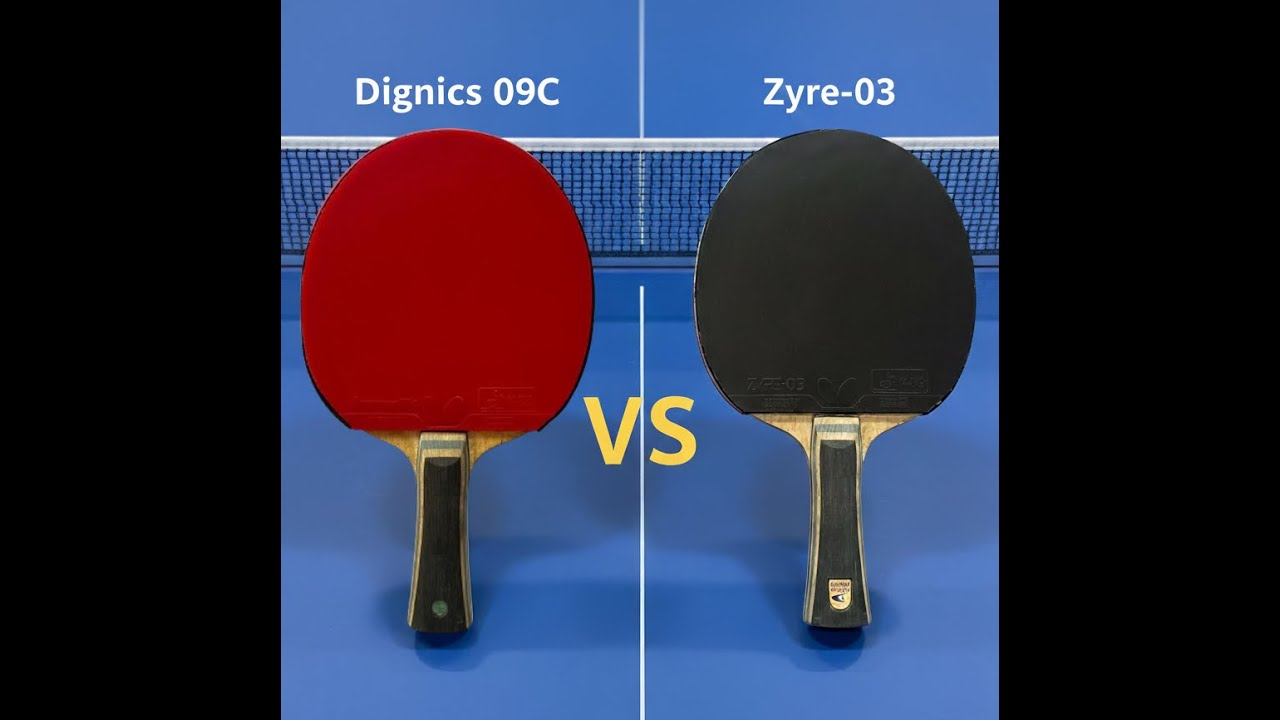

Durability of Rubbers (Zyre 03, Dignics 09c, Dignics 05, Glayzer)

This user has no status.
Member
Sep 2024
14
2
17
Hi everyone,

Current setup:


  • FH: Glayzer 09C (2.1 mm)
  • BH: Zyre 03 (2.0 mm)
Playstyle:
Forehand-dominant, topspin-oriented player. On the backhand mostly blocking, with occasional opening loops.

Training load:
  • 2x 2-hour practice sessions per week
  • 1 league match on the weekend
German TTR: 1720

My concern is that after around 60% of the season, my Glayzer has lost a significant amount of its tackiness and overall grip. I had a similar experience before with Dignics 09C.

Now I’m wondering whether switching to a non-tacky rubber like Zyre 03 or Dignics 05 might offer better durability in terms of grip retention compared to hybrid/tacky rubbers.

What are your experiences regarding durability and performance over time, especially with hybrid vs. non-tacky rubbers?

Thanks in advance!
 
  • Haha
Reactions: plunder
This user has no status.
🏆 Top 1% Commenter
Well-Known Member
Jan 2021
3,917
2,869
8,092
Read 1 reviews
Hi everyone,

Current setup:


  • FH: Glayzer 09C (2.1 mm)
  • BH: Zyre 03 (2.0 mm)
Playstyle:
Forehand-dominant, topspin-oriented player. On the backhand mostly blocking, with occasional opening loops.

Training load:
  • 2x 2-hour practice sessions per week
  • 1 league match on the weekend
German TTR: 1720

My concern is that after around 60% of the season, my Glayzer has lost a significant amount of its tackiness and overall grip. I had a similar experience before with Dignics 09C.

Now I’m wondering whether switching to a non-tacky rubber like Zyre 03 or Dignics 05 might offer better durability in terms of grip retention compared to hybrid/tacky rubbers.

What are your experiences regarding durability and performance over time, especially with hybrid vs. non-tacky rubbers?

Thanks in advance!

The tackiness slowly disspears on all tacky rubbers. I play with H3 3x2hrs a week. I manage (with a little good will) to make my boosted H3 (non Neo) to last a whole season (~5 months) without reboosting. The grippiness was lost at the same rate as any other rubber, no better no worse... The same goes for Tibhar Hybrid MK FX, but the little tackiness it had went pretty fast.

Cheers
L-zr
 
  • Like
Reactions: Egon
This user has no status.
Member
Jan 2026
461
405
1,954
Playstyle:
Forehand-dominant, topspin-oriented player. On the backhand mostly blocking, with occasional opening loops.
Just a constructive thought, if you mostly block on backhand, I'd say Zyre 03 is not the optimal rubber for BH, since it much faster than G09c :)

And for the FH, in order to answer that, do you prefer tensors or tacky overall?
 
  • Like
Reactions: Ninja26Go
This user has no status.
🏆 Top 1% Commenter
Well-Known Member
Jan 2016
5,307
6,812
27,588
I play with d80 d05 and I play 5x2h =10 h a week on average. I change them after a bit more than 3 months about 100 hours.

I think after 2 or even 1 week they lose the brand new feeling (which I don’t like so much because not so used to it) after that they’re very stable. I think they could last a bit more but I resell them to my friend and I can renew my sheets.

My friend is happy to keep those rubbers until I renew mine and he is a better player than me. ( I can beat him but it’s because I’m used to his game )
 
  • Like
Reactions: Egon
This user has no status.
Member
Jun 2025
196
203
580
is the degree of tackiness measurable by how well a certain ball model sticks to the rubber when held upside down?

and what's the difference between grip (or grippyness) and tackiness? gpt doesn't know it either.
Grip is the level of friction between the rubber and the ball. For me, tackiness and stikiness are the same thing, but for others and Google are different:

Tackiness and stickiness both describe adhesive properties, but tackiness refers to the initial, instantaneous grab upon light contact, while stickiness refers to the overall, sustained force needed to separate two surfaces (adhesion) or pull a material apart (cohesion). Tack is the "instant grab," whereas stickiness is the "long-term hold."

For easy spin generation we need maximum friction/grip with minimal force. Stiky rubbers are good for that. Personally, I test grip level by sliding the ball on the surface with minimal pressure and compere the feeling with other rubbers. Let's say that is brushing level of spin. TG3 and H3 are the best rubbers in this test, but are not the stickiest rubbers that I have. For non-sticky rubbers, or just gripy, friction relies mostly on pressure and sponge deformation. Here Donic Slice 40 CS is my best.

There is also this "oily" type of stickiness that many cheap rubbers have. They can hold the ball for more than 20 seconds, but are away from the maximum spin level of H3 in game. So, grip evaluation is better to hapen in a real game, where all factors count.
 
Last edited:
This user has no status.
Hi everyone,

Current setup:


  • FH: Glayzer 09C (2.1 mm)
  • BH: Zyre 03 (2.0 mm)
Playstyle:
Forehand-dominant, topspin-oriented player. On the backhand mostly blocking, with occasional opening loops.

Training load:
  • 2x 2-hour practice sessions per week
  • 1 league match on the weekend
German TTR: 1720

My concern is that after around 60% of the season, my Glayzer has lost a significant amount of its tackiness and overall grip. I had a similar experience before with Dignics 09C.

Now I’m wondering whether switching to a non-tacky rubber like Zyre 03 or Dignics 05 might offer better durability in terms of grip retention compared to hybrid/tacky rubbers.

What are your experiences regarding durability and performance over time, especially with hybrid vs. non-tacky rubbers?

Thanks in advance!

Since when Zyre 03 has a 2.0 mm sponge? Last time I checked it offers 2.5 and 2.7 thickness variants.
 
This user has no status.
🏆 Top 1% Commenter
Well-Known Member
Jan 2024
2,207
2,885
6,883
Read 2 reviews
Grip is the level of friction between the rubber and the ball. For me, tackiness and stikiness are the same thing, but for others and Google are different:

Tackiness and stickiness both describe adhesive properties, but tackiness refers to the initial, instantaneous grab upon light contact, while stickiness refers to the overall, sustained force needed to separate two surfaces (adhesion) or pull a material apart (cohesion). Tack is the "instant grab," whereas stickiness is the "long-term hold."

For easy spin generation we need maximum friction/grip with minimal force. Stiky rubbers are good for that. Personally, I test grip level by sliding the ball on the surface with minimal pressure and compere the feeling with other rubbers. Let's say that is brushing level of spin. TG3 and H3 are the best rubbers in this test, but are not the stickiest rubbers that I have. For non-sticky rubbers, or just gripy, friction relies mostly on pressure and sponge deformation. Here Donic Slice 40 CS is my best.

There is also this "oily" type of stickiness that many cheap rubbers have. They can hold the ball for more than 20 seconds, but are away from the maximum spin level of H3 in game. So, grip evaluation is better to hapen in a real game, where all factors count.
Can we pin this post somewhere?
 
Just a constructive thought, if you mostly block on backhand, I'd say Zyre 03 is not the optimal rubber for BH, since it much faster than G09c :)

And for the FH, in order to answer that, do you prefer tensors or tacky overall?
dont waste zyre if you are only blocking
 
  • Like
Reactions: victormanriquey
This user has no status.
🏆 Top 1% Commenter
Active Member
Dec 2018
925
1,370
3,479
Read 1 reviews
is the degree of tackiness measurable by how well a certain ball model sticks to the rubber when held upside down?
It's a usable quick test but not reliable if what you really want to know is how well the rubber grips the ball when you're looping. What you're measuring is instant adhesion and contact area (which depend on things like humidity, topsheet softness, etc., and not just "tack").
and what's the difference between grip (or grippyness) and tackiness? gpt doesn't know it either.
“Tack” is surface adhesion, cling that resists separation and can delay slipping during low speed/load contact. It relies on the same intermolecular attractions (van der Waals–type forces), but a tacky topsheet behaves more like a pressure-sensitive adhesive. It can wet the ball under light pressure (large real contact area) and dissipate energy during debonding, so you feel “stickiness” and the ball can hang upside down.

“Grip” is effective tangential traction. Essentially how well the rubber converts racket motion into spin/speed before slipping. It comes from a mix of adhesion (tacky or non-tacky) plus indentation-driven real contact area and viscoelastic hysteresis ("mechanical bite") as the rubber deforms under load.

Because effective grip depends on how the topsheet and sponge build contact area and resist shear, a rubber can be very tacky yet feel less grippy for some contacts (e.g., when the sheet/sponge stiffness or slip threshold doesn’t match the stroke), or non-tacky yet extremely grippy at higher loads because hysteresis and contact-area growth generate large tangential forces.
 
says Nothing beats a good mid-far distance, chinese forehand...
Member
Dec 2025
31
31
86
Read 4 reviews
Hi everyone,

Current setup:


  • FH: Glayzer 09C (2.1 mm)
  • BH: Zyre 03 (2.0 mm)
Playstyle:
Forehand-dominant, topspin-oriented player. On the backhand mostly blocking, with occasional opening loops.

Training load:
  • 2x 2-hour practice sessions per week
  • 1 league match on the weekend
German TTR: 1720

My concern is that after around 60% of the season, my Glayzer has lost a significant amount of its tackiness and overall grip. I had a similar experience before with Dignics 09C.

Now I’m wondering whether switching to a non-tacky rubber like Zyre 03 or Dignics 05 might offer better durability in terms of grip retention compared to hybrid/tacky rubbers.

What are your experiences regarding durability and performance over time, especially with hybrid vs. non-tacky rubbers?

Thanks in advance!

Losing the feeling of tackiness on the topsheet is not the same as losing its original playing characteristics. Not at least for Glayzer09C or Dignics09C in my playing experience.

I used my Glayzer09C for 3 months playing 5 days a week for 2-3 hours, with high intensity rallies and match games in my hot and humid club. The feeling of tackiness (upside down ball-holding, sticky feeling when pressing finger against topsheet) is almost gone by 3 months, but it still plays 90% like new. I can still generate point-deciding spin during match games, and the rubber still grips well with serves and receives. If I have a serious game coming up and I absolutely need 100%, I'll replace the rubber. If I'm playing many serious games and joining competitions frequently, I'd probably consider splitting my tournament setup and training setup. To me the Glayzer09C is durable, and when I say durable, I mean it holds on to its original playing characteristics for a very long time, not on how tacky it feels to my fingers.

In my experience, non tacky rubbers are kind of a mixed bag. Some have decent durability, some have crap durability. I have a friend who used Zyre-03 and Dignics09C, he says the Dignics09C lasted him almost two times longer than the Zyre-03 for forehand use.

Zyre-03 on backhand sounds brutal though. I guess if your precise, your punch blocks can be absolutely toxic. And 2.0mm? I didn't know Zyre-03 is sold so thin. Isn't Zyre-03 famous for being super thick like 2.7mm?
 
Last edited:
  • Like
Reactions: Francis86 and Egon
says what [IMG]
says what [IMG]
🏆 Top 1% Commenter
Well-Known Member
Feb 2016
2,470
1,520
5,098
Read 2 reviews
It's a usable quick test but not reliable if what you really want to know is how well the rubber grips the ball when you're looping. What you're measuring is instant adhesion and contact area (which depend on things like humidity, topsheet softness, etc., and not just "tack").

“Tack” is surface adhesion, cling that resists separation and can delay slipping during low speed/load contact. It relies on the same intermolecular attractions (van der Waals–type forces), but a tacky topsheet behaves more like a pressure-sensitive adhesive. It can wet the ball under light pressure (large real contact area) and dissipate energy during debonding, so you feel “stickiness” and the ball can hang upside down.

“Grip” is effective tangential traction. Essentially how well the rubber converts racket motion into spin/speed before slipping. It comes from a mix of adhesion (tacky or non-tacky) plus indentation-driven real contact area and viscoelastic hysteresis ("mechanical bite") as the rubber deforms under load.

Because effective grip depends on how the topsheet and sponge build contact area and resist shear, a rubber can be very tacky yet feel less grippy for some contacts (e.g., when the sheet/sponge stiffness or slip threshold doesn’t match the stroke), or non-tacky yet extremely grippy at higher loads because hysteresis and contact-area growth generate large tangential forces.
I have a hypothesis that flash heating at the contact patch also matters a lot, with the typical trend of higher friction rubbers being more sensitive to thermals. So you might not be able to really evaluate performance without sufficient heating ie: strong enough stroke.

Do you know if that is accurate, or are table tennis topsheets not really thermally sensitive in real use?
 
This user has no status.
🏆 Top 1% Commenter
Active Member
Dec 2018
925
1,370
3,479
Read 1 reviews
I have a hypothesis that flash heating at the contact patch also matters a lot, with the typical trend of higher friction rubbers being more sensitive to thermals. So you might not be able to really evaluate performance without sufficient heating ie: strong enough stroke.

Do you know if that is accurate, or are table tennis topsheets not really thermally sensitive in real use?
I don’t know, but I’m skeptical. You probably do need a strong enough stroke to evaluate a rubber properly, but mostly because you need to enter the right deformation/contact regime, not because grip depends on any substantial thermal activation. Flash heating at the contact patch might make a marginal difference, but my guess is that ball-rubber contact is too brief (roughly 1–2 ms) for it to be a major factor.
 
  • Like
Reactions: shaibu
This user has no status.
Member
May 2019
18
8
26
Losing the feeling of tackiness on the topsheet is not the same as losing its original playing characteristics. Not at least for Glayzer09C or Dignics09C in my playing experience.

I used my Glayzer09C for 3 months playing 5 days a week for 2-3 hours, with high intensity rallies and match games in my hot and humid club. The feeling of tackiness (upside down ball-holding, sticky feeling when pressing finger against topsheet) is almost gone by 3 months, but it still plays 90% like new. I can still generate point-deciding spin during match games, and the rubber still grips well with serves and receives. If I have a serious game coming up and I absolutely need 100%, I'll replace the rubber. If I'm playing many serious games and joining competitions frequently, I'd probably consider splitting my tournament setup and training setup. To me the Glayzer09C is durable, and when I say durable, I mean it holds on to its original playing characteristics for a very long time, not on how tacky it feels to my fingers.

In my experience, non tacky rubbers are kind of a mixed bag. Some have decent durability, some have crap durability. I have a friend who used Zyre-03 and Dignics09C, he says the Dignics09C lasted him almost two times longer than the Zyre-03 for forehand use.

Zyre-03 on backhand sounds brutal though. I guess if your precise, your punch blocks can be absolutely toxic. And 2.0mm? I didn't know Zyre-03 is sold so thin. Isn't Zyre-03 famous for being super thick like 2.7mm?
For me the biggest loss of rubber characteristics I lose with dignics 09c or glayzer 09c after a short period of time is the ability to very easily slowspin underspin/nospin balls. Where it feels like you can just grip the ball with the topsheet so easily with a small wrist motion.

I wish I could keep this feeling for a long time with these tacky rubbers. the rest of the feeing when you play with the rubbers are very similar.

Though I'm playing with Zyre-03 right now and I can't say it loses durability faster than dignics had them for 4 months now and still holding strong. Difficult to say if they are like new but still a good rubber.
 
This user has no status.
Member
Jan 2024
327
411
1,139
Now I’m wondering whether switching to a non-tacky rubber like Zyre 03 or Dignics 05 might offer better durability in terms of grip retention compared to hybrid/tacky rubbers.

What are your experiences regarding durability and performance over time, especially with hybrid vs. non-tacky rubbers?
The most durable rubbers I know: Dignics 05/64/80, Glayzer (normal, not 09C), Fastarc G1, Hammond Z2. Didn't own Zyre 03, but the teammates say it's about the same durability as the D05/64/80, which is excellent.
They are all grippy tensors and last about twice as long as when compared to D09C or G09C.
 
  • Like
Reactions: jonol
says what [IMG]
says what [IMG]
🏆 Top 1% Commenter
Well-Known Member
Feb 2016
2,470
1,520
5,098
Read 2 reviews
I don’t know, but I’m skeptical. You probably do need a strong enough stroke to evaluate a rubber properly, but mostly because you need to enter the right deformation/contact regime, not because grip depends on any substantial thermal activation. Flash heating at the contact patch might make a marginal difference, but my guess is that ball-rubber contact is too brief (roughly 1–2 ms) for it to be a major factor.
Maybe. The contact time is probably too low. If the rubber is always below optimal temperature and the mu increases rapidly with temperature, then the quick ramp might give a momentary real increase in friction, but it'd need to rise enough in temp.

Would not be very difficult to just calculate if you feel like doing some heat math.
 
This user has no status.
Member
Aug 2023
157
57
310
67
Get sticky foils. My rubbers tack and grip remain for a long time.
I protect my H3 with a foil, that sticks to my cleaned rubber. It’s not sticky itself! I use a roller, to be sure, no air bubbles remain. Air = oxidation. That is killing tackiness. I kept some of my old H3 neo. After cleaning, they still pic up the ball!
 
  • Like
Reactions: belllfador
Top