Big Upset with W968 Golden Grand Slam Version

Agree with everyone else, it’s not the blade quality, it’s the treatment on top. You’ve got to seal and the glue you’ve used from my experience is very strong glue. I didnt like using it because the bonding was too strong, even on unsealed koto blades I felt the fibres would rip off unless I pulled very very slowly. Very sorry you’ve experienced such a tough learning curve.
 
says Table tennis clown
🏆 Top 1% Commenter
Well-Known Member
Apr 2020
4,666
2,963
10,850
You don't lift fibers with softwoods outers like hinoki or Sköllawood, as there's literally no fibers in the wood to lift.
Bollocks :ROFLMAO: :ROFLMAO: :ROFLMAO: :ROFLMAO: :ROFLMAO: :ROFLMAO: :ROFLMAO: :ROFLMAO:
IMG20260301171003.jpg
 
says Table tennis clown
🏆 Top 1% Commenter
Well-Known Member
Apr 2020
4,666
2,963
10,850
And this, my friends, is why Butterfly blades are the way to go...
BS-comments like these remind me of those photos that were published here on this forum of some lovely shit-expensive Butterfly blades with half the top ripped off and exposing a beautiful black and blue carbon hybrid layer.
😂
 
This user has no status.
🏆 Top 1% Commenter
Well-Known Member
Apr 2023
1,595
1,482
3,891
Read 5 reviews
BS-comments like these remind me of those photos that were published here on this forum of some lovely shit-expensive Butterfly blades with half the top ripped off and exposing a beautiful black and blue carbon hybrid layer.
😂
And remind me how many Butterfly blades like this vs how many DHS blades? And how many are caused by ripping the rubber off? And you will clearly see that DHS is far more notorious for this than Butterfly, and I say this as a fan of both companies and their blades.

So you can take my “BS comment” and shove it up ur ass and stfu lmaoo
 
This user has no status.
Member
Mar 2024
135
148
322
Hello everyone,

I recently purchased a DHS W968 Golden Grand Slam blade. Since this blade is not sold in my country, I had to buy it through an intermediary service. After receiving it, I verified the serial number on the official website and confirmed that the product is completely authentic.

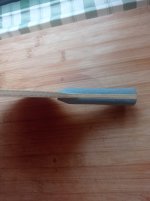
However, I encountered a serious problem. After gluing rubbers onto the blade using Butterfly Free Chack glue and playing with it for a while, I decided to remove the rubber. When I did, the top ply of the blade was severely damaged and parts of the wood surface came off with the rubber.

I also experienced the exact same issue on the other side of the blade when removing the rubber there as well.

Honestly, I was very surprised and disappointed to see this happen on such an expensive blade. I did not expect something like this from a product at this price level.

I contacted DHS support via email and included the blade’s serial number along with photos explaining the situation, but unfortunately I have not received any response so far.

Has anyone here experienced something similar or knows what I should do in this situation? Any advice would be greatly appreciated.

Thank you.
don't use BTY glue on unsealed blades. actually, don't use BTY glue at all. it's trash compared to latex based ones. actually it's trash period.
 
This user has no status.
🏆 Top 1% Commenter
Well-Known Member
Apr 2023
1,595
1,482
3,891
Read 5 reviews
don't use BTY glue on unsealed blades. actually, don't use BTY glue at all. it's trash compared to latex based ones. actually it's trash period.
It’s the one thing of Butterfly that is ultimate shit. I always recommend use DHS or some chinese glue, works best and easy to spread and remove imo
 
This user has no status.
🏆 Top 1% Commenter
Well-Known Member
May 2011
2,432
2,906
6,938
Butterfly blades are pre-sealed, plus many Butterfly blades use Koto outer which doesn't splinter as much as Limba, the material often used on DHS and Stiga blades. Butterfly's glue is also way too strong, it destroys both the blade and the rubber way too easily.

Luckily for the OP, you probably won't notice a difference after the repair. I'd recommend you to seal your blades. Even Butterfly ones can splinter over time. Don't listen to people who tell you it changes the feel of the blade. When properly done it's not physically possible. Variations between blades, rubbers, glue layers, as well as their aging changes the feeling much, much more. There's no way people can separate those changes from the infinitesimally small amount of a sealed blade.
 
Hello everyone,

I recently purchased a DHS W968 Golden Grand Slam blade. Since this blade is not sold in my country, I had to buy it through an intermediary service. After receiving it, I verified the serial number on the official website and confirmed that the product is completely authentic.

However, I encountered a serious problem. After gluing rubbers onto the blade using Butterfly Free Chack glue and playing with it for a while, I decided to remove the rubber. When I did, the top ply of the blade was severely damaged and parts of the wood surface came off with the rubber.

I also experienced the exact same issue on the other side of the blade when removing the rubber there as well.

Honestly, I was very surprised and disappointed to see this happen on such an expensive blade. I did not expect something like this from a product at this price level.

I contacted DHS support via email and included the blade’s serial number along with photos explaining the situation, but unfortunately I have not received any response so far.

Has anyone here experienced something similar or knows what I should do in this situation? Any advice would be greatly appreciated.

Thank you.
Why are you gluing rubbers on a commerative blade? Complete waste. Keep it pristine and admire it, or just don't buy it. You could have sealed the blade.
 
This user has no status.
Agree with everyone else, it’s not the blade quality, it’s the treatment on top. You’ve got to seal and the glue you’ve used from my experience is very strong glue. I didnt like using it because the bonding was too strong, even on unsealed koto blades I felt the fibres would rip off unless I pulled very very slowly. Very sorry you’ve experienced such a tough learning curve.
Somebody should sue DHS for this, selling unfinished products…
 
This user has no status.
New Member
Mar 2025
4
5
18
I have a DHS N301 (National) I followed the advice in Zhang Jike's video and first sanded it, then wiped it with a damp cloth. After it dried, some of the wood grain began to stick out, so I sanded it again to make the surface smooth. After that, I applied a layer of DHS15 glue to remove wood dust. After that, I removed the glue, wiped the surface, and applied a layer of Donic varnish. Since then, I've re-glued the rubber several times without any problems. I'm sure the grain that started to stick out after wiping with a damp cloth would have come off during the re-gluing if I hadn't followed the above steps.
I varnish all my blades, but I agree that I haven't encountered this situation with any of my rackets from any brand. But the n301 plays superbly, so I believe that if you prepare the blade properly, it's top-notch.

 
  • Like
Reactions: sebi
This user has no status.
Member
Mar 2022
420
677
2,038
Wow - that's interesting 🤔

I'm genuinely surprised at the idea of a hinoki outer blade losing fibers -- because seriously, hinoki simply *does not have fibers* -- no softwoods do!

Therefore, I think what you're looking at there is a manufactured veneer... Either that or it's some sort of natural defect in the woodgrain. 🤨

Manufactured veneers are basically thin strips of timber that have been cut from a regular piece of timber, and then glued back together into the form of a veneer. Products like these allow veneer manufacturers to re-use and re-engineer sub-standard timber and turn it into something that has all the appearance of premium, straight grained, knot-free natural wood veneer, but really is nothing if the sort.

A manufacturer using manufactured veneers in a blade is a bloody dodgy-as practice in my book. Manufactured veneers are right on the very fine line between "actual wood" and artificial manufactured wood-based materials like chipboard and MDF.

The ITTF rules state a blade must be made from at least 80% "real wood" by volume. Those products however have almost as much adhesive in them as they do wood. To my mind, they should be classed as wood-based manufacturing materials, and therefore deemed as illegal in ITTF matches. How they are allowed to get away with using that sort of shit product without informing people about it is just staggering to me 🙄🙄🙄
 
Last edited:
This user has no status.
Member
Mar 2022
420
677
2,038
My worst rip happened to and old and very dry primorac carbon. It has a hinoki outer so those woods you mentioned are not immune to this. I also had a rip on a spruce top. The safest way to remove a rubber is slowly side to side or diagonally (across the fibers).

Cheers
L-zr
Did the outers tear, did the timber lose splinters due to impact damage, or did the outers have fibers lift due to cohesive failure of the surrounding lignin? 🤨

If it's the latter, then something is decidedly up with that, because at the risk of repeating myself, to the very best of my current knowledge, softwoods do not have fibers or vessels, only hardwoods do.

If the outer is a genuine softwood species, there really are simply no fibers to lift.
 
Last edited:
says Fighting the EJ bug again...
Member
Mar 2025
340
456
2,117
Read 1 reviews
The ITTF rules state a blade must be made from at least 80% "real wood" by volume. Those products however have almost as much adhesive in them as they do wood. To my mind, they should be classed as wood-based manufacturing materials, and therefore deemed as illegal in ITTF matches. How they are allowed to get away with using that sort of shit product without informing people about it is just staggering to me 🙄🙄🙄
1773411245167.png
 
This user has no status.
Member
Mar 2022
420
677
2,038
This is too true to be funny. 😂😂😂

But hey, at least he's doing the right thing by checking the end grain... If he were checking the planed outer surface I'd be truly worried. 😂 I very much doubt however that he's going to see a damn thing of note with that eyepiece however ☺️
 
  • Haha
Reactions: golden_son
This user has no status.
🏆 Top 1% Commenter
Well-Known Member
Sep 2017
2,229
1,552
4,776
Read 1 reviews
I have a DHS N301 (National) I followed the advice in Zhang Jike's video and first sanded it, then wiped it with a damp cloth. After it dried, some of the wood grain began to stick out, so I sanded it again to make the surface smooth. After that, I applied a layer of DHS15 glue to remove wood dust. After that, I removed the glue, wiped the surface, and applied a layer of Donic varnish. Since then, I've re-glued the rubber several times without any problems. I'm sure the grain that started to stick out after wiping with a damp cloth would have come off during the re-gluing if I hadn't followed the above steps.
I varnish all my blades, but I agree that I haven't encountered this situation with any of my rackets from any brand. But the n301 plays superbly, so I believe that if you prepare the blade properly, it's top-notch.

I had regualr 301. I didn't sand it, didn't wipe, didn't warnish. I changed rubbers many times and never had splinters :)
 
Top