
I saw a thread about the weight of impact. It should be force of impact.

This user has no status.
🏆 Top 1% Commenter
Well-Known Member
Jul 2017
1,784
879
2,985
Assuming a coefficient of restitution of 90% (blade with rubbers) and a 4 ms contact time.
For the velocity of the ball after impact we get:
cor = 90%, m_racket = 0.18 kg, m_ball = 0.0027 kg, v_racket_0 = 0 m/s, v_ball_0 = 10 m/s, m_total = 0.1827 kg

v_ball_1 = (m_ball * v_ball_0 + m_racket * v_racket_0 + m_racket * cor * (v_racket_0 - v_ball_0)) / m_total = -8.719 m/s

v_racket_1 = (m_ball * v_ball_0 + m_racket * v_racket_0 + m_ball * cor * (v_ball_0 - v_racket_0)) / m_total = 0.2807 m/s

For the average force we get: F_average t = m (v_ball_0 - v_ball_1) so
F_average = (0.0027 kg * (10 m/s - (-8.719 m/s))) / 0.004 s = 12.63 N
or for the racket F_average = (0.18 kg * (0 m/s - 0.2807 m/s)) / 0.004 s = -12.63 N
So if the impact speed is 10 m/s and the dwell/contact time is 4 ms. Lets assume that the ball is taking 2 ms to decelerate to a stop relative to the paddle. How far does the ball travel relative to the paddle in that time?

As usual there are some that want to distract the thread.

 
says Leave the righteousness to me.
🏆 Top 1% Commenter
Well-Known Member
Nov 2020
1,611
1,467
7,000
alright.
there is where I say, no engrish
Let's spice the pop-corn up, Tony :)
impact.jpg
 

Attachments

  • Non_Linearity_of_the_BallRubber_Impact_in_Table_Te.pdf
    310.5 KB · Views: 279
This user has no status.
Active Member
Nov 2019
839
758
3,048
Read 1 reviews
Let's spice the pop-corn up, Tony :)


Rinaldi and Manin are also coauthors of the newer paper "Dynamical buckling of a table-tennis ball impinging normally on a rigid target: experimental and numerical studies", Rémond et al., 2022
Now we only need to do some measurements on real rubbers and then we can try to calculate "How far does the ball travel relative to the paddle in that time?" or we simulate first, measure, tune the models used and maybe come up with an answer...
 
  • Haha
Reactions: latej
This user has no status.
🏆 Top 1% Commenter
Well-Known Member
Jul 2017
1,784
879
2,985
In a purely elastic collision, when the projectile mass is much larger than the target, the resultant velocity of the target/ball is only a function of the incoming projectile/paddle and the target/ball velocities and nothing else.
OK, but the collision isn't purely elastic. There is the coefficient of restitution.

If you're trying to literally apply force for a duration through the shot, or to follow through the ball as you hit it, then you're not optimizing your swing to maximize the velocity at impact and instead wasting energy.
How do you apply force through the shot. Force is only applied to the ball during contact. You apply force to the paddle during the swing.

You want to use the above techniques not for how to hit the ball but instead to maximize the velocity of your paddle at impact.
Provided that is what you want to do when you make a flat kill, but not touch shots.

When I started paying attention to the velocity I could generate in the swing of my paddle, just based on the sound of it moving through the air, I quickly discovered that there was tension in my arm because I was trying apply a lot of force.
Too the paddle.

Instead, by relaxing my entire movement from core to arm to wrist and accelerating through the whole duration, I was able to create a much faster paddle velocity at impact and as a result could hit the ball harder.
You aren't clear, the duration of the stroke or duration of contact. It makes a difference.

This site gives a good summary of elastic collisions: http://hyperphysics.phy-astr.gsu.edu/hbase/colsta.html
That is a very good website but collisions aren't purely elastic. The formula in the linked web pages site do not include the the coefficient of restitution.

The case for a paddle and table tennis ball is the m1 >> m2 case where the projectile (paddle+arm) mass is much greater than the target (ball). There's also a calculator there if you want to see how negligible the effect is because of the difference in masses. The resultant velocity of the ball in the opposite direction when hitting approaches the paddle velocity + the incoming ball velocity. This would be in a perfect elastic collision, which of course it isn't, but it also makes it obvious that a stiffer paddle (i.e., creating closer to a perfect elastic collision) would also increase the resultant velocity of the ball.
Good, so you know the collision is not perfectly elastic.
This webpage is better.
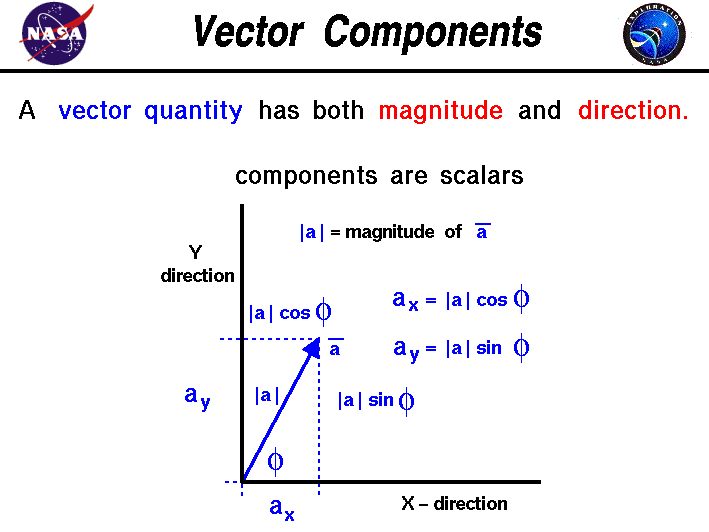
Notice the formula for normal ( 3D perpendicular ) impulse.
Now assuming you know the actual contact time, one can calculate the average force needed to achieve that impulse. Which gets back to knowing the force of impact. However, this doesn't give a complete picture because when the ball makes initial contact the force is 0 and it increases until the ball is stopped relative to the paddle so the peak force is much higher than the average.
 
Top