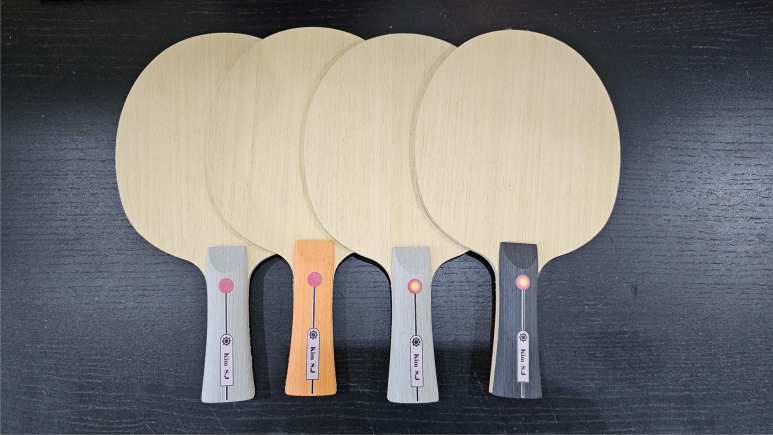
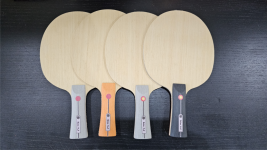
Nexy Fitting Racket Order

This user has no status.
Member
Aug 2025
60
148
211
Hello,
This is Oscar, a designer at Nexy.
I am running the brand Nexy in Korea, and in this article, I would like to introduce Nexy’s next-generation service — the custom fitting racket production service.


Nexy was founded in 2007.
At first, it started as an agency for the German company Tibhar, in order to offer products that Tibhar did not have.
Since then, we have gone through a total of seven generations of product evolution.


Now, we are manufacturing rackets together with Korean factories in a completely new way.

SE-70059c01-45a0-4197-a943-1317460bafd5.png


Fitting Racket, simply put, means custom-made racket production.


I am not sure if the term “Fitting Racket” perfectly describes our service.
At first, we considered using the term “Custom Racket Production,” but finally decided on “Fitting Racket.” We thought this would better reflect the desire of passionate table tennis players who want a racket tailored exactly to them.


Definition of the Fitting Racket Service​


Table tennis lovers have a special affection for their rackets.
However, the products they purchase cannot always meet all of their needs.


Moreover, their requirements are not always the same — they change as their skills evolve.
When their skills are still developing, they may want the ball to travel faster than their own power. But as they improve, they may prefer a racket that responds exactly to their control.


In other words, their needs continuously evolve.
And making rackets that adapt to these evolving needs — that is the very definition of the Fitting Racket Service.


Why Nexy’s Fitting Racket Service is Special​


There are two major patents applied to this service:


  1. A patent related to racket manufacturing methods
  2. A patent related to bonding technology

All of Nexy’s recently made-in-Korea rackets are produced using these two technologies. Let’s take a look.


1. Patent on Racket Manufacturing Method​


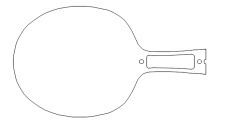
Nexy rackets are manufactured with small holes drilled into the plies (see diagram below).

KakaoTalk_20250812_105338910.jpg


These holes serve as a standardized guide throughout different machines during production.
As a result, products are consistently mass-produced with high precision.

KakaoTalk_20250812_105332818.jpg


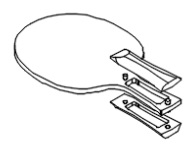
After the drilling process, the handle is attached.
At this stage, the holes again serve an important role: wooden pins are inserted to firmly secure the two sides of the handle.

KakaoTalk_20250812_105336335.jpg

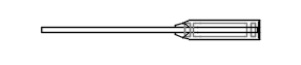
When the handles are attached top and bottom, a small wooden pin is placed between them.
As shown in the photo, this pin remains inside the handle after completion.


Through this process, the handle becomes firmly fixed and will not easily come off under any circumstances.


2. Patent on Bonding Method​


The second patent is one of the core technologies also applied to the Fitting Racket.


Typically, two types of glue are used in racket production. Nexy, however, developed and uses an additional type: polyurethane adhesive.


By using polyurethane, bonding is achieved with almost no weight increase. This allows Nexy rackets to gain elasticity through multiple gluing processes.


In other words, by applying the gluing process two or three times, we can significantly increase the elasticity of the racket.


For example, Nexy’s “Eiger” blade is often evaluated as being more powerful than standard rackets. One user mentioned that while it was too bouncy in a regular training hall, it turned out to be extremely powerful in tournament play — evidence of its strong elasticity.


Production Process After Ordering​


  1. Based on the customer’s basic information, our engineers select the appropriate wood composition and adhesives using accumulated sampling data, and produce the blade.
  2. According to the customer’s details, processing such as balance adjustment, sanding, grip shaping, and additional part assembly is carried out.
  3. After external inspection and bonding inspection, a first sample is delivered to the customer.
  4. The customer tests the first sample, then sends feedback for improvements. They may also consult directly with our engineers to finalize the racket. Based on the sample data and feedback, a new final racket is produced.
  5. The customer’s production data is securely stored at Nexy and used as a reference for producing identical or improved rackets in the future.
  6. The customer receives both the first sample racket and the final finished racket (two rackets in total).
    • For the first sample, the grip is supplied in a single color. If a preferred color is specified at the time of order, it will be produced accordingly. (Available colors: black, bright red, orange, gray, sky blue)


How the Nexy Fitting Racket Service Works


The full process will proceed in the following four steps:


Step 1: Place Your Order

Visit www.nexy.com and fill out the fitting form with your desired specifications.


Step 2: First Sample Delivery

Based on your input, we will create and send a first sample racket.

This package will also include a feedback form where you can further refine your preferences for the final product.


Step 3: Provide Feedback

Try playing with the first sample and let us know how it feels.

Then, fill out the feedback form and send it to us via email with any specific comments.


Step 4: Final Racket Delivery

We’ll produce the final racket incorporating your feedback and deliver it to you.


Service Cost

You will receive two rackets in total (sample + final version), and the full service including shipping costs is $250 USD.


At the moment, our website is not fully functional, so online ordering may not work properly.
If you send me your order by email, I will carefully communicate your requests to the factory and make sure everything is handled properly.


Please send your order to the following email address:
[email protected]
 

Attachments

  • SE-70059c01-45a0-4197-a943-1317460bafd5.png
    SE-70059c01-45a0-4197-a943-1317460bafd5.png
    508.4 KB · Views: 191
This user has no status.
Member
Aug 2025
60
148
211
A brief of Fitting Racket Service.

One person from Austrailia ordered one blade.
He got a very creative idea about it.
Here is some information of what he ordered.

This will be a fusion of 3 blades together , rotela - focala- Golden Viscaria
Select type- Offensive type
Blade type - 5-PLY+2-Carbon Outer
Blade Thickness - 5.9MM
Select Grip Shape - FL
Racket Weight - 88g ±1g

Blade composition details
Limba ( used in Rotela)
3k Carbon ( Used in Rotela)
Ayous ( Used in Rotela
Ayous Hard ( used in Focala)
Ayous (Used in Rotela)
3k Carbon (used in Rotela)
Koto ( Used in Focala)

After receiving the order, our factory produced a template.

KakaoTalk_20250808_093432150_01.jpg


KakaoTalk_20250808_093432150_02.jpg


From those pictures, you can see two sides are different.

The customer who placed this order requested the overall shape and handle design of the Golden Viscaria, but wanted the functional characteristics of Nexy’s Rotela and Focala.
Producing a racket of this kind is indeed a very interesting project.


Here is a part of what the customer wrote:


I would like the deep wrapping of the ball, the wrapping rotation-drive of the Rotela.
The special smashing arc of the Rotela and the unique forward kick it has, but with the hard core of the Focala (not the soft core of the Rotela as described above), and with Koto on the backhand side.
The dwell time should be like the Focala, but I want to wrap the ball like the Rotela or something similar, so that less effort is required.

Based on these requirements, we sourced the materials and carried out the bonding process.
The blade was then cut and the first sample was produced.


KakaoTalk_20250818_132402404_01jl;.jpg


The sample production has now been completed and has already been shipped.
We look forward to hearing good news from the customer.
 
This user has no status.

🏆 Top 1% Commenter
Well-Known Member
Moderator
Oct 2014
19,973
26,531
70,870
Read 17 reviews
I am testing out the service, thr blade I had made for me was Kiri, Hinoki ALC Koto. It plays excellently, I prefer Hinoki to Limba for spin and softness when given the choice. I will probably ask for a different handle to see wherher that can be improved.
 
This user has no status.
🏆 Top 1% Commenter
Well-Known Member
Moderator
Oct 2014
19,973
26,531
70,870
Read 17 reviews
@Nexy designer ,

I have a question about handles. I find that for many "standard handles", blade makers just put them on the blade and let the thickness of the blade determine how fat the handle ultimately becomes. Can there be some considerations to reducing the thickness of the handles based on how thick the blade is in order to give a similar feeling across multiple blades and have much less influence of the thickness of the blade on the handle feeling fat in the player's hands?
 
This user has no status.
Member
Aug 2025
60
148
211
@Nexy designer ,

I have a question about handles. I find that for many "standard handles", blade makers just put them on the blade and let the thickness of the blade determine how fat the handle ultimately becomes. Can there be some considerations to reducing the thickness of the handles based on how thick the blade is in order to give a similar feeling across multiple blades and have much less influence of the thickness of the blade on the handle feeling fat in the player's hands?

Thank you.
You are absolutely right.
In many factories, racket handles are mass-produced in a standard size and then attached to blades of different thicknesses.
As a result, the handle size is determined by the thickness of the blade.
However, most brands have likely found it difficult to disclose this information.


It is no exaggeration to say that Nexy’s Fitting Racket Service was ultimately created to solve this problem.
We do not keep a standard handle in stock; instead, we craft the handle each time according to the size of the racket you want.
So please don’t worry and place your order with confidence.


This is, without question, a true fitting racket.
Each racket is newly made according to the customer’s desired size.
Thank you.
 
This user has no status.
Member
Aug 2025
60
148
211
Having a sample shipped beforehand and then further refining it is such a good idea
That’s absolutely correct.
Shipping twice overseas is quite a big challenge, and it also involves significant costs.
Nevertheless, our factory has decided to provide this service.

Once the factory stabilizes, the cost may rise slightly.
For now, since the exchange rate is not too high, we are able to send two rackets for 250 USD.
However, if the exchange rate drops and labor costs within the factory increase, the price may fluctuate somewhat.
 
  • Like
Reactions: Julzig
This user has no status.
Member
Sep 2022
33
19
136
Nexy designer, please say is it possible possible to buy a Rotela blade in Europe without using the "fitting racket service" option on your website? I don't see that blade available anywhere except some Korean store that doesn't even have an English-language option.
Tabletennis11 sells Nexy equipment but I see that they only have older blade models available.

Are there any descriptions and reviews of this blade available in English? I only found information that it's an "ALC inner" blade with an outer layers of limba and that it uses a new type of gluing invented by Nexy.
 
This user has no status.
Member
Aug 2025
60
148
211
Nexy designer, please say is it possible possible to buy a Rotela blade in Europe without using the "fitting racket service" option on your website? I don't see that blade available anywhere except some Korean store that doesn't even have an English-language option.
Tabletennis11 sells Nexy equipment but I see that they only have older blade models available.

Are there any descriptions and reviews of this blade available in English? I only found information that it's an "ALC inner" blade with an outer layers of limba and that it uses a new type of gluing invented by Nexy.
Thank you for your inquiry.
Nexy is still not a very well-known brand in the European market.

For those who would like to purchase Nexy products — including the three blades EIGER, ROTELA, and FOCALA — you can place an order with me directly by email.
In the past, I operated a global website for selling NEXY products, but it has since been discontinued.
Currently, I personally receive orders by email and arrange the shipping with my team mates.

I will also prepare and upload an introduction about the products.
The email address to send your order to is [email protected].
 
  • Like
Reactions: Peppa Pig
This user has no status.
Member
Aug 2025
60
148
211
Thank you for your inquiry.
Nexy is still not a very well-known brand in the European market.

For those who would like to purchase Nexy products — including the three blades EIGER, ROTELA, and FOCALA — you can place an order with me directly by email.
In the past, I operated a global website for selling NEXY products, but it has since been discontinued.
Currently, I personally receive orders by email and arrange the shipping with my team mates.

I will also prepare and upload an introduction about the products.
The email address to send your order to is [email protected].

1756427296115.png
Product Overview — Rotella (translated)​

Nexy Rotella – Embracing Feel, Harmony of Spin and Power
The Pinnacle of ALC Inner Fiber Blades


Product Summary​


The Rotella is a refined and sensorial ALC Inner Fiber blade introduced by Nexy. While adopting the same structural design as the world-class high-performance DHS W968, Rotella adds Nexy's distinct craftsmanship and tactile finesse, delivering a balanced performance in spin, power, and hitting feel.

Structure & Specifications

  • Composition: Limba – Ayous – Aramid Carbon – Ayous – Aramid Carbon – Ayous – Limba
  • Head Size: 157 × 150 mm
  • Thickness: 5.8 mm
    Rotella maintains typical specs of an offensive blade, while incorporating refined design details to enable precise control.

Key Features​

  1. Rich Touch with Limba Outer Ply
    Limba outer plies are softer than typical Koto, offering a feel that “embraces the ball” rather than simply “strikes it.”
    Ideal for players who prefer to draw and spin rather than deliver blunt attacks, and optimized for spin-oriented power drives.
  2. **High-Stiffness Aramid ALC, W968-Like Concept**
    The aramid carbon ALC core provides both stiffness and rebound, employing a design similar to that of the W968.
    This ensures a solid push on the ball, while the softer Limba overlay allows nuanced feel control.
    Note: Occasional fluffing on the blade edge may occur due to the high-strength fibers, but this does not affect actual performance. The DHS W968 exhibited the same characteristic in its early versions.
  3. Core Base for Fitting Blade Customization System
    Rotella serves as the foundational base model in Nexy’s new fitted blade customization system.
    Its balanced structure, refined sensibility, and wide user adaptability make it an optimal starting point for anyone seeking a personalized blade.

Recommended For Players Who:​

  • Prioritize spin during drives
  • Prefer a “grasp-and-pull” hitting feel
  • Are searching for a blade similar to the W968
  • Are intermediate to advanced players seeking a versatile inner ALC blade
Rotella responds to your touch.
Once it embraces the ball, it doesn’t let go—this is Nexy’s spin-centered control blade.
Experience the essence of profound feel with Rotella today.
 
Last edited:
This user has no status.
Member
Aug 2025
60
148
211

Product Overview — Rotella (translated)​

Nexy Rotella – Embracing Feel, Harmony of Spin and Power
The Pinnacle of ALC Inner Fiber Blades


Product Summary​


The Rotella is a refined and sensorial ALC Inner Fiber blade introduced by Nexy. While adopting the same structural design as the world-class high-performance DHS W968, Rotella adds Nexy's distinct craftsmanship and tactile finesse, delivering a balanced performance in spin, power, and hitting feel.

Structure & Specifications

  • Composition: Limba – Ayous – Aramid Carbon – Ayous – Aramid Carbon – Ayous – Limba
  • Head Size: 157 × 150 mm
  • Thickness: 5.8 mm
    Rotella maintains typical specs of an offensive blade, while incorporating refined design details to enable precise control.

Key Features​

  1. Rich Touch with Limba Outer Ply
    Limba outer plies are softer than typical Koto, offering a feel that “embraces the ball” rather than simply “strikes it.”
    Ideal for players who prefer to draw and spin rather than deliver blunt attacks, and optimized for spin-oriented power drives.
  2. **High-Stiffness Aramid ALC, W968-Like Concept**
    The aramid carbon ALC core provides both stiffness and rebound, employing a design similar to that of the W968.
    This ensures a solid push on the ball, while the softer Limba overlay allows nuanced feel control.
    Note: Occasional fluffing on the blade edge may occur due to the high-strength fibers, but this does not affect actual performance. The DHS W968 exhibited the same characteristic in its early versions.
  3. Core Base for Fitting Blade Customization System
    Rotella serves as the foundational base model in Nexy’s new fitted blade customization system.
    Its balanced structure, refined sensibility, and wide user adaptability make it an optimal starting point for anyone seeking a personalized blade.

Recommended For Players Who:​

  • Prioritize spin during drives
  • Prefer a “grasp-and-pull” hitting feel
  • Are searching for a blade similar to the W968
  • Are intermediate to advanced players seeking a versatile inner ALC blade
Rotella responds to your touch.
Once it embraces the ball, it doesn’t let go—this is Nexy’s spin-centered control blade.
Experience the essence of profound feel with Rotella today.
Here is one review I could find in Korean web site.

1756427511053.png

Build Quality & Finish​

1. Appearance & Finish
The finish has improved noticeably compared to when I reviewed the Eiger.
The thickness of the plies has become more uniform, and although the surface looks somewhat rough, the overall manufacturing quality seems to be stabilizing.
It appears that a coarse sandpaper was used during the sanding process.

The Limba outer ply shows a uniform grain, though the wood itself looks a bit fragile.
A coating would likely improve this, and if you dislike coating, you’ll need to remove rubbers very carefully.

The grip end is rounded, with both sides slightly trimmed down.


3. Grip Feel
The FL grip circumference measures about 80mm at its thinnest part and 96mm at the end, which is on the thin side.
The grip length is 100mm, but the actual measurement is 101.6mm, making it slightly longer.
The curve spreads gradually by about 16mm, which doesn’t feel awkward or uncomfortable.
Overall, the grip wraps well and doesn’t cause discomfort, though players with larger hands may find it thin.


Physical Characteristics​

1. Rebound & Control
Rebound feels around OFF+, with a well-balanced response.
There’s no overly springy feel.
Depending on rubber pairing, this may vary slightly, but with commonly used AGR rubber or combinations like Omega 4 Asia and Ovtcharov ALC, the performance felt similar.
During attack, the ball extended powerfully with no sense of dullness.
The good holding sensation made control feel quite easy.

2. Blocking & Defensive Response
Against strong mid-distance topspins, passive blocks landed well on the table, providing good defensive stability.
On close-range active blocks, the blade seemed to “hold” the ball slightly rather than simply bouncing it off.
The offense-defense balance felt well tuned.

3. Feedback & Feel
The vibration was very unique, almost dull, to the point it felt like there was none when no rubbers were attached.
It seemed to absorb most vibrations.
After attaching rubbers, the vibration increased slightly but still remained short and restrained.

In actual play, this difference was interesting.
Light forehand rallies felt moderately soft, depending on the rubber pairing.
The best feature was the clear feedback of “holding” the ball, especially noticeable on strong impact topspins, giving the impression of high spin and control confidence.

Shots carried weight, with no hollow feel, and drove forward powerfully with stable arcs depending on the impact.
Although unique, the feedback wasn’t dull—it provided a good sense of control.
A coach who tested it even remarked, “This is good!”


Game & Play Performance​

1) Forehand Play
The blade transmits both holding feel and heaviness, producing stable arcs with strong spin and speed.
Despite not feeling bouncy, it delivered shots that were fast and crisp.
The holding sensation gave it stability and made looping comfortable.
Even short-ball loops after serve were easy to execute and felt spinny.
There was no lack of power even from mid to far distance, and smashing lobs was effortless.
Forehand topspins and smashes felt solid, never light.
At close distance, however, flat drives may overshoot if not executed with spin or low trajectory.

2) Backhand Play
The holding feel helped backhand topspins land reliably.
Back-punches and back-shots extended powerfully, and blocking stability was excellent.

3) Push Play
Pushes after serve took spin well, making returns solid.
Drop shots were easy to control.
Push rallies rarely resulted in overshooting; instead, backspin often caused balls to drop into the net.
The holding feel again made pushes easy and consistent.
Backhand pushes on short serves were handled comfortably, enabling confident 3rd-ball loops.

4) Grip Adaptation (for those who dislike thin grips)
Grip feel is important to me, and I usually prefer thicker grips (83–84mm).
Since I’ve mostly used thicker blades, using a thinner one again took some adjustment.
The Rotella grip matches the W968 numeric version in thickness and circumference.
Wrapping grip tape helped, though I still wished for a larger grip option.

5) Suitable Playstyles
Thanks to its balance and control, it suits offensive topspin players, 3rd-ball loopers after serve, and power smashers alike.


Overall Impression​

Rotella is Nexy’s take on the DHS W968 concept, inspired by it but with a different character.

It feels like a solidly performing blade review after a long time.
While not perfect, I was personally quite satisfied, feeling lucky to have selected a particularly good specimen.
It reportedly uses a urethane foamed adhesive—perhaps this contributes to its unique feel?

It feels like a blade suitable for all levels, from beginners to advanced players, and could easily serve as a main weapon.

Strengths:

  • Outstanding holding feel, especially on strong impacts.
  • Excellent offense-defense balance.
  • Boosts confidence thanks to consistent feedback and control.
  • Smaller head size reduces rubber weight burden compared to typical W968-type blades (~90g bare).
  • Offers a unique feel similar to W968 while being lighter and easier to handle.
Though the grip is thin, it isn’t uncomfortable. Players who prefer thicker grips may need time to adjust.

Unlike the crisp vibration of W968, Rotella’s vibration is restrained, yet it doesn’t feel dull—more like a controlled holding sensation.

If W968 feels too expensive or heavy, I would recommend trying Rotella.
 
This user has no status.
Member
Aug 2025
60
148
211
The following is a translation of an article I previously posted on a Korean community forum.
It’s a supplementary explanation about why blades are usually constructed with an odd number of plies.


I have written before about different aspects of blade making, but I thought it might be helpful to go deeper into the topic of ply numbers, so I’m sharing this article.


As a blade designer for Nexy, I always feel a certain caution when writing articles like this. Information needs to be shared at a level that’s helpful, but not so detailed that it fuels excessive curiosity or equipment obsession. I’m also wary of the possibility that people who used to make blades without much understanding might start gaining systematic knowledge through my writing.


Still, my job is to share information and keep pushing beyond what I’ve already shared. If I just hold on to what I know, Nexy’s growth will slow. That’s why I’ve chosen to be bold in opening up this knowledge.


Odd-number ply construction​


Table tennis blades are generally made with an odd number of plies.
Of course, there are exceptions such as single-ply blades (typical of Japanese penhold, e.g. hinoki one-ply), or three-ply blades (like Tibhar’s well-known hinoki blade H-3-9).
But the more common structures are five-ply and seven-ply.


With the advent of synthetic materials, when these are counted as one ply, a five-ply with synthetic material becomes equivalent to seven-ply, and a seven-ply with synthetic material becomes nine-ply.
There are also rare cases of 11-ply or 13-ply constructions, and some companies promote multiple carbon layers. But unless it’s a very specific case (like Tibhar’s Quad Wing series), adding many layers usually brings no real advantage.


From here, a few natural questions arise:


  1. Why are Japanese penhold blades made with one single hinoki ply?
  2. Why are there virtually no even-ply blades? (Tibhar’s IV-L is a rare four-ply example.)
  3. Why is the five-ply structure regarded as the “standard” composition for blades?
  4. Why is the seven-ply considered a “reinforced” version of the five-ply, especially for speed?
  5. Why are nine-ply, eleven-ply and other high-ply all-wood blades so rare?

In this article, I’ll try to answer these five questions step by step.


View attachment 37724

1. Why is a Japanese penhold blade with hinoki made from a single ply?​


In the past, some players who used one-ply hinoki penhold blades were so impressed with their power that they assumed hinoki itself was an inherently fast material. That’s actually a misunderstanding. The kind of hinoki used for one-ply penhold blades is quite soft and not particularly fast by nature. The speed comes from the thickness—about 10 mm—used in these blades, which allows hinoki’s unique “gripping” feel to be preserved while also giving sufficient pace.


If we were to make a shakehand blade of standard thickness (about 6 mm) from a single ply of hinoki, it would be extremely slow. But the reason thin one-plies are avoided is not only speed—it’s also about durability.


When you make a blade from a single piece of wood, the biggest issue is that over time the wood can warp or crack as it dries. Hinoki, with its distinct grain, tends to twist if the grain lies horizontally. To minimize this, a thick cut is required, and vertical grain orientation is preferred. Vertical grain reduces the risk of shrinkage and also improves performance: blades cut with diagonal or off-grain hinoki often produce weak shots and unpleasant vibration.


Another crucial step is long, careful drying. At Nexy, we use wood that has been processed into board form and then dried over an extended period, so by the time we make blades, most deformation has already occurred. Even so, if the grain isn’t straight or if the wood is too thin, warping risk remains, which is why single-ply blades are made from thicker material.


Other woods, because of higher risk of deformation, are rarely used for one-plies. An exception is Ayous, which has little grain structure and resists humidity changes. For this reason Galaxy/Yinhe makes some Ayous one-plies. In Korea, where summer and winter differ greatly in temperature and humidity, material choices are even more limited.


(A useful analogy: the soundboard of a grand piano, often made of spruce. Seasonal humidity changes in Korea frequently cause soundboards to crack. High-end pianos have built-in humidity control, but in winter it’s still common for soundboards to split. Similarly, wood stability is critical in blade construction.)


2. Why are there almost no even-ply blades?​


To prevent warping more effectively, multiple plies are glued together with alternating grain directions. Since wood fibers usually run lengthwise, they shrink in that direction as they dry. Crossing the grains balances the forces and prevents warping.


This leads to the answer: the center ply must be lengthwise grain and as solid as possible, because it transmits ball impact cleanly to the handle. If the center ply were cross-grain, the feedback would be cut off mid-blade. That’s why the middle ply is always vertical grain.


Then comes the second ply in cross-grain, and finally the outer ply in vertical grain. This way the user feels the ball’s impact transmitted naturally down to the handle. It also looks and feels more consistent.


If you build an even-ply blade, the problem is at the center. You’d have to put two vertical-grain plies in the middle. These two could move together in one direction, overpowering the outer plies and causing warpage. If you cross them, then the outer plies end up mismatched, creating asymmetry and again leading to warping. That’s why odd-ply is the rule.


At Nexy, some 5th-generation blades (like Chakra, Arke) use front and back surfaces with different compositions—a bold attempt at asymmetry. When I first designed the Mushiro blade, Tibhar warned it might warp because of the asymmetry. But I had confidence: the core wood was stable, the outer plies were thin, and the carbon layer was placed at one-third depth. The result: no warping, and a success.


Now, with the 5th generation, we’ve refined this know-how. Other brands might fail if they copy it blindly. You could say one of the reasons our 5th generation represents the culmination of a decade’s work is precisely our ability to realize stable asymmetry in blade design.
 
This user has no status.
Member
Aug 2025
60
148
211
KakaoTalk_20250912_093253970_04.jpg


We produced two more blades.
Here I share the image of them.
They are not the final version.
Just the first samples.

KakaoTalk_20250915_091043436_01.jpg


You can see that the blade has ALC inside.
He asked to have a carbon layer, but we added ALC inside, after checking his request.

KakaoTalk_20250915_091043436_03--.jpg


The sample will have a report paper.
They can choose what blade handle they will use later from the report.

Here is one more blade.


KakaoTalk_20250915_091043436_05.jpg


This was ordered from Poland, and I hope he likes it.
Nexy Fitting Racket Service – we will continue to keep you updated.
 
This user has no status.
Member
Aug 2025
60
148
211
Hello, this is Oscar.
I would like to respond here regarding the question we received about the pricing of our Fitting Racket Service.

Our service is not simply about taking an order and producing a racket exactly as requested.
First, we carefully review what kind of racket the customer truly wants. Then, we work to find the right balance between the customer’s requests and the recommendations provided by our technical team.

During this process, we also guide and persuade the customer toward better options when necessary. To facilitate this, we produce and ship a first sample.
In many cases, customers are very satisfied with the first sample, but sometimes further adjustments are required. Please understand that the first sample should be considered an important step for coordination rather than the final product.
Once you have tested the first sample thoroughly and provided feedback, we then produce the second racket based on those insights.

Throughout this process, we provide detailed coordination. Because this communication and coordination with international customers takes place in English, the price is set somewhat higher than in Korea.
We kindly ask for your understanding in this matter.
 
This user has no status.
🏆 Top 1% Commenter
Well-Known Member
Sep 2013
13,139
15,419
36,968
Read 3 reviews
There is no web superstore doing this. Good stuff.
you are right
to me, this is so unprofitable, so this is 100% customer service, and they probably loosing money for every blade being customized (taking into account the amount of man hours + skillset labor rate, compared to the same staff doing mass production).

it is not easy for a company to do this for customers, so huge respect, and Good stuff +1
 
Last edited:
Top