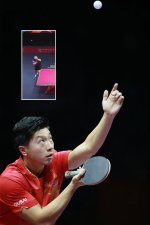
On receiving serve, why the receivers are always squatting low, eye level on the net, but when the opponent toss the ball, the receiver stand up?

If the reason is to see the ball or the contact point or the type of spin being used by the opponent, then why is that while the opponent tosses the ball, before contacting the ball to the racket, the receiver is standing already before receiving?
What's the real purpose of squatting to level the eye to the net and yet standing before the serve happens?
 
  • Like
Reactions: Lizh with skVII
This user has no status.
Member
Aug 2024
219
124
426
If someone is serving a fast long serve it's easier to counter it when being low to the table IMO. You can then raise your upper body to receive a short or half long serve as you will have time to do so. The other way around - not so much.
 
This user has no status.
I think it's mental. Get into a zone of intense focus, then letting the tension go to play with good relaxation and focus.
It's actually more of a physics thing...at least the stepping part is. Getting low allows you to anticipate the contact, and making that first step while your opponent tosses the ball up gets your body in motion and allows you to take the necessary second step to be in position for either a short serve OR a long serve.

As Fang Bo explains, you take your split step, or one tiny step forward with your right foot, then once the server hits the ball, you take your second step with your right foot to adjust for a short ball to your forehand or back. or move your left foot back to adjust to a long serve to your backhand, or you move your right foot backwards again to adjust to a long serve to your forehand. if you're standing still the whole time during the serve, you're already too late by the time your opponent hits their serve.
You need to learn the batsuju step or what they call the 'split step' in badminton, then you will understand why this is done.
exactly. its a necessary footwork to be in the best position possible to return serve. just like tennis players will split step when their opponent hits the ball (then they can quickly change direction to adjust to their opponents hit), you have to do a split step or a small step in table tennis to adjust to your opponents serve.

Its all explained here:


This is seriously one of the most valuable lessons from Fang Bo. If you're not already doing this in your serve return, you're most likely sub 1500 USATT rating. Once you start doing this, you are going to see big improvements to your serve returns simply from being in a better position to return serves.

 
This user has no status.
🏆 Top 1% Commenter
Well-Known Member
Feb 2012
2,131
1,548
4,982
Read 1 reviews
If the reason is to see the ball or the contact point or the type of spin being used by the opponent, then why is that while the opponent tosses the ball, before contacting the ball to the racket, the receiver is standing already before receiving?
What's the real purpose of squatting to level the eye to the net and yet standing before the serve happens?

the receiver is not standing up BEFORE the ball is tossed, he stands a bit up IN SYNC with the ball when toss is occured and falls down again in sync with the ball , when it is falling down before contact. The momentum helps you start your footwork like a spring. If you begin too stiff you wont be able to react fast enough. Try to do this ur self, first receive totally immobile, and then do a small hop or move your core up and down whatever suits you

It synchronizes you with the ball, gives you better understanding of the trajectory, and it gives you a momentum to start the point

There are many ways to do this, this one is the most "popular", check felix lebrun for example, he has a very unique way of doing this
 
  • Like
Reactions: Dr Evil and Tyce
This user has no status.
🏆 Top 1% Commenter
Well-Known Member
Jan 2024
2,224
2,903
6,957
Read 2 reviews
Interesting info, when I catch myself going up and down during the toss I tend to feel a bit silly, but apparently it actually makes sense! Love how sometimes people learn to do things intuitively and discover that it makes sense afterwards
 
This user has no status.
🏆 Top 1% Commenter
Well-Known Member
Feb 2012
2,131
1,548
4,982
Read 1 reviews
Interesting info, when I catch myself going up and down during the toss I tend to feel a bit silly, but apparently it actually makes sense! Love how sometimes people learn to do things intuitively and discover that it makes sense afterwards


fang bo and zhang jike when they are familiar with the opponent serve, they react/move inside the table alot before contact is made, and they rely on their very good reflexes and BH if the ball is long. Ma long has a more safe approach . In general what makes you feel comfortable, silly looking or not, most of the times is correct.

I liked to take small hops before receive too, nobody taught me that, I just felt it. The funny thing is when I started watching youtube tutorials I thought my receive was bad and I practice just to mess up something that was completely fine
 
  • Like
Reactions: UpSideDownCarl
This user has no status.
🏆 Top 1% Commenter
Active Member
Dec 2018
926
1,373
3,484
Read 1 reviews
the receiver is not standing up BEFORE the ball is tossed, he stands a bit up IN SYNC with the ball when toss is occured and falls down again in sync with the ball , when it is falling down before contact. The momentum helps you start your footwork like a spring.
This is how I was taught to do it. Keep eyes close to the level of the ball, weight up then down to pre-load your legs, start moving early and then adjust.
 
says Making a beautiful shot is most important; winning is...
🏆 Top 1% Commenter
Well-Known Member
Mar 2021
4,848
5,738
12,095
Except they are not squatted when the server contacts the ball. They stand more upright long before contact.
It's all about approximation. It cannot be last minute only move the legs. It is through experience and gut feel; once the receiver process the servers body language and other ques, he has to decide. He cannot wait until the server touch the ball with the bat only move; it will be too late. There are a lot of nuances at play here...
 
  • Like
Reactions: jbvttcc
It's actually more of a physics thing...at least the stepping part is. Getting low allows you to anticipate the contact, and making that first step while your opponent tosses the ball up gets your body in motion and allows you to take the necessary second step to be in position for either a short serve OR a long serve.

As Fang Bo explains, you take your split step, or one tiny step forward with your right foot, then once the server hits the ball, you take your second step with your right foot to adjust for a short ball to your forehand or back. or move your left foot back to adjust to a long serve to your backhand, or you move your right foot backwards again to adjust to a long serve to your forehand. if you're standing still the whole time during the serve, you're already too late by the time your opponent hits their serve.

exactly. its a necessary footwork to be in the best position possible to return serve. just like tennis players will split step when their opponent hits the ball (then they can quickly change direction to adjust to their opponents hit), you have to do a split step or a small step in table tennis to adjust to your opponents serve.

Its all explained here:


This is seriously one of the most valuable lessons from Fang Bo. If you're not already doing this in your serve return, you're most likely sub 1500 USATT rating. Once you start doing this, you are going to see big improvements to your serve returns simply from being in a better position to return serves.
Oh. I just learned this now when I watch the video. Thank you so much. Because I am so weak in receiving .maybe this is the solution..i need to practice this
 
This user has no status.
Interesting info, when I catch myself going up and down during the toss I tend to feel a bit silly, but apparently it actually makes sense! Love how sometimes people learn to do things intuitively and discover that it makes sense afterwards
wish i would have figured it out sooner haha
 
  • Like
Reactions: Tyce
This user has no status.
Oh. I just learned this now when I watch the video. Thank you so much. Because I am so weak in receiving .maybe this is the solution..i need to practice this
we are all weak haha. When I first started doing this my serve return was worse because its it takes a bit to get used to the timing, but after a few hours and a few sessions its way better and my serve return has increased exponentially.
 
This user has no status.
Active Member
Oct 2024
626
407
1,561
It's some basics in ANY sports: low stance, on your toes, to let your nerves and muscles behave like a spring indeed, in order to always go FORWARD, because you get MORE CONTROL of EVERYTHING by going FORWARD:

- football/soccer goalkeeper in penalties or penalty shoot-out: always low and making first a step forward

- volleyball on receiving opponent's serve, your shoulders are oriented FORWARD too, to get a better control (you'll never see Grebenikov, the world's best libero, with his shoulders back), low stance is prefered too, here the spring motion is intended to absorb the power of the serve, you just put your opposite knee in front of the desired direction by making a step forward : pass to the right --> left knee in front so all your body and your shoulder is oriented to the team mate you want to pass the ball to. I've been first a setter then a libero for decades in VB.
This guy has probably the best VB tutorial channel on Youtube with Jiri Popelka's

Now the new technique is to shuffle without having a step forward, but you still keep your posture low. Even if you have to make a step backward, it's in order to control FORWARD after that step, that's what he says at the end "attack the ball":
 
Last edited:
we are all weak haha. When I first started doing this my serve return was worse because its it takes a bit to get used to the timing, but after a few hours and a few sessions its way better and my serve return has increased exponentially.
I am trying this for few days. And it feels difficult for me but I think I am improving
 
This user has no status.
I am trying this for few days. And it feels difficult for me but I think I am improving
keep at it man. it will pay off. Its a rhythm and timing thing. just like how you cant learn a dance (rhythm & timing) in a day, you won't learn this skill in a day.
 
Top