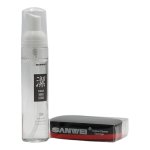
REvolution no.3 Cleaner

This user has no status.
Member
Apr 2019
30
1
50
Anyone who knows theiur stuff have any experience with it?
Specifically asking about its effects on tacky and non tacky rubber. (as i play with both).
Will I have to get a specific cleaner for the tacky or is this alright ?
Some cleaners promise crazy result and actually end up hurting the rubber in the long term (ppl think they work great cos it provides a temporary boost but the cleaner actually degrades the rubber faster) is this one of those ?

Thanks.

(Bonus q(not necessary to answer): any good reccomendations for a sponge to clean with?
 
This user has no status.
I use it to clean D09c. In my personal opinion, it should not be used frequently (I use it once every two weeks). I use BF spray cleanser for cleaning after every workout.
If anyone is wondering "why"?: I have two identical table tennis rackets ("double"), and I clean one of them with Revolution (after each practice), and the other - in the way described above. I sometimes change rackets when playing (different BH long pips). After two weeks, the rubber cleaned with Revolution cleaner became less sticky.
I think this is influenced by the fact that it is 2 in 1: a cleaner and a refresher. However, using it every two weeks, the result is excellent - it really helps maintain good rubber playing qualities.
This is my personal experience, maybe someone uses it differently, but for me this method is the best.
 
This user has no status.
Member
Mar 2024
139
161
339
that product does what it's advertises to do. it's ingredients actually make sense.
we have a very similar product which is(shameless plug) as good as this one(we are not ready for mass market yet and currently selling only locally). we couldn't find any other formula that works better than the one they use.

using your(clean) hand is actually better than a sponge, we've found. your skin's texture does a really good job collecting the unwanted particles from the rubber. if you prefer a sponge, use a sponge, $0.5 dishwashing sponges, $10 tt marketed sponges, they all work fine.
 
says rejoicing in rbpon 🆚 robipon
Member
Sep 2024
360
216
1,209
Read 2 reviews
it's ingredients actually make sense.
so which are the ingredient's?

( i use a diy'ed-70% rubbing alcohol solution and i can see how much more dirt/dust i get rubbed off from the rubber sheet than just with water . rubber stays tacky as ever . no need to use Revolution No.3 imho )
 
This user has no status.
Member
Mar 2024
139
161
339
so which are the ingredient's?

( i use a diy'ed-70% rubbing alcohol solution and i can see how much more dirt/dust i get rubbed off from the rubber sheet than just with water . rubber stays tacky as ever . no need to use Revolution No.3 imho )
:) you'll have to do your own research to find out the formula.

some of that "dirt/dust" you see coming off the tt rubber when using alcohol is actually rubber. while you can clean tt rubber with alcohol, you'll usually get less mileage out of the rubbers because you wear them out faster. some rubbers wear lose their desired properties really fast, others are less reactive to alcohol. depends on the specific type/blend of rubber is used to manufacture the tt rubber.

this does not mean you shouldn't use alcohol. if you like the results, keep using it. you'll need to replace the rubbers a tad more often compared with when using plain water or cleaners that rely on the same ingredients like the revolution cleaner for cleaning for example, but so what? there is indeed no need to use commercial cleaners. having a good quality cleaner doesn't improve your tt skills.
 
says rejoicing in rbpon 🆚 robipon
Member
Sep 2024
360
216
1,209
Read 2 reviews
while you can clean tt rubber with alcohol, you'll usually get less mileage out of the rubbers because you wear them out faster. some rubbers wear lose their desired properties really fast, others are less reactive to alcohol. depends on the specific type/blend of rubber is used to manufacture the tt rubber.
interesting, thx. i got the Revolution No.3 cleaner now too, and 2 fresh sheets of Mercury installed (which are loved for being very tacky). will use the No.3 regularly (say after 3 full training sessions), and in between only water, on the red sheet, while using alcohol on the black sheet (as a control).

from my experience, one can get 10-11 months of Mercury service life (100k+ hits), if one cleans with alcohol vigorously after every full training session (3k hits). at the 11th month the tackiness drops off abruptly, despite the use of protective foils. yinhe glue, yinhe sheets, are inexpensive on alix (trump tarriffs?), so i doht mind exchanging the sheets after ~10.5 months.

i really like rubbing alcohol as the final cleaning agent on Mercury after every full training session but it should be better to use No.3 instead. I need to learn the difference in "performance", so that, after 10 months, i can employ just 1 refined cleaning method. i would prefer to use No.3 only ... because only 3 drops are needed and it doesn't evaporate as rapidly as rubbing alcohol. let's see how my 10months-test-experiment goes stay tuna 🐟
 
This user has no status.
Member
Mar 2024
139
161
339
interesting, thx. i got the Revolution No.3 cleaner now too, and 2 fresh sheets of Mercury installed (which are loved for being very tacky). will use the No.3 regularly (say after 3 full training sessions), and in between only water, on the red sheet, while using alcohol on the black sheet (as a control).

from my experience, one can get 10-11 months of Mercury service life (100k+ hits), if one cleans with alcohol vigorously after every full training session (3k hits). at the 11th month the tackiness drops off abruptly, despite the use of protective foils. yinhe glue, yinhe sheets, are inexpensive on alix (trump tarriffs?), so i doht mind exchanging the sheets after ~10.5 months.

i really like rubbing alcohol as the final cleaning agent on Mercury after every full training session but it should be better to use No.3 instead. I need to learn the difference in "performance", so that, after 10 months, i can employ just 1 refined cleaning method. i would prefer to use No.3 only ... because only 3 drops are needed and it doesn't evaporate as rapidly as rubbing alcohol. let's see how my 10months-test-experiment goes stay tuna 🐟
rubber color plays a part in it's properties too. black rubber is made with carbon black, while red is usually made with azo dyes. they are very different substances with very different properties.

still, your approach is a decently good way of comparing the 2 cleaners.
 
  • Like
Reactions: plunder
I've used rev3 cleaner for nearly 3 years now. In that time only bought 1 bottle so it lasts a long time using a few drops per clean.

In my experience it works just fine on both tacky and non-tacky rubbers. Certainly a more straightforward experience on non tacky rubbers though. Drop on, wipe off.

I've found that you need to be a little more careful on tacky rubber if using a sponge. Because you have to rub the cleaner till it disappears, you can easily accelerate the wearing of your topsheet, as it dries quickly the sponge can start to grip and scuff the rubber. No such issues if you wipe with your hand.

I used to use rev3 after every practice but now just use it every so often, or at tournaments where I need a very quick freshen up with 1 drop and wipe off with my hand. The rest of the time I just use a small spray bottle loaded with tap water, wipe, wave to air dry and put cover sheets on tight with a roller.

For me when using rev3, best results come from using 2 drops and wiping away with my hand. Drop on and quickly spread across whole bat face, then wipe away in bigger sweeps of the hand.

If you use too much it doesn't seem to dry properly and can leave a greasy residue. If rubber is particularly dirty I'll use 3 drops then follow rev3 with water to rinse.

Rev3 is a great cleaner, but it won't make a worn out tacky rubber tacky again. But if used properly it definitely helps new tacky rubber stay tacky as far as I'm concerned.
 
  • Like
Reactions: plunder
says rejoicing in rbpon 🆚 robipon
Member
Sep 2024
360
216
1,209
Read 2 reviews
The instructions say 'use hands to rub in' or something. But then the rubber should be already clean, i.e. cleaned with water imho. What has been working well for me so far, i clean the red rubber gently with a wet sponge (and i can see the dust/dirt coming off onto the sponge), then drop 4-5 drops (instead of 2-3 drops) on the rubber and quickly disperse/rub them all over the rubber face with my index finger, and then, before the liquid evaporates (nobody wants a greasy residue film on the rubber eh?), use a silicone squeegee of top quality/perfect size to wipe the excess (liquid+dirt) off.

Since the squeegee is so effective at wiping off, basically none of the liquid stays on the rubber: the liquid had time/a chance to penetrate the rubber when i rubbed it in with the index, that's about it.

In any case, no matter which cleaning fluid or alcohol one uses, the silicone squeegee (it's very small and robust!) is imho a perfect way to clean off the rubber surface without stressing 😰 the rubber.

And today i am testing it as spreader for Yinhe glue on a blade!! (advantage: spreads evenly AND the tool stays reversibly intact (unlike a piece of foam or sponge after contact with latex glue); disadvantage: might not only spread but even take off all glue from the blade 😅)

EDIT: yikes, as a self-reminder, next time measure the weight of the blade right before applying 1 layer of glue, and then again after the 1 layer of (diluted) glue has been applied and dried. Also it helps to store the blade in the fridge, before applying the glue. The lower surface temperature gives me more time to disperse the glue evenly (with finger and squeegee). Test completed. I like the squeegee-glueing method. It works great as spreader (some practice is needed otherwise you wipe off all glue lol) also because it's 15cm wide (unlike a piece of foam).

EDIT2: i did the measurement of the glue's weight, and i am surprised. Here we go: for the thinnest 1 layer of dried latex-based glue, which one would manage to produce manually (with a piece of foam, fingas, or squeegee), the weight is 0.97g (let's round it to 1.00g). Yes, that much!! So for a full racket you'll need at least 4 layers (1 layer on either side of the blade, 1 layer on each rubber's sponge = (1+1)+(1+1) = 4), i.e. if you're using latex-based glue, you're adding a minimum of 4.0g to the racket's weight. Good to know as reference.
 
Last edited:
  • Like
Reactions: Egon
says rejoicing in rbpon 🆚 robipon
Member
Sep 2024
360
216
1,209
Read 2 reviews
(tacky = sticky = synonymous.)

hmmm :unsure: ...
As a preliminary observation, it's easy to state that the cleaner fluid has an immediate effect on the rubber or its surface, i.e. there's definitely a chemical or physical reaction happening right away.

Our long-term question should then be:
Is the result of this reaction good or bad for the tackiness, grip or performance of the rubber?

Regarding a fresh sheet of mercury, which is renowned worldwide for its tackiness, I have noticed that applying the cleaner fluid (as outlined above, with rapid rubbing-in and clearing with a squeegee) reduces its tackiness. This can easily be seen by how much force it takes to peel off the STIGA protective film (AliX item 1005007438720959). The film also indicates whether the rubber sticks to it at all. And sections of the rubber doht anymore, horror! :eek:

Maybe(?) in game play, a religiously RevNo3-treated new mercury sheet (= rubber's surface has altered and lost its "STIGA-tackiness") performs as nicely as a sticky** new mercury sheet but that's a bit hard to determine: for such a comparison test, one would need to/or be willing to ...etc... 🙃 Maybe it performs as nicely (or usefully), maybe not. Prolly not. Point being, the rubber's surface is altered and not anymore what you've originally bought: an unaltered mercury. Original, unaltered mercury is a terrific performer. Altered mercury will be a different performer. Different .. in a good way or in a bad way? Are you willing to alter a perfectly good new sheet only to find out which kind of different?

** = i succeeded in restoring (and even enhancing?) the tackiness of my new mercury sheet by having reverted to cleaning with water (every session and during a session) and water+alcohol (every 3 sessions). Using a sponge cloth, one can definitely see that the alcohol takes off residual dirt/dust which the water-only treatment didn't manage to clean off. well, i use alcohol, which is harsh, and you may prefer soapy water/foam instead, which is a totally harmless thing on rubber ask chatgpt, in any case i get up to 10-11 months of service life out of mercury with my type of cleaning treatment. personally i doht want to deal with soapy cleaners because then one ends up with a soapy film or so (residues), which asks for another cleaning with pure water. same with cleaning window glass, yeah i use soapy water to get off the bulk of the dirt but i finalize the cleaning with alcohol on a sponge cloth. everyone has a slightly different cleaning philosophy. yes, alcohol is harsh (for many/most cleaning tasks) but its cleaning result is superior. it's effortless and thorough.

A great tip:
When you cut a new rubber sheet to size, keep the leftover cuttings. They serve as reference point (for original tackiness), and can also serve for cleaner fluid tests (or glueing tests, or knife blade tests).

And my 2 bottles of RevNo3 cleaner fluid? — I am gonna use them on old rubber sheets and on leftover cuttings, on returnboards, basically for more, curious tests, but ... i am done using it on my new mercury sheets, no more!🤯 I'll keep employing my <water and water+alcohol> cleaning method, for a guaranteed 10-11 months of "STIGA-stickiness" (get the STIGA films too, if you haven't do so yet! they are thick, soft, stretchy, non-crease films, unlike foils).

 
Last edited:
  • Like
Reactions: thisisit
This user has no status.
Member
Mar 2024
139
161
339
(tacky = sticky = synonymous.)

hmmm :unsure: ...
As a preliminary observation, it's easy to state that the cleaner fluid has an immediate effect on the rubber or its surface, i.e. there's definitely a chemical or physical reaction happening right away.

Our long-term question should then be:
Is the result of this reaction good or bad for the tackiness, grip or performance of the rubber?

Regarding a fresh sheet of mercury, which is renowned worldwide for its tackiness, I have noticed that applying the cleaner fluid (as outlined above, with rapid rubbing-in and clearing with a squeegee) reduces its tackiness. This can easily be seen by how much force it takes to peel off the STIGA protective film (AliExpress item 1005007438720959). The film also indicates whether the rubber sticks to it at all.

Maybe(?) in game play, a religiously RevNo3-treated new mercury sheet (= rubber's surface has altered and lost its "STIGA-tackiness") performs as nicely as a sticky** new mercury sheet but that's a bit hard to determine: for such a comparison test, one would need to/or be willing to ...etc... 🙃

** = i succeeded in restoring (and even enhancing?) the new mercury tackiness by having reverted to cleaning with water (every session and during a session) and water+alcohol (every 3 sessions). Using a sponge cloth, one can definitely see that the alcohol takes off residual dirt/dust which the water-only treatment didn't manage to clean off. well, i use alcohol, which is harsh, and you may prefer soapy water instead, which is a totally harmless thing on rubber ask chatgpt, in any case i get up to 10-11 months of service life out of mercury with my type of cleaning treatment.

A great tip:
When you cut a new rubber sheet to size, keep the leftover cuttings. They serve as reference point (for original tackiness), and can also serve for cleaner fluid tests (or glueing tests, or knife blade tests).

And my 2 bottles of RevNo3 cleaner fluid? — I am gonna use them on old rubber sheets and on leftover cuttings, on returnboards, basically for more, curious tests, but ... i am done using it on my new mercury sheets, no more! I'll keep employing my <water and water+alcohol> cleaning method, for a guaranteed 10-11 months of STIGA-stickiness. Get the STIGA films too, if you haven't do so yet! They are thick, soft, stretchy, non-crease films, unlike foils.
great follow up!
using rubber leftovers is great way of saving $ while experimenting.
 
  • Like
Reactions: plunder
Top