
Rubber arc height and length discussion

This user has no status.
Hey guys,
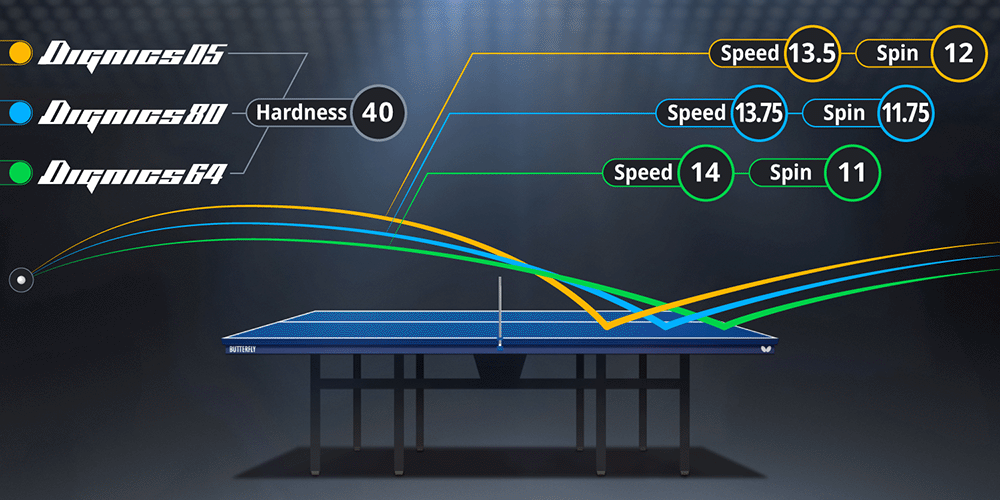
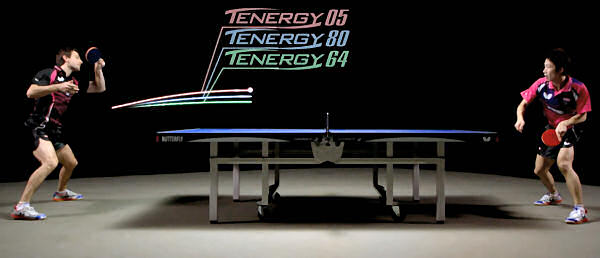
I would like to discuss the arcs (throw angles) of table tennis rubbers. Butterfly has made an image for tenergy and dignics line, showing the arc differences between 05, 80 and 64 models.
dignics-3.png

tenergy_trajectory_throw.jpg


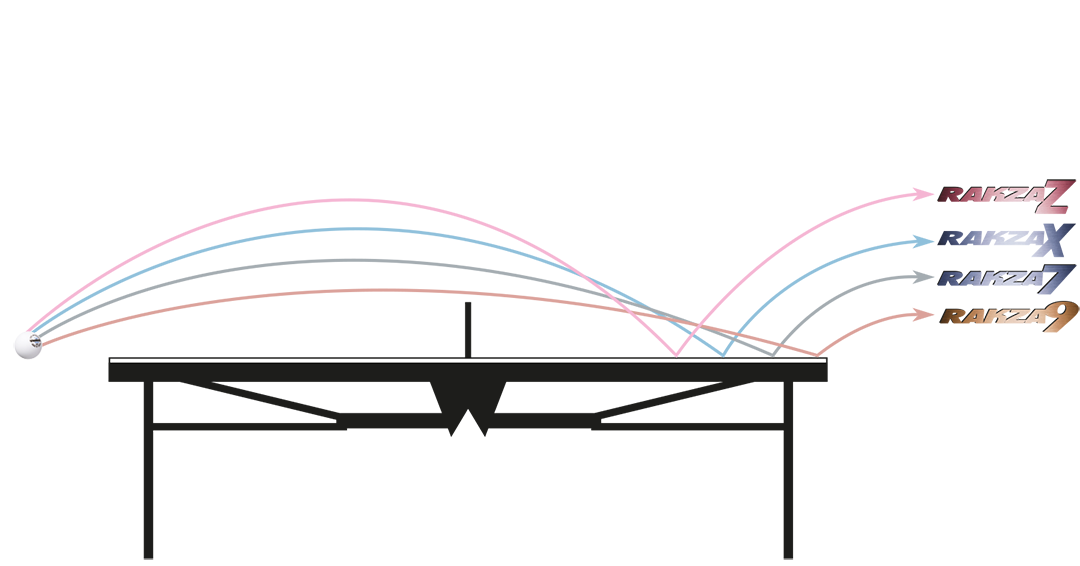
Yasaka also has this example with Rakza rubbers
Rakza%20Z%20graph%202%20white%20png.png


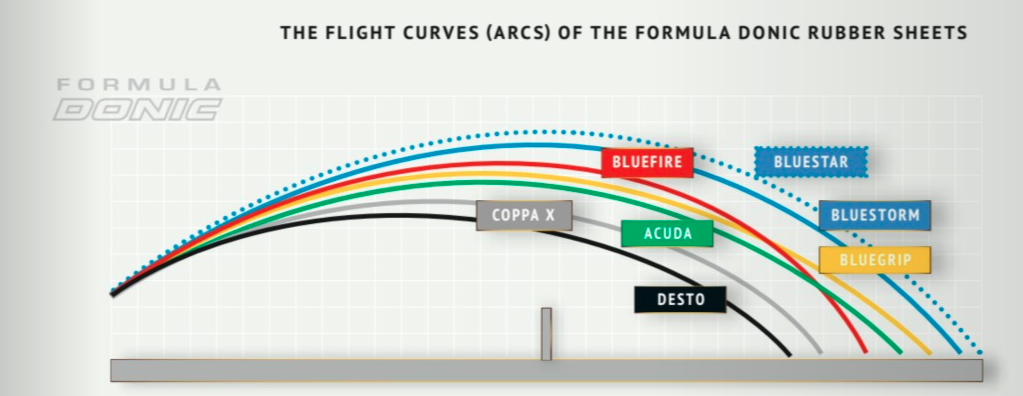
Donic has two graphs, but they show different information
belag-bluestorm-z-flugkurve.jpg

1769003110994-png.40072


From my understanding, rubbers with lower arcs are usually longer and the ones with higher arcs are shorter. Then we have rubbers like Zyre 03 that have both high arc and length.

Is it possible to choose an ideal rubber for your playstyle without having to go trough so many different models?

Both Dignics 80 and Rakza 7 are middle variants of their series, but are their arc heights similar?

Do you recommend starting off with medium throw rubbers and then pivoting based on your personal needs?

What would be a great starter rubber as benchmark? Rakza 7 perhaps?
 
This user has no status.
🏆 Top 1% Commenter
Well-Known Member
Mar 2015
1,473
1,200
4,354
Read 3 reviews
Normally it depends on the ratio of spin and speed generation response curves. A high throw rubber will generate spin easily on most contact while it's speed increase slope is flatter. You can't cheat physics, you can't generate high spin without a high arc. What we perceive as "very spinny" sometimes isn't actually very spinny, but have an uncomfortable spin/speed ratio.
 
  • Like
Reactions: Poi
This user has no status.
Member
Nov 2025
166
247
714
The graphs are a rough guide at best, but they are consistent with what most people seem to confirm anecdotally.

Tenergy 64/Rakza 9 are noticeably very fast and produce flatter shots compared to rubbers like Tenergy 05/Fastarc G1.

However there's going to be a lot of variance depending on the blade and your play level.

I agree it's reasonable to start off with fairly balanced rubbers like Rakza 7 and then evolving from there. For many people, Rakza 7 is a great rubber and suits them for many years (or forever, depending on playstyle).
 
  • Like
Reactions: Tyce
says what [IMG]
says what [IMG]
🏆 Top 1% Commenter
Well-Known Member
Feb 2016
2,562
1,566
5,267
Read 2 reviews
Throw angle is the difference between the ball's exit trajectory and the swing normal trajectory. It's related to the arc, but not really.

Arc is purely a function of the velocity and spin, but the depth and height will change based on the throw angle normalized to any given swing.

I think those example pictures are extremely exaggerated. I've never observed anything even remotely close to that.
 
says Shoo...nothing to see here. - zeio
🏆 Top 1% Commenter
Well-Known Member
Jan 2018
13,494
13,137
29,959
Hey guys,
I would like to discuss the arcs (throw angles) of table tennis rubbers. Butterfly has made an image for tenergy and dignics line, showing the arc differences between 05, 80 and 64 models.
dignics-3.png

tenergy_trajectory_throw.jpg


Yasaka also has this example with Rakza rubbers
Rakza%20Z%20graph%202%20white%20png.png


Donic has two graphs, but they show different information
belag-bluestorm-z-flugkurve.jpg

1769003110994-png.40072


From my understanding, rubbers with lower arcs are usually longer and the ones with higher arcs are shorter. Then we have rubbers like Zyre 03 that have both high arc and length.

Is it possible to choose an ideal rubber for your playstyle without having to go trough so many different models?

Both Dignics 80 and Rakza 7 are middle variants of their series, but are their arc heights similar?

Do you recommend starting off with medium throw rubbers and then pivoting based on your personal needs?

What would be a great starter rubber as benchmark? Rakza 7 perhaps?
Start with spin/relatively close to the table (05) and move either way depending if you want speed/playing farther away (64) or balance/middle-of-the-road (80).

Practically all ESN offerings are copycats of that principle.
 
This user has no status.
The graphs are a rough guide at best, but they are consistent with what most people seem to confirm anecdotally.

Tenergy 64/Rakza 9 are noticeably very fast and produce flatter shots compared to rubbers like Tenergy 05/Fastarc G1.

However there's going to be a lot of variance depending on the blade and your play level.

I agree it's reasonable to start off with fairly balanced rubbers like Rakza 7 and then evolving from there. For many people, Rakza 7 is a great rubber and suits them for many years (or forever, depending on playstyle).
Is it true that 05 is meant for close to the table, 80 mid-zone and 64 far away?
 
This user has no status.
Start with spin/relatively close to the table (05) and move either way depending if you want speed/playing farther away (64) or balance/middle-of-the-road (80).

Practically all ESN offerings are copycats of that principle.
Just out of curiousity, Zyre 03 and Dignics 64 both have long lengths, but the heights of the arcs differs. How does that affect gameplay away from the table?
 
This user has no status.
Member
Sep 2025
50
87
166
  1. In a vacuum, horizontal distance scales quadratically with speed (d ∝ v^2). 110% speed = 121% more distance.
  2. With Magnus effect from topspin, the force scales linearly with speed (F ∝ v). 110% speed = 110% more downward force. You can think of it like additional gravity (even though the direction isn't perfectly downward).
  3. Magnus effect also scales linearly with angular speed (F ∝ ω). 110% spin = 110% more downward force.
Horizontal distance scales much faster than Magnus effect. This means faster initial speed results in much wider trajectory, despite the heavier diving effect.

Side note: The above has not accounted for air drag, which is dependent on current speed. At higher speeds, distance travelled scales logarithmically with speed. Meaning more speed has diminishing returns. Visualize a ln(x) graph. It is certainly a factor given TT balls' low density, but it doesn't have a subjectively pronounced effect except when very far from the table.

Putting aside idealized physics scenarios, how does one pick equipment in practice? One key nuance is that humans can adapt. In most of the manufacturer graphics, even the initial angle is different. This makes sense! When I pick up a faster racket than I'm used to, first few balls will fly out of bounds, but then I will compensate the angle by closing the racket angle or swinging more horizontally. In short, we can make most equipment work.

However, what are the trade-offs? We know from the physics that more speed will take much more compensation. By compensating with a more closed angle, one narrows the margin of errors. A flat arc flies close to the net and lands close to the edge. These take more precision to thread the needle, but at the same time are harder for the opponent to return. One can consider this higher skill floor for higher reward.

As such, if you're being competitive and optimizing to win: find the minimum level of consistency (AKA spin, AKA arc height) that you're willing to accept, then maximize the speed while being able to maintain that consistency. It comes back to the adage: Only go as fast as your skill allows.

And if you're playing for fun, go for less speed for more back and forth. It's more fun for everyone!
 
Last edited:
  • Like
Reactions: SorryForTheEdge
Cool measurements (if true)! It's funny how everything else has units, but not the initial "power". Obviously that's not the power in physics measured in watts. Marketing department pulled additional numbers out of their butt?
Not to mention, this is the only diagram where you can "see" the player hitting it.
 
This user has no status.
Member
Nov 2025
166
247
714
Is it true that 05 is meant for close to the table, 80 mid-zone and 64 far away?
I don't think it's that cut and dry, I tend to play pretty close to the table and I prefer the 80 to the 05 on backhand.

If you like to play close to the table and punch the ball a lot, you might still like Tenergy 64.

You might also like to play further away and use the 05 to play high, spinny loops and counters.

If you are not sure, just pick something in the middle range, use it til it wears out and then see if you want more of the same, or something else.
 
says Shoo...nothing to see here. - zeio
🏆 Top 1% Commenter
Well-Known Member
Jan 2018
13,494
13,137
29,959
Just out of curiousity, Zyre 03 and Dignics 64 both have long lengths, but the heights of the arcs differs. How does that affect gameplay away from the table?
In theory, it should be easier to land your shots with Z03 when playing away from the table. In practice, it's often the other way.
 
This user has no status.
🏆 Top 1% Commenter
Well-Known Member
Mar 2023
1,254
1,155
8,201
As far as I understand, these angles largely depend on the technical parameters of the topsheet.
For example, in 64 series, pimples are much less common than in 05. Therefore, 64 series have a lower angle and feels softer having approximately the same sponge in hardness. In the 80 series, this parameter is halfway between the 64 and 05 series.
It is much easier to create spin with a thin touch with 05 topsheet, which cannot achieve with 64 topsheet. 05 topsheet is more sensitive to spin than 64 and 80 topsheets.
This Google Translate has been killing me to be honest.
 
Last edited:
This user has no status.
As far as I understand, these angles largely depend on the technical parameters of the topsheet.
For example, in 64 series, pimples are much less common than in 05. Therefore, 64 series have a lower angle and feels softer having approximately the same sponge in hardness. In the 80 series, this parameter is halfway between the 64 and 05 series.
It is much easier to create spin with a thin touch with 05 topsheet, which cannot achieve with 64 topsheet. 05 topsheet is more sensitive to spin than 64 and 80 topsheets.
This Google Translate has been killing me to be honest.
I tried D05 and D64, but not D80. Can't tell the arc height difference in gameplay, but the length difference is very noticable.
 
This user has no status.
I started with Rakza 7, best middle centre balanced do-it-all rubber if you are starting. Some say it's even too fast for a beginner so I went for 1.8mm when I started. You will find your playstyle after a while, believe me you will know what you like once you develop your technique. For me it, higher throw angles allow me to play more angles and far more safety rather than just speed. Other value more speed and getting past opponents with low angles. Both are valid approches. It's all dependent on your play style and what you enjoy.
 
This user has no status.
I started with Rakza 7, best middle centre balanced do-it-all rubber if you are starting. Some say it's even too fast for a beginner so I went for 1.8mm when I started. You will find your playstyle after a while, believe me you will know what you like once you develop your technique. For me it, higher throw angles allow me to play more angles and far more safety rather than just speed. Other value more speed and getting past opponents with low angles. Both are valid approches. It's all dependent on your play style and what you enjoy.
Have you tried different thickness of R7 later on in your career. I wonder how much 0.2 or 0.3 mm can influence the distance and height of the arc.
 
This user has no status.
Member

Sep 2021
213
191
571
There is also some blade manufacturers stating that different blade can result in the higher or lower ball arc. Namely that outer carbon has lower or flatter arc and inner carbon will have a higher safer arc. I feel this is more visible when a blade is flexible or harder. A flexible blade tends to give a higher ball arc then a harder blade with the same rubber.
 
  • Like
Reactions: barusu
Top