
To step back or not to step back…..???

says Making a beautiful shot is most important; winning is...
🏆 Top 1% Commenter
Well-Known Member
Mar 2021
4,848
5,737
12,094

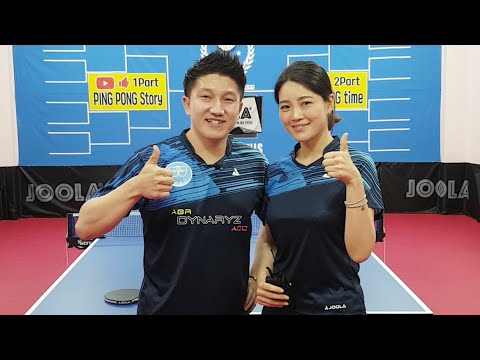
This YTuber coach recommends a slight step back after the initial open up to prepare for the second and third and fourth and so on ball…. This is also how my operating system works.

However, recently I came across a video by Global TT ( Coach Xiao Han ) who advocated not to step back; her rational? She explains that in the amateur scene, many balls come back weak an if one were to step back, they cannot reach the ball or cannot play a powerful shot.
So, one coach says A, another says B.

What sayeth fellow forumers? C / D perhaps.
 

NDH

says Spin to win!

NDH

says Spin to win!
🏆 Top 1% Commenter
Well-Known Member
Moderator
Feb 2016
1,588
2,710
4,906
Read 3 reviews
I think it all depends on the player and their ability.

Can you play attacking loop after attacking loop after attacking loop?

If so, you'll need the extra space by taking a step back.

To say that a player "can't reach" the ball (or play a powerful shot) if they have taken a step back, would indicate the ball is quite short.

Most amateurs would not be able to play an attacking powerful shot over the table anyway.

If you can.... Sure, stay in for that first attacking shot.

But if you have stepped in, played an aggressive shot, and the opponent plays it back - Are you going to be in a good position to keep attacking?

Or will you be like a fish on land..... stuck at the table, with no option but to play a weak shot back.... and then give them the chance to attack you?
 
This user has no status.
I think this is all depends on your open ups and the ability of your opponent. I do think it is a common mistake by low level players who go back and end up reaching...but at higher levels, this is less a problem. But there are plenty of lower level players that have a killer FH....so you have to play to the situation and just have the awareness to not go back if it is not needed.
 
This user has no status.
I'm a fan of GlobalTT, but also struggle with her definition of "amateur". Seems to be a wide range of players that she wants to address. As you face higher level "amateurs" the quality of their blocks requires you to have that step back. And in general it is easier to step into the table again if your see the ball is shorter, than trying to back off, once you recognize the ball is faster/longer. This is why I also disagree with her general rule of staying close to table, after your opening.
 
This user has no status.
🏆 Top 1% Commenter
Well-Known Member
Sep 2020
1,016
1,114
3,185
Read 1 reviews
It is easy:
You hit hard enough and opponent has fast equipment you step back.
You hit weak and/or opponent has slower equipment you stay closer.

Aaaaand that rule depends on many more factors. Tactics for example. If you see your opponent standing perfectly to your blocks you should block them shorter or more active to force him/her on his backfoot.

But in general both rules can apply and are not wrong.
 
This user has no status.
🏆 Top 1% Commenter
Well-Known Member
Jan 2021
3,917
2,869
8,092
Read 1 reviews
The video is so very true. It’s not only after the first ball it’s basically almost all the time. That’s one of my weaknesses. I forget to take that step many times and because almost everyone I play against give me very fast balls I end up defending. If I was positioned further back I would have time to attack.

Cheers
L-zr
 
  • Like
Reactions: victormanriquey
This user has no status.
Member
Jan 2026
461
405
1,961
I usually step back a little bit (and then stay there unless I'm under pressure) if:
- I served long, specially top/side/dead
- I pushed long on a receive
- Whenever I see the opponent trying to open the rally

And I don't step back (yet) if:
- I served short back spin, as I know mostly it gets pushed short so I need less steps to go for the flick
 
This user has no status.
Active Member
Apr 2013
710
603
1,586
Read 1 reviews
However, recently I came across a video by Global TT ( Coach Xiao Han ) who advocated not to step back; her rational? She explains that in the amateur scene, many balls come back weak an if one were to step back, they cannot reach the ball or cannot play a powerful shot.
I think this is the one that everyone should start with.

Then once you get to a certain level where your opponents start playing the ball faster and deeper you should practice stepping back after the first open-up. Or else it will be difficult keeping the pressure on you opponent after like Olav demonstrated.

One important thing to keep in mind is how you handle slower balls after you take a step back, because if you do happen to play against an opponent that doesnt give you the ball fast/and or deep enough for that distance you are screwed.
 
This user has no status.
Member
Jan 2026
461
405
1,961
I think this is the one that everyone should start with.

Then once you get to a certain level where your opponents start playing the ball faster and deeper you should practice stepping back after the first open-up. Or else it will be difficult keeping the pressure on you opponent after like Olav demonstrated.

One important thing to keep in mind is how you handle slower balls after you take a step back, because if you do happen to play against an opponent that doesnt give you the ball fast/and or deep enough for that distance you are screwed.
This is very true as well :)
 
says Making a beautiful shot is most important; winning is...
🏆 Top 1% Commenter
Well-Known Member
Mar 2021
4,848
5,737
12,094
I think this is the one that everyone should start with.

Then once you get to a certain level where your opponents start playing the ball faster and deeper you should practice stepping back after the first open-up. Or else it will be difficult keeping the pressure on you opponent after like Olav demonstrated.

One important thing to keep in mind is how you handle slower balls after you take a step back, because if you do happen to play against an opponent that doesnt give you the ball fast/and or deep enough for that distance you are screwed.
One of the difficulty I have is playing with long-pips blocker. I loop, they block short, sometimes double bounce or else half long. I step in late, can only safe push back and they counter with a fast punch to the wide FH or BH.
 
This user has no status.
Member
May 2012
101
158
321
I always coach taking this space in between as a standard and make changes from there based on what you're against. My rationale is that it is ALWAYS easier to have a little extra space/time and step into the table than it is to be too close to the ball and have to find extra space in a split second. Otherwise everyone's receive stance would be crowding over the table. And considering most players who aren't advanced snatch balls way too early way too often, it's a bit of a buffer to get them in the right direction when it comes to ball timing.
 
This user has no status.
🏆 Top 1% Commenter
Well-Known Member
Oct 2016
2,027
1,751
4,159
Better to step out:
- moves faster forward. Better to learn to step in/jump in on left leg.
- need to have body with weight forward to be able to play the stroke forward, as we need especially on topspin.
- if you are close you get on the heels and can not move well
- hopefully you get a block which you can wait at the highest point, be a bit further back so you can get body in the shot and kill it.
I do not think it makes sense to open up and then not try to play a good harder stroke on the second ball. Need to earn something on the second ball. Of couse we can open up and play second ball early with tempo but maybe not get the same advantage i think.
 
This user has no status.
Member
Sep 2025
33
43
97
Both pieces of advice can be summarized as one simple logic: if you anticipate the opponent to counter with quality, then step back to prepare.

Anticipation is about using one's head and knowing one's opponent. When Waldner successfully anticipates that a ball is coming to his FH corner, does it mean he's always waiting in his FH corner? No, right?

The logic is never "if I do step A then I always follow with step B;" instead it's "I think X is most likely so I prepare for X in this situation." The former is being predictable; the latter is being predictive.
 
Top