says
Fair Play First
2.4 APPEARANCE
The rubber surface of the racket coverings shall be
⚫ uniform
⚫ without coating
⚫ matt

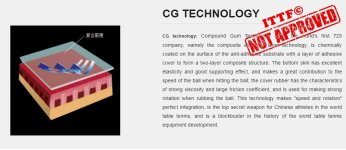
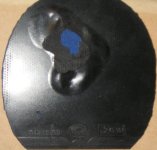
The problem is not the coating. It was added to the Technical Leaflet T4 (known as "M4: Racket Coverings" now) at a much later date (see Technical Leaflet T4 from 1/1998) after Tempest, a grippy rubber whose topsheet was composed of 2 layers (see 2nd link in my previous post for those interested) and tacky rubbers first appeared.ITTF rejected coated topsheets long moons ago. ITTF M4 document states as follows:
2 THE LAWS OF TABLE TENNIS
...
2.4 THE RACKET
...
2.4.3.2 Sandwich rubber is a single layer of cellular rubber covered with a single
outer layer of ordinary pimpled rubber, the thickness of the pimpled
rubber not being more than 2.0mm.
4. THE RACKET
4.1. The racket may be of any size, shape, or weight. Its surface shall be dark coloured and matt. The blade shall be of wood, continuous, of even thickness, flat and rigid. If the blade is covered on either side, this covering may be either—
4.1.1. of plain, ordinary pimpled rubber, with pimples outward, of a total thickness of not more than 2 mm.; or—
4.1.2. of “sandwich”, consisting of a layer of cellular rubber surfaced by plain ordinary pimpled rubber—turned outwards or inwards—in which case the total thickness of covering of either side shall not be more than 4 mm.
...
4.5.
Specification: Pimpled Rubber
A single covering with pimples evenly distributed not fewer than 10 nor more than 50 to the square centimetre (65-325 to the square inch) on rubber which, whether natural or synthetic, is non-cellular, and of which the total thickness includes the height of the pimples and adhesive.
3.4. THE RACKET
...
3.4.3. The visible surface of each side of the blade, whether used for striking the ball or not, shall be uniformly dark coloured and matt; any trimming or binding round the edge of the blade need not be of the same colour as either side, but shall not be white, yellow or brightly reflecting.
3.4.4. A side of the blade used for striking the ball may be:
3.4.4.1. uncovered, in which case the wood, if not naturally dark, shall be darkened in such· a way /as not to alter the frictional characteristics of the surface—for example', by staining and not painting—or:
3.4.4.2. covered over the whole of the striking surface with a layer of plain, ordinary, pimpled rubber, pimples outwards, having a total thickness including adhesive of not more than 2mm or:
3.4.4.3. covered over the whole of the striking surface with “sandwich” rubber, consisting of a layer of cellular rubber surfaced with plain, ordinary, pimpled rubber, pimples inwards or outwards, having a. total thickness including adhesive of not more than 4mm.
...
Specifications
3.4.6. “Pimpled rubber” is a layer of non-cellular rubber, either natural or- synthetic, with pimples evenly distributed over its surface at a density of not less than 10/sq cm and not more than 50/sq cm.
3.4.7. A “uniform” colour is one which is basically the same over the whole of a single surface; minor variations of shade, such as those due to fading or wear, may be ignored.
30

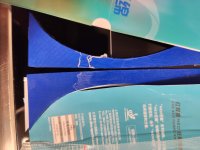
Yes, this rubber is used by all top professionals, strip all the titles now!!Two-layer topsheet. Is it legitimate?
Not at all. Production of the "sandwich topsheets" is now discontinued as a result of ITTF reiterated warning. Nevertheless, a decent number of the products still remain on market. Get alert.
View attachment 30877
View attachment 30876