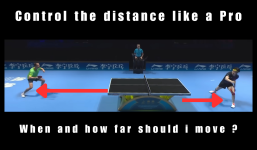

When should I back away from the table?

This user has no status.
Hello,

As the title suggests, I have a question about when to move away from the table.

As a beginner, I rarely step back more than an arm's length from the table. When my opponents repeatedly attack from their forehand to my forehand side, I often feel more successful by staying close to the table, crouching slightly in the forehand corner, anticipating where the ball will go, and blocking it back. This seems to work better for me than backing off and trying to counter-loop.

However, I suspect this may be a bad habit that provides short-term success but won't be effective in the long run as I face stronger players.

Could you give me some guidelines on how to handle this type of situation? In particular, when should I stay close to the table and block, and when should I step back and counter-loop? What are the advantages and disadvantages of each approach?

Thanks!
 
This user has no status.
Member
Feb 2024
198
249
613
There’s no golden rule as to whether or not you should fall back. Is matter of preference. However for beginners most common is to learn to stay at the table to control the game. Placement over power

That said, counter loop from far is an advanced technique you need to be able to comfortably control it during training before doing it in a match.

From far you can do fishing, slicing, flat drive or looping.
 
  • Like
Reactions: lightspin and Draf
This user has no status.
Member
Oct 2023
76
118
436
Read 1 reviews
Forget about counter-looping for now (that's advance level stuff, not even intermediate level), focus on control, consistency and footwork.

Learn to move in and out. At lower levels, nobody can spin the ball really well or add power to their shots so it's more rewarding to stay close to the table and just block everything back. But once you level up, staying close becomes harder and harder and you'll be more under pressure.

Also, your setup doesn't excel close to the table, so just try to take a step back but be ready to move close to the table when needed. That also means don't go too far back, stand somewhere that you can get to the table relatively easily when you need to.

That way you can still block, but also you have room to add a bit more quality to your shots (spin/power).
 
  • Like
Reactions: kindof99 and Draf
This user has no status.
🏆 Top 1% Commenter
Well-Known Member
Jan 2024
2,518
3,400
8,072
Read 7 reviews
Staying at the table is definitely not a bad habit! As you back away from the table, the wide angles make for much more ground to cover. So unless you can force your opponent in playing a narrow angle of your choosing, stepping further back is a disadvantage.

In my limited experience, it's harder to learn to stick to the table if you're used to backing off, than it is to learn to back off a step when you're used to staying close.
 
This user has no status.
🏆 Top 1% Commenter
Well-Known Member
Jan 2021
3,995
2,937
8,274
Read 1 reviews
Hello,

As the title suggests, I have a question about when to move away from the table.

As a beginner, I rarely step back more than an arm's length from the table. When my opponents repeatedly attack from their forehand to my forehand side, I often feel more successful by staying close to the table, crouching slightly in the forehand corner, anticipating where the ball will go, and blocking it back. This seems to work better for me than backing off and trying to counter-loop.

However, I suspect this may be a bad habit that provides short-term success but won't be effective in the long run as I face stronger players.

Could you give me some guidelines on how to handle this type of situation? In particular, when should I stay close to the table and block, and when should I step back and counter-loop? What are the advantages and disadvantages of each approach?

Thanks!
- Every time you hit a hard long ball.
- Every time you hit a long serve.
- In short every time you expect to get a hard ball back.
- Also try getting used to a serve receive position a little further back than an arms length.
Its always easier to move forward than to move back.

Cheers
L-zr
 
This user has no status.
Member
Nov 2025
224
336
968
Once a topspin rally starts I try to have at least enough room to block or counter loops that land deep on the table.

That's generally 1-3 steps back, depending how much speed and spin the other player tends to play with.

After you serve or play a loop, you should expect some pace or topspin in the return and give at least a step or two. Beyond that, really depends on the matchup and the situation. Some players I will deliberately play close and block because they struggle against it, others I will give up space and play spinny loops. It's good to be comfortable doing both, so you can use the best tool against your opponent, or even just to change up the rhythm of your rallies to force errors.
 
says what [IMG]
says what [IMG]
🏆 Top 1% Commenter
Well-Known Member
Feb 2016
2,756
1,710
5,662
Read 2 reviews
A lot of people are saying to step back against offensive shots and I agree with that, but I don't see anyone saying why exactly.

Apart from just having more time when stepping back, one thing that has helped me is to consider where the apex of the ball path is. If it's behind me I can literally only take the ball on the rise, which is very difficult for me sometimes. I noticed also it's very difficult to judge the landing point of the incoming ball if you're very close to where it will be.
 
This user has no status.
Member

Feb 2024
198
249
613
In reality you need to back off before you know if your opponent is going to play an offensive shot, because if you are close to the table you won't have time to adjust after the bounce of a deep offensive shot. (Or even a fast long push)

Another reason you hear often, if the ball lands short or half long you move into the table which is substantially easier than falling back.
 

NDH

says Spin to win!

NDH

says Spin to win!
🏆 Top 1% Commenter
Well-Known Member
Moderator
Feb 2016
1,632
2,924
5,225
Read 3 reviews
Could you give me some guidelines on how to handle this type of situation? In particular, when should I stay close to the table and block, and when should I step back and counter-loop? What are the advantages and disadvantages of each approach?
This will change as you improve.

The harsh reality of amateur table tennis (99.999% of this forum) is that *hardly* anyone is consistent when it comes to counter looping away from the table in a match.

You may see it on YouTube, either Pro's or channels like TTD, but the "away from the table counter looping" style is incredibly advanced.

The other issue less advanced players have is that whilst you might be competent in stepping away and counter looping.... The chances of you having to play more than 2 shots in a row is slim - So you just don't get the consistency.

In your position, as a beginner, I'd work on being aggressive (if you are an attacker), which will put the opponent on the back foot.

When they get in first, try and contain as much as you can by blocking, and if you see an opportunity to counter - Take it.

Do all of the "away from the table" stuff in training and coaching.
 
says One pound of practice is worth more than thousand pounds...
Active Member
Aug 2013
530
395
1,543
Read 3 reviews
The distance from the table is also dependent on the player's height and his or her physiology. If you are tall or have long arms, your terminology of 'far' and 'near' will be different from what a 8-10 years old will generally perceive. Additionally, how much you bend your torso and keep your center of gravity lower also makes a huge difference.
I feel a good starting point is to keep a relaxed arm distance from the table and bend your upper torso and bring you center of gravity on your toes. Once you do this, you can see that the distance which you measured with your hand earlier has now changed.
If you are older player, and have vision issues or slow reflexes then you need to formulate your distance and game plan accordingly. There is no point in following standard advice if it only leads to frustration and confusion.
 
  • Like
Reactions: kindof99
This user has no status.
🏆 Top 1% Commenter
Well-Known Member
Moderator
Oct 2014
20,847
27,591
73,576
Read 17 reviews
Hello,

As the title suggests, I have a question about when to move away from the table.

As a beginner, I rarely step back more than an arm's length from the table. When my opponents repeatedly attack from their forehand to my forehand side, I often feel more successful by staying close to the table, crouching slightly in the forehand corner, anticipating where the ball will go, and blocking it back. This seems to work better for me than backing off and trying to counter-loop.

However, I suspect this may be a bad habit that provides short-term success but won't be effective in the long run as I face stronger players.

Could you give me some guidelines on how to handle this type of situation? In particular, when should I stay close to the table and block, and when should I step back and counter-loop? What are the advantages and disadvantages of each approach?

Thanks!
Not that you should copy me, but I am above average in height and I have never seriously learned to back off the table and am often caught at the table blocking and countering under pressure. I have tried to get slightly better at taking steps backwards but in the end, I find that the lower hanging fruit for most players is to get much more effective in serve and attack and receive to anticipate 4th ball. Those things tend to make stepping back more natural. You can step back after a fast quality long topspin serve if the serve makes down the line placement more difficult so you can anticipate the returh. IF you serve spins that are hard to keep short ( no spin and topspin), you can often step back slightly anticipating that you can step back into the table for popups. But stepping back all by itself without making it a function of the kind off play you are forcing on your opponent with your serve or receive I think is very artificial. Of course, your opponent may also force it on you. And there is some benefit if you are low enough to being able to play quality shots when the ball is bellow net height and above table height but long if you are a powerful player. But in the end, if you are a player who forces the play on the opponent. stepping back is not your priority as much as handling the play as it evolves.
 
  • Like
Reactions: kindof99
This user has no status.
Member
May 2017
303
452
1,596
Some players have made it their personal style to back off the table. You might just experiment to find out what works for you. Do you prefer to loop closer or further away from the table? Are you fast enough to handle fast shots coming at you when you are close to the table? If you are quick, you might want to stay closer in general. If you have a higher top speed when moving but aren't quick, then maybe further away is best. I know that professional players will change their distance during a match to disrupt their opponents timing.

Personally, I stay 1 step away when the ball is in underspin mode, then after the first loop I jump back a step or two. Some coaches have said I needed to back up even further and they were probably correct. Experiment and find out what works for you.
 
says Making a beautiful shot is most important; winning is...
🏆 Top 1% Commenter
Well-Known Member
Mar 2021
4,923
5,874
12,330
Hello,

As the title suggests, I have a question about when to move away from the table.

As a beginner, I rarely step back more than an arm's length from the table. When my opponents repeatedly attack from their forehand to my forehand side, I often feel more successful by staying close to the table, crouching slightly in the forehand corner, anticipating where the ball will go, and blocking it back. This seems to work better for me than backing off and trying to counter-loop.

However, I suspect this may be a bad habit that provides short-term success but won't be effective in the long run as I face stronger players.

Could you give me some guidelines on how to handle this type of situation? In particular, when should I stay close to the table and block, and when should I step back and counter-loop? What are the advantages and disadvantages of each approach?

Thanks!

Q: When should back away from table
A1: when you are preparing to counter-loop or counter-drive.
A2: After opening loop, opponent blocks the ball will come back with a lot of spin that was generated by your good self. You must back up to drive and if you don’t the ball kicks up and will mess your timing and contact and the ball will fly long.
A3: You are playing mostly offensive you need the distance to initiate proper kinetic chain or in simple english, give you more time to load your stroke.
 
Top