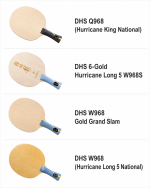
Blade sealing w968 help

says Table Tennis - the sport for life.
Member
Jan 2013
413
448
1,980
Many blades splinter easily after the first removal, even when glued with proper glue. Think of the Stiga allround or offensive classic, if you don't seal those you'll peal off splinters after the first or second removal.
The polyurethane sealers are the best, but even the table tennis ones provide decent protection. If you only put on a single thin layer, I doubt many will feel any difference. Many blades come sealed from the factory, so there's nothing inherently wrong with sealing a blade.
 
  • Like
Reactions: riemsesy
This user has no status.
Member
Aug 2021
329
318
699
Read 1 reviews
Better seal than sorry. That was my motto, until I bought Acoustic and Violin (many many years ago during the Violin and Acoustic craze).

At first I hesitated to seal those 2 blades. In the end, I sealed my Acoustic but did not seal my Violin. My Violin is intact, because the outer ply is quite hard. But for Acoustic, I was afraid that I was going to lose the special feeling. It turns out that I am not a Pro who can really feel subtle differences in feel. So when I sealed my Acoustic thinly, I did not feel any differences.

When I store those 2 blades for a long time, I notice that the sealed one (Acoustic) still has smooth surface. For Violin, it is still smooth but I see several yellowish spots, which I think caused by fungus or something like that. So I think sealing your blade does not only prevent splinters, but also protect the surface from fungus (or other things that form yellowish spots).
 
This user has no status.
Member
Feb 2017
28
32
93
These are such high quality pieces of wood. You can feel it when you first hold it in your hands. I would not worry about it splintering and would not seal it.
 
says Spin and more spin.
🏆 Top 1% Commenter
Well-Known Member
Moderator
Dec 2010
16,640
18,534
56,964
Read 11 reviews
Minwax Wipe On Poly is what I would use. I would use the oil based version:

In USA you can find it in any hardware store.

Screenshot 2024-11-19 at 4.07.37 AM.png


Screenshot 2024-11-19 at 3.55.28 AM.png


You can also find this on line at Ace Hardware Store, Amazon, Walmart and plenty of other places. All you need is a pint and you could probably seal 200-300 blades with one pint.

I would not use water based because, if part of the point of sealing is that you are protecting the wood from water damage (not just splintering)....water damage from water based glue....then why on earth would you use water in your sealant.

This is designed to seal wood. It is designed to be rubbed on with a cloth so you can put a VERY VERY thin layer and get FULL coverage. You don't need more than one thin layer.

You don't have to seal. If you are using a blade with a Koto top ply like ScrubPlayer, then there is no need to seal. If you are using a blade with a Limba top ply like the W968, then this would protect against splinters. If you are using any blade and wanted to protect from water (from the glue) seeping into the wood, then this will protect against that as well.

But it is a preference. You can seal. You can not seal. And if you are using a blade with a Limba top ply, one of the reasons to seal would be to protect against splintering while protecting against water.
 
Minwax Wipe On Poly is what I would use. I would use the oil based version:

In USA you can find it in any hardware store.

View attachment 33209

View attachment 33210

You can also find this on line at Ace Hardware Store, Amazon, Walmart and plenty of other places. All you need is a pint and you could probably seal 200-300 blades with one pint.

I would not use water based because, if part of the point of sealing is that you are protecting the wood from water damage (not just splintering)....water damage from water based glue....then why on earth would you use water in your sealant.

This is designed to seal wood. It is designed to be rubbed on with a cloth so you can put a VERY VERY thin layer and get FULL coverage. You don't need more than one thin layer.

You don't have to seal. If you are using a blade with a Koto top ply like ScrubPlayer, then there is no need to seal. If you are using a blade with a Limba top ply like the W968, then this would protect against splinters. If you are using any blade and wanted to protect from water (from the glue) seeping into the wood, then this will protect against that as well.

But it is a preference. You can seal. You can not seal. And if you are using a blade with a Limba top ply, one of the reasons to seal would be to protect against splintering while protecting against water.
Yeah a lot of people recommend this, from your experience did you notice any change in playing characteristics?
 
says my wife is better married than me.
Member
Nov 2024
307
215
578
Which blade sealant is the best?
I use the one from Joola (but I don't know if that is the best) and I am sealing all of my blades. I am not sure I personally would feel a difference with a blade sealed vs. non-sealed if I put 2 layers of glue on the blade and 3 layers of glue on the rubber.
 
  • Like
Reactions: Charlesmorris
This user has no status.
🏆 Top 1% Commenter
Well-Known Member
Oct 2018
1,686
2,055
4,220
On my W968 prov I did use sealing in the end since I had the splintering issue. Not huge splinters but these little hair splinters, but it is annoying and I don't want my racket to shed. I used the DHS sealer since I assumed it is probably the best for limba as most DHS blades use the soft limba outer ply. Also since I use Chinese glues that are similar to No15 or just straight out DHS No15 I assumed it will stick to this sealer reasonably. Not sure about the sticking part so in the end I sanded the sealer off almost completely and I don't have any splintering issues anymore this way either.

Also when I used the sealer I spread it on the blade with the little brush it came with and after completely spreading it I waited a few minutes and I wiped off the excess with a tissue.

If I have to be honest the Donic Formula or Xiom i-Sure sealers look more convenient and maybe better option but for me the DHS worked out pretty well in the end.
I don't like sealing at all and would not do it if my blade didn't splinter.

What Chinese players do is that they have the old style VOC glue (Haifu) and put a layer on the blade directly then on top they put a layer of water based glue. I think this is probably the best solution if you don't play official matches where your racket is tested for VOC.

I think another solution is tho make sure you don't glue too often. If you swap rubbers often the wood will soak in too much water and become soft. Dry wood is much harder than wet. Just try chopping wet and dry wood and you will know. BTW chopping wood is a pretty good table tennis exercise to make sure to learn how to concentrate your power in one quick swing.
 
On my W968 prov I did use sealing in the end since I had the splintering issue. Not huge splinters but these little hair splinters, but it is annoying and I don't want my racket to shed. I used the DHS sealer since I assumed it is probably the best for limba as most DHS blades use the soft limba outer ply. Also since I use Chinese glues that are similar to No15 or just straight out DHS No15 I assumed it will stick to this sealer reasonably. Not sure about the sticking part so in the end I sanded the sealer off almost completely and I don't have any splintering issues anymore this way either.

Also when I used the sealer I spread it on the blade with the little brush it came with and after completely spreading it I waited a few minutes and I wiped off the excess with a tissue.

If I have to be honest the Donic Formula or Xiom i-Sure sealers look more convenient and maybe better option but for me the DHS worked out pretty well in the end.
I don't like sealing at all and would not do it if my blade didn't splinter.

What Chinese players do is that they have the old style VOC glue (Haifu) and put a layer on the blade directly then on top they put a layer of water based glue. I think this is probably the best solution if you don't play official matches where your racket is tested for VOC.

I think another solution is tho make sure you don't glue too often. If you swap rubbers often the wood will soak in too much water and become soft. Dry wood is much harder than wet. Just try chopping wet and dry wood and you will know. BTW chopping wood is a pretty good table tennis exercise to make sure to learn how to concentrate your power in one quick swing.
Hi Zwill,

Appreciate all the info! Issue is I’m boosting every 6-8 weeks on Neo 3 rubbers. Two table tennis companies I contacted said they either use the donic (TT11) or Xiom (customTT) sealer so I don’t think there’s gonna be much difference in either one. However similar thought process I bought the dhs protective coating as I assumed this should be made for their blades.

I’ve got two unsealed fan zhendong alc blades so I’m going to run a test with my robot. First test with an unsealed alc vs min wax poly alc and see how the difference is. Then a dhs protective coating sealed alc vs the min wax poly alc. This should give me a good idea which one id prefer to use on the national player w968 on the way.

Charles
 
This user has no status.
Active Member
Sep 2023
764
607
2,963
I would not use water based because, if part of the point of sealing is that you are protecting the wood from water damage (not just splintering)....water damage from water based glue....then why on earth would you use water in your sealant.
because it isn't enough water to penetrate the wood and it eveporates very quickly before it could have any negative effect. the water based poly urethane laquers are quite safe for wood.
do I would love that minwax product.. maybe its available in NL / EU
What Chinese players do is that they have the old style VOC glue (Haifu) and put a layer on the blade directly then on top they put a layer of water based glue. I think this is probably the best solution if you don't play official matches where your racket is tested for VOC.
indeed, like this
works just as well
 
because it isn't enough water to penetrate the wood and it eveporates very quickly before it could have any negative effect. the water based poly urethane laquers are quite safe for wood.
do I would love that minwax product.. maybe its available in NL / EU

indeed, like this
works just as well
Hello,

How do you seal your blades? If you’re saying the water based poly is ok seems you have experience.

How does this Haifu glue prevent splintering on the blade? Seems a good option if it means I don’t need to seal.

I can see two available on prott, whale 2 speed glue and dolphin 2 speed glue, do you know the difference between them?

Charles
 
Hello,

How do you seal your blades? If you’re saying the water based poly is ok seems you have experience.

How does this Haifu glue prevent splintering on the blade? Seems a good option if it means I don’t need to seal.

I can see two available on prott, whale 2 speed glue and dolphin 2 speed glue, do you know the difference between them?

Charles
Didn’t take me long to find what wakkibatty said on using VOCs glue, seems like a knowledgeable person so I’m going to pass on that https://www.tabletennisdaily.com/forum/topics/which-glue-is-more-safe-for-the-wood.31396/
 
This user has no status.
Active Member
Sep 2023
764
607
2,963
yes.. he 's right.. though, more of a problem imho in the time when players reglued their rubbers between matches.
I have a bottle of this too and I use it where there is enough wind.
but
this is a nice vid about sealing with the stuff @UpSideDownCarl mentioned..
personally I wouldn't seal the handle

edit 🤦🏻‍♂️
add the vid ( think this person works at nasa)
 
Last edited:
This user has no status.
Plebs. Don't seal. It splinter because when you push you hit the blade on the table. Just sand it smooth when you change rubber and you are good to go. If the splinter is unavoidable, peel that wood off and fix it with wood filler
You are free to ruin your blades!
 
  • Like
Reactions: riemsesy
This user has no status.
I recommend sealing every blade with soft top ply (spruce, Limba, abachi, koto).
I would use water based lacquer, spread it evenly with a sponge (you can use the sponge for the glue) and then wipe it of after 10 seconds with a cotton cloth.
With this procedure you only seal the very top of the top ply as it can't penetrate that deep in just 10 seconds.
Just my 2 cents...
 
  • Like
Reactions: riemsesy
says Spin and more spin.
🏆 Top 1% Commenter
Well-Known Member
Moderator
Dec 2010
16,640
18,534
56,964
Read 11 reviews
because it isn't enough water to penetrate the wood and it eveporates very quickly before it could have any negative effect. the water based poly urethane laquers are quite safe for wood.
do I would love that minwax product.. maybe its available in NL / EU

Would you take a damp sponge and brush it across the blade face so you got a tiny layer of water on your blade? Would you do that on purpose?

I see no reason to do that ever. Especially when the only thing that is INCONVENIENT about the OIL BASED product is that it takes a little longer to dry. I can wait 12 hours for the sealant to dry. And I feel like the original oil based versions actually work better.

The water based products are "cool" and interesting from a science standpoint. Once the product is dried it is no longer water soluble or it would not seal the wood against water penetration. What they have done is a chemical process that makes it so they can suspend the Polyurethane in the water and once the water dries it is no longer water soluble.

If there was something that showed me that that process made the polyurethane better or stronger, I would be okay with it. But I would still rather have the polyurethane disolved in a chemical that actually is a solvent for the substance rather than one that really isn't. And the oils that are solvents for the poly are 100% fine for the wood. Whereas, regardless of what you say, water is not so great for wood.

So, it is fine if you like waterbased sealant. But those are my reasons for not wanting to use them on wood even if I think the science behind them is pretty interesting.

BTW: if you use water based glue on a raw wood blade (no sealant), the blade will, over the course of several rubber changes and re-gluing the rubbers onto the blade multiple times, the blade will start feeling duller and will start playing slower.

So the people talking about how sealing a blade will change the feel are neglecting the fact that NOT sealing the blade and gluing rubbers on with glue that is "dissolved" in water, (similar chemical process - those glues are not water soluble after they dry) will also affect how the blade plays. And in the long run, gluing with water based glue will impact how the blade feels much more over time than using a sealant will.

Another detail that should be looked at: if sealing the blade changes how the blade feels, does it:
a) make the blade feel BETTER.
b) make the blade feel WORSE.
c) make the blade feel a tiny bit different but not really better or worse.

And if you put one really thin layer of sealant on a blade, would anyone on this forum really be able to feel the difference? The thicker the layer of sealant, the more it will change the way the blade feels.

But something to note: Stiga has a set of blades with what they call NCT coating which is basically a THICK layer of sealant that makes the blade feel a little harder, and a little crisper. Those NCT blades feel great. Did the sealant make the blade feel better or worse? :)

Really, each person would feel something different so, it depends on your perception. Some may feel the blade feels better after sealing. Others, the opposite. But most won't even be able to tell the difference.

 
  • Like
Reactions: Charlesmorris
says Spin and more spin.
🏆 Top 1% Commenter
Well-Known Member
Moderator
Dec 2010
16,640
18,534
56,964
Read 11 reviews
personally I wouldn't seal the handle

I fully agree with this. I have played with a few blades where the handle was sealed and it makes the handle slippery and to me, it made the handle feel awful.

But everyone is different. I know people who like having their handle sealed because, then it stays looking clean and new.

I don't care much about how it looks. I care much more about how the handle feels. And raw wood feels much better in my hand than polyurethane or tape. :)
 
Would you take a damp sponge and brush it across the blade face so you got a tiny layer of water on your blade? Would you do that on purpose?

I see no reason to do that ever. Especially when the only thing that is INCONVENIENT about the OIL BASED product is that it takes a little longer to dry. I can wait 12 hours for the sealant to dry. And I feel like the original oil based versions actually work better.

The water based products are "cool" and interesting from a science standpoint. Once the product is dried it is no longer water soluble or it would not seal the wood against water penetration. What they have done is a chemical process that makes it so they can suspend the Polyurethane in the water and once the water dries it is no longer water soluble.

If there was something that showed me that that process made the polyurethane better or stronger, I would be okay with it. But I would still rather have the polyurethane disolved in a chemical that actually is a solvent for the substance rather than one that really isn't. And the oils that are solvents for the poly are 100% fine for the wood. Whereas, regardless of what you say, water is not so great for wood.

So, it is fine if you like waterbased sealant. But those are my reasons for not wanting to use them on wood even if I think the science behind them is pretty interesting.

BTW: if you use water based glue on a raw wood blade (no sealant), the blade will, over the course of several rubber changes and re-gluing the rubbers onto the blade multiple times, the blade will start feeling duller and will start playing slower.

So the people talking about how sealing a blade will change the feel are neglecting the fact that NOT sealing the blade and gluing rubbers on with glue that is "dissolved" in water, (similar chemical process - those glues are not water soluble after they dry) will also affect how the blade plays. And in the long run, gluing with water based glue will impact how the blade feels much more over time than using a sealant will.

Another detail that should be looked at: if sealing the blade changes how the blade feels, does it:
a) make the blade feel BETTER.
b) make the blade feel WORSE.
c) make the blade feel a tiny bit different but not really better or worse.

And if you put one really thin layer of sealant on a blade, would anyone on this forum really be able to feel the difference? The thicker the layer of sealant, the more it will change the way the blade feels.

But something to note: Stiga has a set of blades with what they call NCT coating which is basically a THICK layer of sealant that makes the blade feel a little harder, and a little crisper. Those NCT blades feel great. Did the sealant make the blade feel better or worse? :)

Really, each person would feel something different so, it depends on your perception. Some may feel the blade feels better after sealing. Others, the opposite. But most won't even be able to tell the difference.

Really appreciate the knowledge and wisdom here, I’ve got Minwax poly oil warm satin on the way same as picture! I noticed there’s different types - warm gloss, warm satin or clear gloss, does this matter?
 
This user has no status.
🏆 Top 1% Commenter
Well-Known Member
Nov 2022
2,022
3,248
7,959
Minwax Wipe On Poly is what I would use. I would use the oil based version:

In USA you can find it in any hardware store.

View attachment 33209

View attachment 33210

You can also find this on line at Ace Hardware Store, Amazon, Walmart and plenty of other places. All you need is a pint and you could probably seal 200-300 blades with one pint.

I would not use water based because, if part of the point of sealing is that you are protecting the wood from water damage (not just splintering)....water damage from water based glue....then why on earth would you use water in your sealant.

This is designed to seal wood. It is designed to be rubbed on with a cloth so you can put a VERY VERY thin layer and get FULL coverage. You don't need more than one thin layer.

You don't have to seal. If you are using a blade with a Koto top ply like ScrubPlayer, then there is no need to seal. If you are using a blade with a Limba top ply like the W968, then this would protect against splinters. If you are using any blade and wanted to protect from water (from the glue) seeping into the wood, then this will protect against that as well.

But it is a preference. You can seal. You can not seal. And if you are using a blade with a Limba top ply, one of the reasons to seal would be to protect against splintering while protecting against water.
Huge fan of wipe on poly.

But a few things I disagree with here. Water based wipe on poly water evaporates in like a few minutes, that's kinda the point of it. So I don't think there's a problem there. If you're fine with much more grams of water entering a blade over the course of hours through humidity and sweat on an unsealed blade, then a few minutes on a blade face should be a few orders of magnitude less harmful.

Also, the only time I left a blade unsealed was because it was koto because I thought harder plies wouldn't splinter. Well, it splintered on the first rubber change. I no longer believe koto is safe from splintering. If the grains are aligned with the direction you're pulling the rubber, and the wood already had poor density for some reason, it will splinter.
 
This user has no status.
🏆 Top 1% Commenter
Well-Known Member
Nov 2022
2,022
3,248
7,959
Really appreciate the knowledge and wisdom here, I’ve got Minwax poly oil warm satin on the way same as picture! I noticed there’s different types - warm gloss, warm satin or clear gloss, does this matter?
It just changes the color of the wood somewhat. Warm means it'll turn the wood a bit yellowish, like a very light wood stain.

I just get the clear because I don't want to change the look of the blade.
 
  • Like
Reactions: Charlesmorris
Top