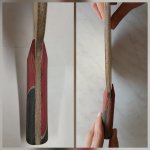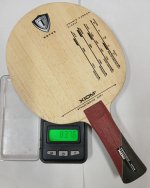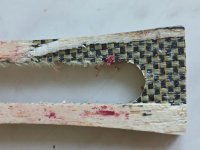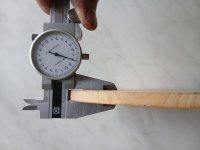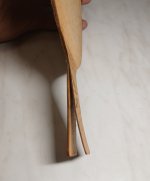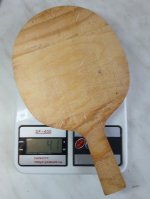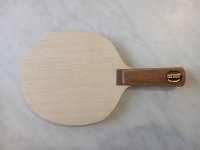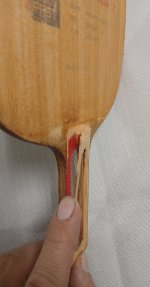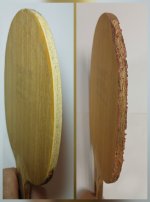


The inside view, design, and construction of factory blades that come to us for repair

This user has no status.
🏆 Top 1% Commenter
Well-Known Member
Mar 2023
1,090
1,060
7,515
From my experience, just removing the edges below the chord makes the blade 20Hz slower and a little more flexible. Other solutions are change of the handle, like Victas Award Offensive or cutting channels above the handle, like Yasaka Gatien Extra 3D. Award Offensive handle change one of my blades from 1200Hz to 1050Hz, was too much flex, but fun to play.
The frequency changes as the blade size changes. As the blade size decreases, the frequency increases. By the way, the speed in the game also increases, but control (may the BrokenBall forgive me), in my opinion, decreases.
 
This user has no status.
🏆 Top 1% Commenter
Well-Known Member
Jan 2021
3,917
2,869
8,092
Read 1 reviews
The frequency changes as the blade size changes. As the blade size decreases, the frequency increases. By the way, the speed in the game also increases, but control (may the BrokenBall forgive me), in my opinion, decreases.
BB has been gone for ages, but I hear Your concern... Do not wake the sleeping tiger....

Cheers
L-zr
 
  • Haha
Reactions: H3R0 and Egon
This user has no status.
Member
Jun 2025
196
203
583
The frequency changes as the blade size changes. As the blade size decreases, the frequency increases. By the way, the speed in the game also increases, but control (may the BrokenBall forgive me), in my opinion, decreases.
I agree but will add some thoughts.

Blade frequency is related to speed and stiffness but can be misleading when it is used for comparison of blades with different mass and dimensions. Type of wood can affect blade behavior as well, carbon layers, etc. Just frequency can be useful to trace changes in the same blade (signs for delamination, moisture, glue degradation) or rough comparison of blades with similar composition.

The logic behind blade frequency is basic physics - mechanical resonance, related to elasticity and mass. Heavy and flexible blades will have lower frequency. Change of the blade dimensions affect both variables. Some examples: the reduction of Sword Razor head from 165x155 to 160x155mm, increase frequency from 1160 to 1190Hz. Removing wood edges below the chord adds 20Hz more with loss of unsignificant weight. Above the handle is where most of the bending happens. So, removing wood around that area will impact blade stiffness and frequency more.

Blade control is something subjective and depends on rubbers and play style. Stiffer blade is bad for looping, but is good for blocking and smashing. Heavy blade provide more stability but require more physical effort.
 
Last edited:
  • Like
Reactions: sebi, H3R0 and Egon
This user has no status.
🏆 Top 1% Commenter
Well-Known Member
Mar 2023
1,090
1,060
7,515
I like this data you're gathering @Egon . Interesting to see how blades that even cost a few hundred dollars are not immune to variations in their blades. Have you worked on OSP or Nittaku (instrument line) blades and were there also variations like youre seeing on butterfly and DHS high end blades?
OSP blades has never been sent for repairs, Nittaku blades have been sent, but of different types, so there are no statistics yet. I was surprised by the Xiom Stradivarius blade, which I plan to write about soon.
 
says Table tennis clown
🏆 Top 1% Commenter
Well-Known Member
Apr 2020
4,666
2,963
10,850
Now you know what to do ))
Brutalizing blades with a dremel is nothing new for me but i never had this invaluable information before. Just for the general amusement this pic shows a blade i really like but it never quite fitted my small hand. Now it does 😂 P.S you are looking at FH and i am a lefty)
1772616210896.jpeg
 
  • Like
Reactions: Egon
This user has no status.
🏆 Top 1% Commenter
Well-Known Member
Mar 2023
1,090
1,060
7,515
I don't know why, but we used to think of the Xiom Stradivarius as a budget alternative to the Viscaria. After repairs, it turned out they're completely different blades.
The first difference is the cavities in the handles and blade itself. The second difference is the completely different fiber, in which the aramid fibers are arranged longitudinally and the carbon fibers are transversely. The third difference is the very large chord – 92 mm. And the fourth difference is the very hard glue used to attach the handles. Often, to remove the handles, we use heat, a utility knife, and patience. This time, heat didn't help at all; my patience was running out, and the handles still wouldn't budge. In the end, I won this battle, but I came away completely exhausted :LOL:
Blade Parameters:.
Head Size - 149х157 mm
Weight - 84 grams
Thickness - 5.9 mm
Chord - 92 mm!
Handle - Fl 100,6 mm in length, there are cavities in the handle and blade itself
Frequency after repair - 1523 Hz
Balance after repair - 34 mm

1000011673.jpg
 

Attachments

  • 20250916_133916.jpg
    20250916_133916.jpg
    880.1 KB · Views: 107
  • 20250915_144713.jpg
    20250915_144713.jpg
    1.9 MB · Views: 111
  • 20250906_172128.jpg
    20250906_172128.jpg
    2.3 MB · Views: 111
Last edited:
  • Like
Reactions: Julzig
says Table tennis clown
🏆 Top 1% Commenter
Well-Known Member
Apr 2020
4,666
2,963
10,850
This time, heat didn't help at all; my patience was running out, and the handles still wouldn't budge. In the end, I won this battle, but I came away completely exhausted :LOL:
Ohhhshit ! what a mess. Some things are really here to try our patience. Do you think the glue was the famous Xiom musical instrument glue ? 😂 😂 😂
 
  • Like
  • Haha
Reactions: Wakkibatty and Egon
This user has no status.
🏆 Top 1% Commenter
Well-Known Member
Mar 2023
1,090
1,060
7,515
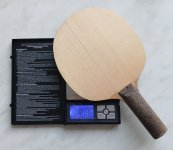
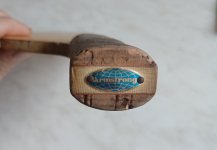
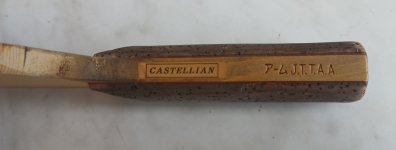
1-ply wood hinoki Blade Armstrong Castellian made in Japan.
To avoid what happened in the photo, be very careful with these blades.
By the way, there was a surprise here too. For some reason, the weight decreased after the repair, even though we didn't do anything to reduce the weight. I think the blade dried out.
1000011187.jpg
 

Attachments

  • 20260301_145437.jpg
    20260301_145437.jpg
    2.5 MB · Views: 96
  • 20260301_145244.jpg
    20260301_145244.jpg
    1.7 MB · Views: 91
  • 20260215_114509.jpg
    20260215_114509.jpg
    635.6 KB · Views: 94
  • 20260215_114310.jpg
    20260215_114310.jpg
    662.9 KB · Views: 82
Last edited:
This user has no status.
Member
Mar 2022
420
677
2,038
Ohhhshit ! what a mess. Some things are really here to try our patience. Do you think the glue was the famous Xiom musical instrument glue ? 😂 😂 😂
Couldn't be the glue, unless Xiom takes a very liberal interpretation of the words 'traditional', 'instrument' and 'glue'.

Traditionally, luthiers used either hard hide glue or else some other protein-based glue. Main reason being, hide glue is fully reversible with the application of heat and water. If the glue didn't at least soften a little with the application of heat, then it wasn't hide glue.
 
This user has no status.
🏆 Top 1% Commenter
Well-Known Member
Mar 2023
1,090
1,060
7,515
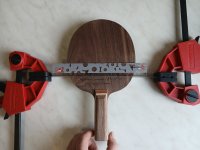
Since I share blade balance data in my posts on repairing and making new blades, someone might be interested in how quickly and easily this can be done.
I call this method the three-ruler method, since it requires three rulers. In principle, you can get by with two rulers, but three is more convenient. Perhaps someone else has an easier way to do this? Let me know.
The method is simple. Take a ruler, place it edgewise on a table, and hold it there. For example, I use two clamps. Place the blade on it, and find the balance point where the handle and blade balance. Then place a second ruler on this line, and use a third ruler to measure the distance to the handle.
Based on this data, you can draw conclusions about the blade's balance. And this is very important. Conventionally, up to 30 mm is considered lower balance, which means heavier rubber can be used. And vice versa. This method can also be used to indirectly judge whether the handle has cavities, as some people like them and others don't.
1000011654.jpg
 

Attachments

  • 20260304_082109.jpg
    20260304_082109.jpg
    2.3 MB · Views: 81
  • 20260304_082701(1).jpg
    20260304_082701(1).jpg
    1.5 MB · Views: 80
Last edited:
This user has no status.
🏆 Top 1% Commenter
Well-Known Member
Mar 2023
1,090
1,060
7,515
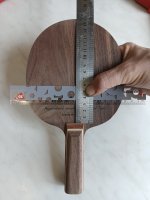
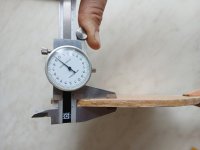
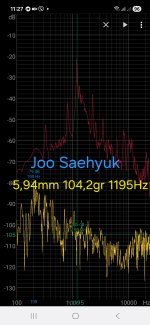
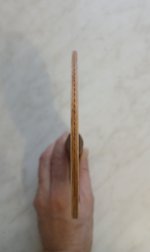
Another great Butterfly defensive blade is in the repair - Joo Saehyuk
Composition 5-plywood planchonello?/koto/ayous/koto/planchonello?
Head size - 165x156 mm
Thickness - 5,94 mm
Chord - 87 mm
Weight - 104,4 gr
Handle - St 100x22,9x28,5mm no cavities
Balance - 39 mm high
Frequency - 1195 Hz
The intermediate layer is definitely koto, as is the central layer, ayous, but the surface wood is something I haven't personally encountered, possibly planchonello. Judging by the way it was removed during the renovation, it's a fairly soft wood.
1000011781.jpg
 

Attachments

  • 20260307_113020.jpg
    20260307_113020.jpg
    2.5 MB · Views: 69
  • Screenshot_20260307_112738_Spectroid.jpg
    Screenshot_20260307_112738_Spectroid.jpg
    532.5 KB · Views: 68
Last edited:
  • Like
Reactions: belllfador
This user has no status.
Member
Nov 2025
26
20
87
This is a great topic on the forum—there is a lot to learn from it. Well done for sharing your knowledge and for the excellent photos that show your work on repairing the blade.

I have a few logical questions. I understand that repairing damage on the edges of the blade head (from stronger or weaker hits against the table) will have very little or no influence on the blade’s characteristics after the repair.

However, I don’t think the same applies if the blade completely breaks at its weakest point, which also carries the greatest stress — the area just above the handle scales. I also understand that you very carefully joined the large part of the main blade face with the smaller part located below the handle scales.

You probably did this using small wooden dowels about 1–2 mm in diameter and very precise drilling with drill bits of that size. In the end, with wood glue and properly adjusted clamps, everything was pressed together carefully and precisely to create a strong joint.

For example, ordinary wooden toothpicks—the kind sometimes used as small eating utensils—could be quite suitable for something like this, or something similar.

However, in my opinion, a blade repaired in this way can never have exactly the same feeling as it had before it was broken and damaged. It may even feel better than the original in someone’s hand, but that is completely subjective.

With such a joint, the characteristics of the main blade face inevitably change.

If I’m mistaken, please feel free to correct me.
 
This user has no status.
🏆 Top 1% Commenter
Well-Known Member
Mar 2023
1,090
1,060
7,515
This is a great topic on the forum—there is a lot to learn from it. Well done for sharing your knowledge and for the excellent photos that show your work on repairing the blade.

I have a few logical questions. I understand that repairing damage on the edges of the blade head (from stronger or weaker hits against the table) will have very little or no influence on the blade’s characteristics after the repair.

However, I don’t think the same applies if the blade completely breaks at its weakest point, which also carries the greatest stress — the area just above the handle scales. I also understand that you very carefully joined the large part of the main blade face with the smaller part located below the handle scales.

You probably did this using small wooden dowels about 1–2 mm in diameter and very precise drilling with drill bits of that size. In the end, with wood glue and properly adjusted clamps, everything was pressed together carefully and precisely to create a strong joint.

For example, ordinary wooden toothpicks—the kind sometimes used as small eating utensils—could be quite suitable for something like this, or something similar.

However, in my opinion, a blade repaired in this way can never have exactly the same feeling as it had before it was broken and damaged. It may even feel better than the original in someone’s hand, but that is completely subjective.

With such a joint, the characteristics of the main blade face inevitably change.

If I’m mistaken, please feel free to correct me.
You are absolutely right, after repair the blade will not be new, but this does not mean that it will be worse than new :).
 
This user has no status.
🏆 Top 1% Commenter
Well-Known Member
Mar 2023
1,090
1,060
7,515
A great old Stiga Erik Lindh blade, made in Sweden. Over time, the glue failed and the top veneer had come off in chunks. There was also some delamination of the internal parts, which we also fixed. The handle lens looks very classy. Why don't they make them like this anymore?
20260125_224432.jpg
 

Attachments

  • 20260114_082553.jpg
    20260114_082553.jpg
    695.6 KB · Views: 80
  • 20260104_170554.jpg
    20260104_170554.jpg
    758.6 KB · Views: 69
  • 20260104_144000.jpg
    20260104_144000.jpg
    1.4 MB · Views: 71
  • 20260114_082853.jpg
    20260114_082853.jpg
    2.5 MB · Views: 76
Last edited:
This user has no status.
Member
Jan 2021
330
269
731
A great old Stiga Erik Lindh blade, made in Sweden. Over time, the glue failed and the top veneer had come off in chunks. There was also some delamination of the internal parts, which we also fixed. The handle lens looks very classy. Why don't they make them like this anymore?
View attachment 40788
Agree! The handle shape is also great.
 
  • Like
Reactions: Egon
This user has no status.
🏆 Top 1% Commenter
Well-Known Member
Mar 2023
1,090
1,060
7,515
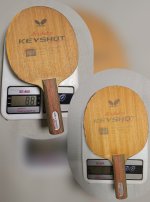
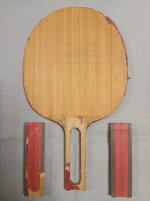
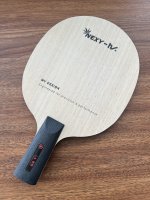
Butterfly Keyshot Light blade 3 layers of wood + 2 layers of pure arylate (no carbon).
This was a long-standing repair and there will be few technical details on this blade, but still in the photo you can see what the red arylate looks like and also a very large cavity in the handle.
The core is probably ayous, but that's not accurate :D, the surface is koto.
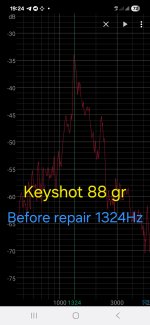
Weight - 87/88 gr
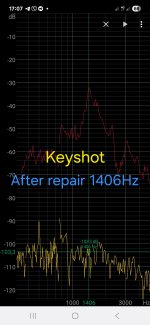
Frequency before repair - 1324Hz
After repair -1406Hz
1000012129.jpg
 

Attachments

  • 20251001_162929.jpg
    20251001_162929.jpg
    2 MB · Views: 84
  • 20251014_112126.jpg
    20251014_112126.jpg
    838.4 KB · Views: 82
  • 20251014_112434.jpg
    20251014_112434.jpg
    1.6 MB · Views: 87
  • 20251001_162859(1).jpg
    20251001_162859(1).jpg
    2 MB · Views: 74
  • Screenshot_20250930_192435_Spectroid.jpg
    Screenshot_20250930_192435_Spectroid.jpg
    396.8 KB · Views: 72
  • Screenshot_20251014_170755_Spectroid.jpg
    Screenshot_20251014_170755_Spectroid.jpg
    463.6 KB · Views: 62
Last edited:
  • Like
Reactions: returnee
This user has no status.
Member
Nov 2025
26
20
87
I’m interested in whether the handle grip plates can be easily removed when they are factory-glued. A friend has an old Viscaria that he has been playing with for more than 10 years, and the handle plate on the FH side — the one with the small Viscaria badge — is quite damaged. For now, he has a piece of cork glued there and sanded down.

He has bought new high-quality handle grip plates and would like to replace the old ones. Thank you for your answer.
 
Top