


This user has no status.
Member




Hey all!
Pretty new player here — I've been playing for about a year or so.
I fell very much in love with the sport, but with kids and work I don't have the possibility to play as much as I'd like. I tend to satisfy my urges by spending way too much time on forums, reading up on equipment, watching videos and ordering shit from the internet 🙃
I also have a robot at home that I practice with.
Anyway, enough about me. Let's get to the point.
I've been searching for a really tacky forehand rubber and ordered several rubbers that I had read were supposed to be notoriously tacky.
To my disappointment, none of the ones I've tried have been nearly as tacky as some older reviews and forum posts describe them.
I've still found some very nice rubbers, and I fully understand that a rubber can produce great spin without being extremely tacky. But I was curious about the tackiness itself.
Then something strange happened.
During the summer I accidentally left my blade in the attic, where I have my robot, for about a week.
There is lots of dust up there and the temperature fluctuates quite heavily — things that, according to common sense, should probably be bad for a rubber.
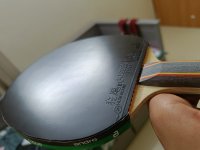
But when I picked up the racket again, the rubber had become insanely tacky.
It wouldn't drop a ball at all when I held the racket upside down.
And when I played with it, it was a beast.
I couldn't let this go.
Something had clearly changed, but I had no idea what.
My best theory was the prolonged exposure to high daytime temperatures followed by lower temperatures at night, perhaps combined with condensation forming and drying repeatedly.
Unfortunately, summer is over here now, so I can't reproduce the exact attic conditions 1:1.
So naturally, instead of forgetting about it like a normal person, I bought more rubber and started experimenting.
I dug through forums looking for "established" methods people claim can restore or increase tackiness. I also read about rubber as a material in general — how it reacts to different substances, environmental exposure and ageing.
And then I added a few things that I fully expected to have a negative effect, simply because I was curious.
The two rubbers used were:
Rubber 1: Giant Dragon Submarine
Rubber 2: DHS Hurricane 3 Commercial
I limited the experiment to these two because Submarine was the rubber involved in the original attic incident, while H3 gave me a well-known Chinese rubber as a second reference.
I originally did this purely to satisfy my own curiosity, so the evaluation method is admittedly sketchy.
I tested tack mainly by pressing a clean ball against each sample and lifting it, as well as pressing and rolling the ball against the surface to get a subjective feel for the tackiness.
In an ideal world I would have used many identical sheets mounted on blades, controlled pressure and proper timed ball-lift tests.
I didn't.
So treat small differences — especially anything marked with (?) — as subjective observations rather than hard measurements.
Apply substance → let sit/dry for 2–3 hours → initial tack test → gently wash with a water-soaked towel → let dry → second tack test
The post-wash result was the part I was most interested in, since simply leaving an oily or sticky substance on the surface obviously doesn't necessarily mean the rubber itself has changed.
Rubber 1 — Submarine
Even more interestingly, the effect seems to become stronger when the process is repeated.
Submarine responds faster and more strongly than H3.
However, the effect does not appear to long term permanent. If I stop doing it and simply clean the rubber with water over the following sessions, the tack gradually returns to normal.
So far, this has been the most interesting and reproducible result of the experiment.
I don't know why it happens, and I'm not claiming that "sweat rejuvenates Chinese rubber". There are several possible factors involved in sweat, and my testing method isn't good enough to isolate them.
But the effect itself has been repeatable enough that I don't think I'm imagining it.
This surprised me considering the original attic incident.
Once it returned to room temperature, I couldn't detect any short-term change in tack.
After washing: Back to approximately the original level.
Result: Dust itself doesn't seem to explain the attic rubber.
That mystery remains unsolved.
Simple prolonged heat didn't reproduce it. Cooling didn't reproduce it. Dust didn't reproduce it. Steam didn't reproduce it. Sunlight actually made things worse.
Most of the substances people might intuitively expect to "condition" the rubber either did very little, produced only temporary surface tack, or actively damaged it.
There were, however, two interesting surprises: linseed oil soap and sweat.
Immediately after application it actually made both rubbers slippery, which didn't look promising at all. But after washing it off, the result changed.
Submarine showed a noticeable increase in tack, while H3 showed a smaller increase.
The effect wasn't dramatic enough for me to draw any strong conclusions, and unlike the sweat test I haven't reproduced it enough times to feel confident about it. Still, among all the random substances I tried, this was one of the very few that appeared to leave the rubber more tacky after the substance itself had been washed away.
So I think it deserves an honourable mention — and probably some further testing.
The effect remained after gentle washing but gradually decreased after normal water cleaning over subsequent sessions.
Even more interestingly, repeated treatments seemed to intensify the effect. Submarine responded faster and more strongly than H3, but I could observe the same general behaviour on both rubbers.
Again, I don't know why this happens.
I'm very curious about what component of the sweat is responsible — salts, skin oils, moisture, pH, some combination of them, or something else entirely.
And then there is still the original attic incident.
Maybe temperature cycling matters more than temperature alone. Maybe humidity/condensation was involved. Maybe several factors acted together. Or maybe there was something completely different going on that I haven't thought of.
So at this point my completely unscientific ranking of interesting results would probably be:
1. The attic incident — by far the largest increase in tack, but still unexplained and not reproduced.
2. Sweat — the most interesting result because the increase in tack was noticeable, repeatable and seemed to intensify with repeated exposure.
3. Linseed oil soap — a smaller surprise, but interesting because tack appeared to increase after the soap had been washed away.
Everything else ranged from "basically nothing happened" to "congratulations, you have ruined a perfectly good piece of rubber."
Either way, I've now spent an unreasonable amount of time rubbing random substances onto pieces of Chinese table-tennis rubber.
In the name of questionable hobby science. 🫡🏓
Pretty new player here — I've been playing for about a year or so.
I fell very much in love with the sport, but with kids and work I don't have the possibility to play as much as I'd like. I tend to satisfy my urges by spending way too much time on forums, reading up on equipment, watching videos and ordering shit from the internet 🙃
I also have a robot at home that I practice with.
Anyway, enough about me. Let's get to the point.
The mystery
According to what I've been reading online, it seems like a lot of Chinese rubbers used to be considerably tackier just a few years ago, and then... something happened?I've been searching for a really tacky forehand rubber and ordered several rubbers that I had read were supposed to be notoriously tacky.
To my disappointment, none of the ones I've tried have been nearly as tacky as some older reviews and forum posts describe them.
I've still found some very nice rubbers, and I fully understand that a rubber can produce great spin without being extremely tacky. But I was curious about the tackiness itself.
Then something strange happened.
During the summer I accidentally left my blade in the attic, where I have my robot, for about a week.
There is lots of dust up there and the temperature fluctuates quite heavily — things that, according to common sense, should probably be bad for a rubber.
But when I picked up the racket again, the rubber had become insanely tacky.
It wouldn't drop a ball at all when I held the racket upside down.
And when I played with it, it was a beast.
I couldn't let this go.
Something had clearly changed, but I had no idea what.
My best theory was the prolonged exposure to high daytime temperatures followed by lower temperatures at night, perhaps combined with condensation forming and drying repeatedly.
Unfortunately, summer is over here now, so I can't reproduce the exact attic conditions 1:1.
So naturally, instead of forgetting about it like a normal person, I bought more rubber and started experimenting.
The experiment
I bought two more sheets of the same rubber and two sheets of commercial Hurricane 3, cut them into test pieces and started exposing them to pretty much everything I could think of.I dug through forums looking for "established" methods people claim can restore or increase tackiness. I also read about rubber as a material in general — how it reacts to different substances, environmental exposure and ageing.
And then I added a few things that I fully expected to have a negative effect, simply because I was curious.
The two rubbers used were:
Rubber 1: Giant Dragon Submarine
Rubber 2: DHS Hurricane 3 Commercial
I limited the experiment to these two because Submarine was the rubber involved in the original attic incident, while H3 gave me a well-known Chinese rubber as a second reference.
A big disclaimer about the testing
This was never intended to be a scientific experiment.I originally did this purely to satisfy my own curiosity, so the evaluation method is admittedly sketchy.
I tested tack mainly by pressing a clean ball against each sample and lifting it, as well as pressing and rolling the ball against the surface to get a subjective feel for the tackiness.
In an ideal world I would have used many identical sheets mounted on blades, controlled pressure and proper timed ball-lift tests.
I didn't.
So treat small differences — especially anything marked with (?) — as subjective observations rather than hard measurements.
Basic procedure
For the substance tests I generally used the following procedure:Apply substance → let sit/dry for 2–3 hours → initial tack test → gently wash with a water-soaked towel → let dry → second tack test
The post-wash result was the part I was most interested in, since simply leaving an oily or sticky substance on the surface obviously doesn't necessarily mean the rubber itself has changed.
Substance exposure
Glycerin ☹️
Rubber 1 — Submarine- Noticeable softening of the rubber itself.
- No tack at all before washing.
- After washing: slightly less tacky than the untreated rubber.
- Minor softening.
- No tack before washing.
- After washing: slightly less tacky than untreated.
Olive oil 😌
Rubber 1- Increased tack before washing.
- After washing: approximately back to original tack.
- Increased tack before washing.
- After washing: possibly slightly tackier than original (?).
Sunflower oil 😌
Rubber 1- Essentially the same result as olive oil.
- Similar to olive oil before washing.
- No noticeable increase after washing (?).
Lemon oil 😖
Rubber 1- Slippery before washing.
- Still slippery after washing.
- Slippery before washing.
- Still slippery after washing.
Linseed oil 😌
Rubber 1- Did not really dry.
- Possible minor increase in tack after washing (?).
- Did not dry.
- No noticeable increase after washing.
Linseed oil soap 🙂
Rubber 1- Slippery before washing.
- Noticeable increase in tack after washing.
- Slippery before washing.
- Minor increase in tack after washing.
Hand soap 😞
Rubber 1- Possibly a very small decrease in tack after washing (?).
- Possibly a very small decrease in tack after washing (?).
Dishwashing liquid 🙃
Rubber 1- No noticeable difference after washing.
- No noticeable difference after washing.
Hand disinfectant 😫
Rubber 1- Rubber ruined.
- Rubber ruined.
Nail polish remover 😫
Rubber 1- Rubber ruined.
- Rubber ruined.
Bleach 😫
Rubber 1- Rubber became slightly stiffer.
- No improvement in tack.
- Might have longer-term effects, and I doubt they are positive.
- No obvious change in stiffness.
- Possible minor decrease in tack (?).
- Again, possible longer-term effects.
Regular Stiga rubber cleaner 🙃
Rubber 1- No noticeable difference after one cleaning.
- No noticeable difference after one cleaning.
Revolution No. 3 Bio Cleaner & Rejuvenator 🙃
Rubber 1- No noticeable difference after one treatment.
- No noticeable difference after one treatment.
Water 🙃
Rubber 1- No difference after one wash/exposure.
- No difference after one wash/exposure.
And then there was sweat... 🙂
This one surprised me.Rubber 1 — Submarine
- Increased tack before washing.
- Retained increased tack after gentle wash.
- Smaller effect than on Submarine.
- Minor increase in tack both before and after washing.
Even more interestingly, the effect seems to become stronger when the process is repeated.
Submarine responds faster and more strongly than H3.
However, the effect does not appear to long term permanent. If I stop doing it and simply clean the rubber with water over the following sessions, the tack gradually returns to normal.
So far, this has been the most interesting and reproducible result of the experiment.
I don't know why it happens, and I'm not claiming that "sweat rejuvenates Chinese rubber". There are several possible factors involved in sweat, and my testing method isn't good enough to isolate them.
But the effect itself has been repeatable enough that I don't think I'm imagining it.
Environmental exposure
I also tried several non-chemical/environmental treatments.Heat — 50°C oven for 24 hours
Result: No noticeable effect (!)This surprised me considering the original attic incident.
Steam/mist from boiling water
Result: No noticeable effect.Refrigerator — approximately 5–6°C
Result: No noticeable effect.Freezer — below 0°C
Result: Rubber became hard while cold. Obviously.Once it returned to room temperature, I couldn't detect any short-term change in tack.
Dust — one week
Before washing: Huge decrease in tack.After washing: Back to approximately the original level.
Result: Dust itself doesn't seem to explain the attic rubber.
Sunlight — one week
Result: Decreased tack on both rubbers.So... what did I actually learn?
First of all, I still haven't reproduced the insane tackiness of the original attic rubber.That mystery remains unsolved.
Simple prolonged heat didn't reproduce it. Cooling didn't reproduce it. Dust didn't reproduce it. Steam didn't reproduce it. Sunlight actually made things worse.
Most of the substances people might intuitively expect to "condition" the rubber either did very little, produced only temporary surface tack, or actively damaged it.
There were, however, two interesting surprises: linseed oil soap and sweat.
Linseed oil soap — the small surprise 🙂
Linseed oil soap was interesting because I didn't really expect much from it.Immediately after application it actually made both rubbers slippery, which didn't look promising at all. But after washing it off, the result changed.
Submarine showed a noticeable increase in tack, while H3 showed a smaller increase.
The effect wasn't dramatic enough for me to draw any strong conclusions, and unlike the sweat test I haven't reproduced it enough times to feel confident about it. Still, among all the random substances I tried, this was one of the very few that appeared to leave the rubber more tacky after the substance itself had been washed away.
So I think it deserves an honourable mention — and probably some further testing.
Sweat — the big surprise 🙂
For whatever reason, repeated sweat exposure produced a noticeable and reproducible increase in tackiness, especially on Giant Dragon Submarine.The effect remained after gentle washing but gradually decreased after normal water cleaning over subsequent sessions.
Even more interestingly, repeated treatments seemed to intensify the effect. Submarine responded faster and more strongly than H3, but I could observe the same general behaviour on both rubbers.
Again, I don't know why this happens.
I'm very curious about what component of the sweat is responsible — salts, skin oils, moisture, pH, some combination of them, or something else entirely.
And then there is still the original attic incident.
Maybe temperature cycling matters more than temperature alone. Maybe humidity/condensation was involved. Maybe several factors acted together. Or maybe there was something completely different going on that I haven't thought of.
So at this point my completely unscientific ranking of interesting results would probably be:
1. The attic incident — by far the largest increase in tack, but still unexplained and not reproduced.
2. Sweat — the most interesting result because the increase in tack was noticeable, repeatable and seemed to intensify with repeated exposure.
3. Linseed oil soap — a smaller surprise, but interesting because tack appeared to increase after the soap had been washed away.
Everything else ranged from "basically nothing happened" to "congratulations, you have ruined a perfectly good piece of rubber."
Either way, I've now spent an unreasonable amount of time rubbing random substances onto pieces of Chinese table-tennis rubber.
In the name of questionable hobby science. 🫡🏓