Daily Table Tennis Chit Chat

This user has no status.
Member
May 2011
69
130
270
Question about serve receive!

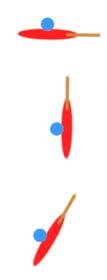
Most serves, folks go for max spin. The coaches teach you to brush the side of the ball, and to have the ball contact only the rubber, and not contact the wood underneath, for max spin

can-read-serves.jpg
I can read these serves clearly, via the "proper way"--I pay attention to moment of contact. At that point, the "red" and "blue" are clearly separated.

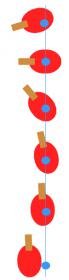
But sometimes I see right-handed, backhand serves like this:
serve.jpg

the red and blue are not visually separated.

when I receive this, it comes to me 3 kinds:
- backspin (+ very small sidespin)
- no spin
- pure side topspin (I push and it flies out the table on opponent's side)

before, during, and after contact, the paddle is behind the ball. The paddle is almost vertical for the entire stroke, and "follows the ball" long before/after contact.

This happens very quickly. But I video recorded my matches, and played back in slow motion. I replay the videos to "play guessing game" to see if I can guess each serve right, but I still guess wrong, even when I "pause" the serve to try to decode the serve.

It's a common serve (although when others I play with do this serve, their paddle does not "follow the ball" as much as this one guy I played against).

How do you guys deal with this serve?
Because I am curious how everyone receive this.
 
Last edited:
  • Like
Reactions: OldschoolPenholder
This user has no status.
🏆 Top 1% Commenter
Well-Known Member
Moderator
Oct 2014
19,976
26,540
70,898
Read 17 reviews
Question about serve receive!

Most serves, folks go for max spin. The coaches teach you to brush the side of the ball, and to have the ball contact only the rubber, and not contact the wood underneath, for max spin

View attachment 15010
I can read these serves clearly, via the "proper way"--I pay attention to moment of contact. At that point, the "red" and "blue" are clearly separated.

But sometimes I see right-handed, backhand serves like this:
View attachment 15011

the red and blue are not visually separated.

when I receive this, it comes to me 3 kinds:
- backspin (+ very small sidespin)
- no spin
- pure side topspin (I push and it flies out the table on opponent's side)

before, during, and after contact, the paddle is behind the ball. The paddle is almost vertical for the entire stroke, and "follows the ball" long before/after contact.

This happens very quickly. But I video recorded my matches, and played back in slow motion. I replay the videos to "play guessing game" to see if I can guess each serve right, but I still guess wrong, even when I "pause" the serve to try to decode the serve.

It's a common serve (although when others I play with do this serve, their paddle does not "follow the ball" as much as this one guy I played against).

How do you guys deal with this serve?
Because I am curious how everyone receive this.

Try hard to look at the angle of the paddle and the amount of surface area. Also look hard at the direction of paddle when it stabs the ball. More towards the tip of the paddle tends to indicate side backspin unless the motion is really sideways
and more behind the ball. More towards the handle of the blade tends to indicate no spin or topspin unless the paddle is almost flat. Unless your opponent is serving really heavy spin, sidespin brush strokes tend to return the ball - they don't always prevent an attack but they tend to return the ball and that is sometimes better than nothing.

The other approach is to hit the side of the ball and then follow through based on whether it is backspin (upwards) or sidespin( forwards or over).

If it is a backhand serve, the more to the right of you or the left of his body the opponent contacts the ball, the more likely it is to be backspin. The more to the left of you or right of his body he contacts the ball, the more likely it is to be topspin.
 
Last edited:
I do this serve myself (popular amongst choppers)

There are 2 elements to the underspin serve. Angle and downward brush. Some people do not angle the bat differently. If they do angle, the under will be more obvious because the stroke will be more horizontal. But if they are the type to keep the face of the racket flat (I do both for variation) then the flat version will tend to bounce higher and hit the table closer to the server.

There will likely be side, and it will almost always be spinning from the receiver’s left to right. Rarely it is the opposite because it’s so obvious. If they do, they have to get low because the contact point is at the top of the stroke.

I find it near impossible to not have some side so if you angle your blade as next level said, you will probably be okay and your pushes won’t be so high.

Also, it’s hard to do a deceptive topspin without a lot of follow through.


Sent from my iPhone using Tapatalk
 
Last edited:
  • Like
Reactions: OldschoolPenholder
This user has no status.
Member
Aug 2017
184
231
962
... hence I also try to keep learning the backhand loop and trying to find a common thread between my loop drive and looping technique so that the transition is smooth and natural depending on the incoming ball , instead of me having to think I am going to do a drive on this ball and a loop on this one ...

I had similar questions with drive vs loop vs loop drive. My coach said that when he was a junior in Europe they just distinguished between counter hitting and topspin. Counters are hit with a mostly neutral bat angle and a mostly horizontal swing. Topspins are hit with some combination of closed bat angle and a low to high swing trajectory. Different topspin shots just differ in the degree to which the bat angle is closed and the swing trajectory is upward. So a loop gets its topspin more from brushing upward with relatively open bat angle against the back of the ball which tends to lift the ball into a higher arcing trajectory, whereas a drive gets its topspin from a more horizontal stroke with closed bat angle brushing over the top of the ball which produces a flatter trajectory with a more forward rather than upward kick off the table. But there's no bright line between the two strokes or even between counters and topspins, it's just a matter of degree. My coach advised me to think of bat angle, swing trajectory, and contact point rather than loops, loop drives, etc. It's really only semantics but I've found it helpful.
 
Last edited:
This user has no status.
Member
May 2011
69
130
270
I do this serve myself (popular amongst choppers)
Also, it’s hard to do a deceptive topspin without a lot of follow through.

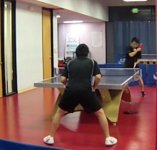
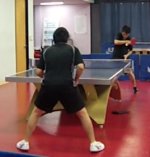
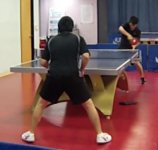
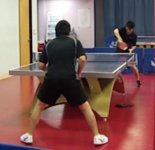
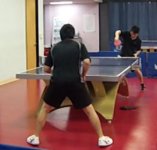
Here is one example of real video frames

1.jpg2.jpg3.jpg4.jpg5.jpg

I cannot tell if the moment of contact is frame #3, or #4.
If moment of contact is frame #4, then it looks like backspin (could still be sidespin though if the contact point is center of the ball and not under the ball)

Further, if moment of contact is frame #3, I still cannot tell if it's backspin or sidespin. Is the paddle swiping left, or down? Or left-down?

At frame #1, the paddle's is next to the guy's left ear, so there is a lot of space between the paddle and the ball.
It's easy for him to "flat hit" the ball with the same stroke (i.e. fast, no-spin serve)

This is even harder for me to read during the game, because from the serve-receiver's angle, the paddle looks like it's behind the ball for a long time (the paddle surface is faced toward the receiver).

What is the server doing? Because I am confused!
 
Last edited:
This user has no status.
🏆 Top 1% Commenter
Well-Known Member
Moderator
Oct 2014
19,976
26,540
70,898
Read 17 reviews
Here is one example of real video frames

View attachment 15012View attachment 15013View attachment 15014View attachment 15015View attachment 15016

I cannot tell if the moment of contact is frame #3, or #4.
If moment of contact is frame #4, then it looks like backspin.

Further, even if I somehow find out frame #3 is moment of contact, I cannot tell if it's backspin or sidespin. Is the paddle swiping left, or down? Or left-down?

At serve start, the paddle's is next to the guy's left ear, so there is a lot of space between the paddle and the ball.
It's easy for him to "flat hit" the ball with the same stroke (i.e. fast, no-spin serve)

This is even harder for me to read during the game, because from the serve-receiver's angle, the paddle looks like it's behind the ball for a long time (the paddle surface is faced toward the receiver).

Danny Seemiller serves like this and it is evil. The key is to look for slice or brush hit. Slice means backspin, brush hit usually means sidespin or side topspin. Do you have the TTEdge app? Brett has something not quite as evil but similar.

3 is very likely topspin/sidespin and 4 is very likely backspin. But the way the ball comes off will give you a hint as the slice tends to slow down and the top tends to kick forward. Its only if he is skillful enough to serve both slowly that the madness starts.
 
Last edited:
  • Like
Reactions: OldschoolPenholder
This user has no status.
🏆 Top 1% Commenter
Well-Known Member
Moderator
Oct 2014
19,976
26,540
70,898
Read 17 reviews
I had similar questions with drive vs loop vs loop-drive. My coach said that when he was a junior in Europe they just distinguished between counter hitting (drives) and topspin (everything else from loop-drives to a brush loops). Counters are hit with a mostly neutral bat angle and a mostly horizontal swing. Topspins are hit with some combination of closed bat angle and a low to high swing trajectory. Different topspin shots just differ in the degree to which the bat angle is closed and the swing trajectory is upward. So a 'loop' gets its topspin more from brushing upward with relatively open bat angle against the back of the ball which tends to lift the ball into a higher arcing trajectory, whereas a 'drive-loop' gets its topspin from a more horizontal stroke with closed bat angle brushing over the top of the ball which produces a flatter trajectory with a more forward rather than upward kick off the table. But there's no bright line between the two strokes or even between counters and topspins, it's just a matter of degree. My coach advised me to think of bat angle, swing trajectory, and contact point rather than loops, drive-loops, etc. It's really only semantics but I've found it helpful.

Brett Clarke (TTEdge) made the distinction between drives/counterhits/flat strokes vs topspins/loops/kick blocks meaningful for me by explaining to me how it affects blocks so I teach drives so that people learn to block properly in practice and consistently in matches. Before learning drives, my close to the table topspin game was conceptually and often practically inconsistent. Now the best thing I probably coach is how to block since people completely misconceive the stroke at the lower levels and sometimes even good players with strong offense and good touch just have blocking conceptually wrong.
 
  • Like
Reactions: OldschoolPenholder
This user has no status.
For those of you who are really into watching other people take lessons:

I decided to despite my injuries and overworked body make a push for 2100-2200 level with training from a local coach. I haven't spent any money on organized coaching on a regular basis for almost 2 years now so this is very different for me.

The coach is a lady lefty penholder who was 2600 USATT around her peak. The way she coaches me and just about everything she tells me to do is 100% against how I think about the sport. She gives very specific technical instructions while I am more Zen and general in my TT approach. And of course, she is trying to fix my knees with exercises.

That said, having someone give me specific instructions to guide my approach to the game is probably a good thing as she will hold me accountable for how I play. And getting to practice against 2600 level consistency and ball quality is probably the biggest thing. I thought really hard about it and it is cheaper than travelling to play local leagues or getting similar coaching elsewhere. She lives pretty close to me. So as much as I hate to pay the extra money, let's see where it goes.

So without further ado, here is lesson 1 from last week:
https://www.youtube.com/watch?v=-SpEUsk6Dy4

After watching this very instructive lesson. I felt like Nextlevel gave the TTD community a very nice Christmas gift. I even feel its better than the Nextlevel Blade giveaway. Thanks for the video!!!
 
This user has no status.
🏆 Top 1% Commenter
Well-Known Member
Mar 2015
1,418
1,125
4,197
Read 3 reviews
Here is one example of real video frames

View attachment 15012View attachment 15013View attachment 15014View attachment 15015View attachment 15016

I cannot tell if the moment of contact is frame #3, or #4.
If moment of contact is frame #4, then it looks like backspin (could still be sidespin though if the contact point is center of the ball and not under the ball)

Further, if moment of contact is frame #3, I still cannot tell if it's backspin or sidespin. Is the paddle swiping left, or down? Or left-down?

At frame #1, the paddle's is next to the guy's left ear, so there is a lot of space between the paddle and the ball.
It's easy for him to "flat hit" the ball with the same stroke (i.e. fast, no-spin serve)

This is even harder for me to read during the game, because from the serve-receiver's angle, the paddle looks like it's behind the ball for a long time (the paddle surface is faced toward the receiver).

What is the server doing? Because I am confused!

I would add that if you can't read the serving motion then read the bounce of the ball.
 
  • Like
Reactions: OldschoolPenholder
This user has no status.
So i took a week off due to a old injury in my playing arm flaring up. Not serious, just rest was needed. After the week off, i took my regular Saturday coaching lesson. Didn't go too hard to be safe, just worked on my backhand basically and the chiquita banana flip. I had some progress with the bh flip. Still chugging along.

Usually at the end of my lesson i play a match with my coach(around 2550 USA rating). He starts off giving me seven points and if i win, then we take away one point advantage in the next game. I was pretty much on fire, win the first 2 games and was up 9-0 in the third. Yes 9-0 in the 3rd!!! Then my coach switches strategy and starts playing slow spinny loops & short angle shots. Needless to say i end up losing 3 straight...So Sad:( My coach knows i like to play with pace so he knew the weak area in my game. Now i have to work on counter looping slow spinny loops and better footwork to short angle shots. GRRRR.... OSPH told me i better not post this story about losing in the forums, but i feel its better to let the world know so i can grow and get better.

I had a piece of Tibhar Hybrid K1 Plus Max thickness sitting in my living room for close to 6 months and decided to give it a go this weekend. Recently i have been playing with MX-P and the rubber shrinks 1-2mm in about 2-3 months because the factory booster has worn off. So the K1 Plus is Tibhars attempt at making there version of the H3 neo. First off the K1 Plus does not need boosting, it comes out of the package flat and has no chemical booster smell. It plays like a more controlled version of a Boosted H3 Neo. Not fast but fast enough, similar arc to H3 neo, light tackiness, very spinny on serves and loops. Its something i would continue to use if nothing better comes out. Oh yeah, K1 Plus is only available for Asia. So you have to order from the Asian sites.

Last bit of news, my OSP Ultimate came in today. Requested 90 grams and they sent me a 88 gram weighted one. Close enough. Wont get to play with it until this upcoming weekend. :D
 
Last edited:
This user has no status.
🏆 Top 1% Commenter
Well-Known Member
Mar 2015
1,418
1,125
4,197
Read 3 reviews
After watching this very instructive lesson. I felt like Nextlevel gave the TTD community a very nice Christmas gift. I even feel its better than the Nextlevel Blade giveaway. Thanks for the video!!!

Totally agree. So much things to correct, so much to learn. Thanks for sharing that video!
 
This user has no status.
🏆 Top 1% Commenter
Active Member
Jun 2015
986
1,373
3,883
Read 3 reviews
Merry Christmas dear TTD friends! So much interesting stuff being written here.

I have a question, about the ball shaped stroke or thick contact.

Does that mean you should start the stroke with a more opened racket face and then close it while brushing the ball to lessen the chance to hit an edge?

I always thought that changing the angle of the stroke mid stroke is a big no go as it gives you different outcomes depending on where in the stroke you hit the ball.
 
Last edited:
  • Like
Reactions: OldschoolPenholder
This user has no status.
Active Member
Jan 2016
570
999
1,871
In case if you guys didn't know already, He Zhi Wen (an old world class Lefty Short pips penholder) has been coming to my club (Robert Chen's club at<cite> http://aacct.org</cite><cite class="_Rm"></cite> ).

You might seem him coaching in the afternoons these days, ( and you might see me :p ), so you wanna see him and take pictures or what not, now's your chance
 
Last edited:
This user has no status.
🏆 Top 1% Commenter
Well-Known Member
Moderator
Oct 2014
19,976
26,540
70,898
Read 17 reviews
Merry Christmas dear TTD friends! So much interesting stuff being written here.

I have a question, about the ball shaped stroke or thick contact.

Does that mean you should start the stroke with a more opened racket face and then close it while brushing the ball to lessen the chance to hit an edge?

I always thought that changing the angle of the stroke mid stroke is a big no go as it gives you different outcomes depending on where in the stroke you hit the ball.

Yeah, that is what they tell people who don't get it. The thing is that some people try to hit the ball and then jerk their wrist to add spin or something like that. It is bad *default* technique and has issues in terms that it reduces the overall swing speed so it should not be your default stroke. However, all top players do something like it as an emergency stroke sometimes if the ball is the right kind of ball. But you can't be a top player if that is your default technique as the power and consistency is not enough.

But as you get more experienced, you realize that all strokes form a path. I am describing the path of the stroke when I say things like hit the ball and cover, or hit the ball and go up, or hit the ball and fade up or hit the ball and fade over. I find in my experience that the racket angle determines the contact point for controlling the spin, the path determines what spin you are adding to the ball, and the thickness of the contact determines how much pace vs spin you will generate. But the three are all connected so my seperation may not make complete sense. The path sometimes captures everything as the path sometimes sets the racket angle and the path *can* affect the thickness of the contact.

But in any case, what you should not be changing too radically is the swing path. If the ball is slow and you have time to approach it with a slower start, you can change it, but when it is fast, it is just about impossible to change, and in general anyways, you should have already read the ball early and set your swing path in general based on the incoming ball so you can get maximum acceleration into the ball. There is no point dropping your racket when you know that your opponent is not a chopper and you have just looped the ball, your racket should be high and ready to make contact somewhere on top of the ball or close to it on the side since the next ball will be topspin depending on block or countertopspin 95% of the time (the crazy chop blocker not withstanding). So you don't want to lift the ball off the bounce, you can't come from well beneath and behind, your ball will have to come round close to the ball height and likely over the side to use spin avoidance. So you usually play down to up to counteract backspin, back to front (or more usually, left to right or right to left) to counteract topspin or topspin and sidespin. The swing is the same, the path and contact point and thickness will change to accommodate the incoming spin.

The thing is that when you hit the back of the ball (and I probably tried to explain this to you a year and a half ago), the ball is going to be pushed forward by your impact so your path has to be set to spin but it is hard to spin if your path is set to hit the ball on its face as you are absorbing all the incoming spin. It is why most loops off the bounce are hooks or fades if you watch what happens to the ball after the shot, they knock the ball of its axis and add their own spin instead of fighting the spin on the ball. Even loops in rallies are similar. Let's hear a pro describe it.

https://www.youtube.com/watch?v=ozVAt4LT90o (he explains that for a spinny ball, you almost need to push the ball down to depress heavy topspin - someone would argue that he is still coming round the side and over but that is another story - the swing is one example of a path).

https://www.youtube.com/watch?v=9kZRmomeckg (he explains how to avoid the spin to keep the rally going with sidespin - this is the most relevant one to what I wrote about - but it doesn't have to be sidespin per se, it is more about the contact point - an observant person will note that the hook stroke is not that different a stroke from part 1. He also explains that sidespin lets you take the ball later in some cases).

https://www.youtube.com/watch?v=9kZRmomeckg (he gives a mental approach for when the ball is less spinny. But note that his swing is not that different and in every case, he is using a hooking swing to counterloop the ball off the bounce with minor changes to the swing trajectory based in how he reads the incoming ball).

So the thing is that many people when they first hear spin, they think of brushing. No, spin is not about brushing, spin is about good rubber and the *PATH* of the swing. It is when you need to make the ball spin a lot over a short distance that you brush more, but if the ball is coming in fast with heavy spin and you are off the table and you need to make the ball travel, you may not be able to brush as much. The most important thing is to set the swing path and chose a good contact point so that you get the result you are looking for. But if you hit the ball where the spin is most, your angle has to be perfect and you will be fighting the incoming spin and pace - this is why some people can only loop from 10 feet off the table as they need the ball to lose some of its power so they can play their lifting stroke. This is madness - if I had to play this way, I would have quit table tennis a long time ago.

What I do, as old as I am, is try to read the ball and figure out how it is spinning and to play my stroke on a point on the ball where the spin is not too heavy so I can get the effect I am looking for. This is why people are able to take the ball off the bounce. The trick is to take the ball as early as possible and borrow the incoming pace and spin and come round the side and loop it with sidespin and use the incoming topspin to play your own spin. It's a physics problem that the brain solves with practice if you let it.


IF you look at your loop carefully and you swing the full path with salute at the forehead, you will see that it comes round the side and over the ball. IT is also often a curved stroke though some people can increase or reduce the curve. So the angle is change slightly throughout the stroke. You just don't try to hit the ball and change it immediately after hitting the ball. And in fact setting the angle throughout the stroke is silly and will usually hit the ball long unless you are lucky. What you need to do is follow the shape of the ball with your strokes in general, and this will tend to produce the effect you are looking for, how much of the shape you follow depends on spin, speed, incoming ball etc. But you will see that if you do this, it is easier to exposed the racket to the ball for safety and hit the side a bit on most strokes to fight incoming spin, this makes your stroke safer and lets you add your own spin and power if you are using inverted. Give it a try and let me know how it goes. Trying to brush too much often means you miss the ball, it is a bad habit I try to fix in my own game and in some of my students, but old habits die hard. But the more you hit the ball with good rubber and turning stroke, the more your spin will be. Don't try to avoid the ball, hit the ball with turning stroke. Then reduce the thickness of contact to get more brush spin when you are certain of your contact, trying to avoid the ball from the start will lead to too much missing.

So yes, try to use as much racket face as possible to turn the ball. It takes some practice and adjustment, but watch pros like Mizutani or Maze if you want to see the technique. I posted a lot of backhand videos but technique for forehand is similar, you can watch my matches or that of most of my opponents to get it.

 
Last edited:
This user has no status.
🏆 Top 1% Commenter
Well-Known Member
Moderator
Oct 2014
19,976
26,540
70,898
Read 17 reviews
Merry Christmas dear TTD friends! So much interesting stuff being written here.

I have a question, about the ball shaped stroke or thick contact.

Does that mean you should start the stroke with a more opened racket face and then close it while brushing the ball to lessen the chance to hit an edge?

I always thought that changing the angle of the stroke mid stroke is a big no go as it gives you different outcomes depending on where in the stroke you hit the ball.


Here you can watch lots of top players practice at the world cup but I would like you to just look at Koki Niwa and Jun Mizutani. Different techniques, but you see the same circular motion in their strokes. This is how they swing at the ball 95% of the time, they just change the swing path (Starting point, contact, finishing point) to adapt to the spin and change the quality of ball they want to produce. You can see that they are hitting the ball a bit on the side and finishing over and forward in order to hit with power and spin. MY timing and practice is not as good as theirs but I try to do the same thing.

https://www.youtube.com/watch?v=_8m5sBZQnKw
 
This user has no status.
Member
Aug 2017
184
231
962
Brett Clarke (TTEdge) made the distinction between drives/counterhits/flat strokes vs topspins/loops/kick blocks meaningful for me by explaining to me how it affects blocks so I teach drives so that people learn to block properly in practice and consistently in matches. Before learning drives, my close to the table topspin game was conceptually and often practically inconsistent. Now the best thing I probably coach is how to block since people completely misconceive the stroke at the lower levels and sometimes even good players with strong offense and good touch just have blocking conceptually wrong.

What kind of misconception? Maybe too passive? I think of most blocks as abbreviated counters with a soft hand and bat angle closed as needed for incoming spin.
 
  • Like
Reactions: OldschoolPenholder
This user has no status.
🏆 Top 1% Commenter
Well-Known Member
Moderator
Oct 2014
19,976
26,540
70,898
Read 17 reviews
What kind of misconception? Maybe too passive? I think of most blocks as abbreviated counters with a soft hand and bat angle closed as needed for incoming spin.
Many people (usually lower rated players) lift their rackets on their blocks to block with topspin. Sometimes, this can lead to their being unable to block properly in matches or play close to the table in general.
 
  • Like
Reactions: OldschoolPenholder
Top