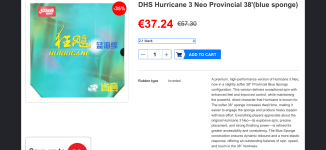
What DHS says:
"Handbook of DHS T.T. Products" (translations by Google Translate)
https://drive.google.com/drive/folders/1xss4XdArxyhyyifUyy3y2tzR3AC6zGlT
"The No. 20 sponge, developed by DHS in 2000, closely inherits the design of the No. 22 sponge. Its control is enhanced primarily through the addition of plasticizers and changes in processing. Therefore, it has a softer feel and a cleaner surface finish. However, their basic performance is similar. The No. 20 sponge has finer, denser pores to increase its potential energy, resulting in a longer trajectory and higher speed. The No. 22 sponge has high tensile strength and strong rebound, maintaining a lower trajectory. Through forceful friction, it can generate high-speed spin and strong forward momentum." page 79 (90 in the PDF)
"The Blue Provincial Hurricane seems to have increased in weight? Is it due to formula adjustments or glue? Since 2021, the blue sponge rubbers used by national and provincial teams have undergone toughening treatment. This increased toughness allows the sponge to withstand more and denser impacts, extending its lifespan. After toughening, the blue sponge has more power, resulting in a slight weight increase, generally 3-5 grams." page 88 (99 in the PDF)
My experience
View attachment 40404
That's how my last provincial H3N 39 BS looked like fresh and because of the slight dome 1) I thought I give one a try unboosted... Freshly glued a ball dropped from around 10 cm (4 inches) made exactly one bounce... Never put so many touch shots in the net. Loops were doable but I'm quite sure that I would have had a much harder time to maintain good form in random drills or real matches similar to what
@Nima Abadi said. One could still see what the BS is capable of but only with way to much input. The reviewer in 1) plays it unboosted too and one can see the effort he puts into his shots.
In short:
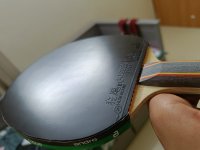
View attachment 40410 If it doesn't look at least like this I would only use it to work on technique and footwork but for this a commercial OS would suffice too.
1) usually they were either flat or had a slight reverse dome like in this video