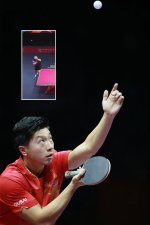

On receiving serve, why the receivers are always squatting low, eye level on the net, but when the opponent toss the ball, the receiver stand up?

This user has no status.
Member
Apr 2024
203
118
813
It's actually more of a physics thing...at least the stepping part is. Getting low allows you to anticipate the contact, and making that first step while your opponent tosses the ball up gets your body in motion and allows you to take the necessary second step to be in position for either a short serve OR a long serve.

As Fang Bo explains, you take your split step, or one tiny step forward with your right foot, then once the server hits the ball, you take your second step with your right foot to adjust for a short ball to your forehand or back. or move your left foot back to adjust to a long serve to your backhand, or you move your right foot backwards again to adjust to a long serve to your forehand. if you're standing still the whole time during the serve, you're already too late by the time your opponent hits their serve.

exactly. its a necessary footwork to be in the best position possible to return serve. just like tennis players will split step when their opponent hits the ball (then they can quickly change direction to adjust to their opponents hit), you have to do a split step or a small step in table tennis to adjust to your opponents serve.

Its all explained here:


This is seriously one of the most valuable lessons from Fang Bo. If you're not already doing this in your serve return, you're most likely sub 1500 USATT rating. Once you start doing this, you are going to see big improvements to your serve returns simply from being in a better position to return serves.
I still haven't been able to follow Fang Bo's exact instructions. I always used to hop probably because I saw higher level players do that.

One thing I have recently changed that has helped me is to time my hop. It used to be when the opponent lifted the ball in the air; now I try to time it with the opponent's contact on the serve. It does seem to improve my balance when receiving.

 
This user has no status.
🏆 Top 1% Commenter
Well-Known Member
Oct 2010
2,860
2,798
10,533
I see ppl haven't seen the batsuju step tutorial still.

So basically your aim for the split step is to load your feet with energy to bounce to wherever you want to go.

How do you load your feet with energy? By having your centre of gravity drop down. You can't drop your centre of gravity from an excessively low position, it has to be somewhat higher.

Any upwards 'jump' is just a waste of time and energy although you can do it. The only benefit is more energy to borrow (from a higher start point) but as TT foot movements are focused on speed and not distance, it is simply inefficient to jump. Ultimately it is the drop that creates the energy in your feet (from converting gravitational potential energy)

So really it's getting into your regular moderately low stance to prepare you for the final position you will reach after the split step, and also focusing on the ball. Then as your opponent throws the ball, you raise your centre of gravity to 'prepare' for the drop, and then you drop when the opponent contacts the ball, thus loading your feet with energy to move into position explosively wherever the ball might go.

It is precisely the same principle in badminton which I play a lot these days
 
  • Like
Reactions: Wrighty67
This user has no status.
🏆 Top 1% Commenter
Well-Known Member
Sep 2013
13,139
15,420
36,968
Read 3 reviews
If the reason is to see the ball or the contact point or the type of spin being used by the opponent, then why is that while the opponent tosses the ball, before contacting the ball to the racket, the receiver is standing already before receiving?
What's the real purpose of squatting to level the eye to the net and yet standing before the serve happens?
It is to get into the ready position (low as you call it), and then following the ball once the toss is happening.

following the ball meaning, your whole body and soul and going with the movement and from there, any signal you get from the server, will determine your next action.

so in the layman part, you may think it is just going down and up, but the whole process is a lot deeper than that, both physically and mentally.
 
says nothing
says nothing
🏆 Top 1% Commenter
Well-Known Member
Apr 2021
1,106
1,277
3,974
Read 1 reviews
If the reason is to see the ball or the contact point or the type of spin being used by the opponent, then why is that while the opponent tosses the ball, before contacting the ball to the racket, the receiver is standing already before receiving?
What's the real purpose of squatting to level the eye to the net and yet standing before the serve happens?
until I received training from a ex-professional player, I understand the reason why. It is because you need to see the top of the ball after contact to anticipate the spin and placement of the serve.
 
Top