This user has no status.


João Geraldo, a member of the Portuguese team, when asked by a fan about the pink table on Instagram, responded: "A bit glaring, the overhead lighting makes me a bit dazzled, and judging the ball’s trajectory is harder."
Ma Long and Xu Xin were quite surprised when fans mentioned this. While walking, a fan asked Ma Long, who was stunned and replied, "Huh, what? A red table?" (see video in link: this link).
It’s hard to imagine how much the athletes’ eyes must ache after a match. Additionally, the red color makes people anxious, subconsciously increasing mental stress.
Eye strain + high mental tension + unclear ball visibility = both athletes’ and spectators’ brains feel like they’re about to explode.
Visually, the human eye is highly sensitive to red wavelengths. Staring at them for long periods strains the optic nerves and reduces accuracy in judging the ball’s speed and spin. The red table strongly reflects light, and the high color contrast between the ball and the table creates an "invisible ball" effect, impacting shot decisions.
Psychologically, red is often associated with warnings and pressure, potentially heightening game stress and affecting technical stability.
Moreover, switching from traditional dark tables to red requires athletes to recalibrate their visual-motor coordination, posing a challenge for players who rely on precise anticipation.
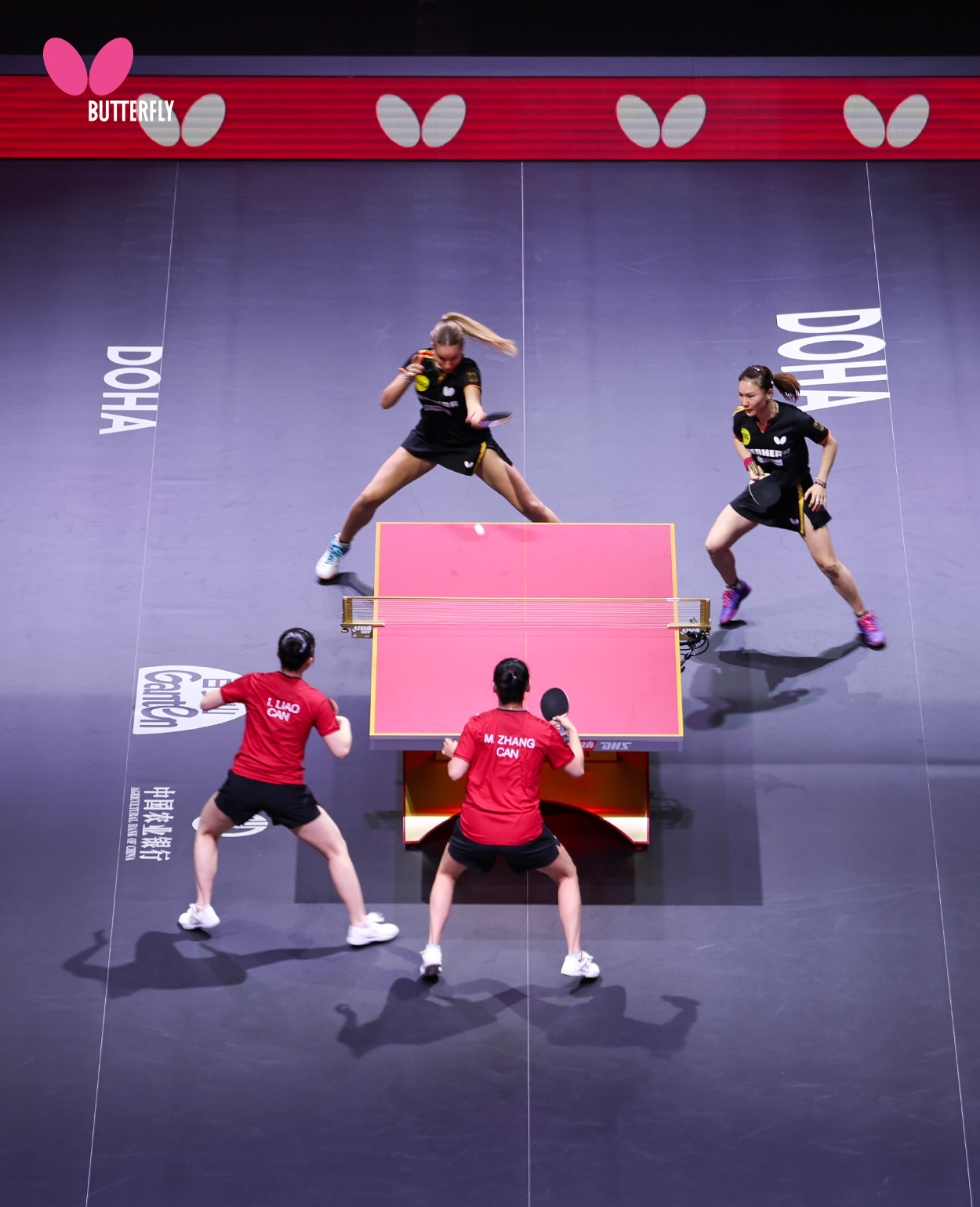
Per regulations, tables at major tournaments must be dark, primarily dark blue or dark green, for visual reasons. The International Table Tennis Federation’s rules state that tables must be dark for official matches.
One explanation for this choice is that wealthy individuals in the Middle East (Doha, the host city) favor the red-and-gold combination, which looks luxurious.
The German team has purchased backup glasses, planning to wear specialized eyewear if significant issues arise. The Korean team has designed fluorescent uniforms (essentially a countermeasure).
Other cases of visual impact:
At the 2017 World Table Tennis Championships, a spectator watching matches on an all-red FLOOR reported needing to rest their eyes for about half an hour after each match.
In a previous WTT match, Liang Jingkun was dazzled by the opponent’s coach’s bright yellow outfit and requested the coach change clothes.
Ma Long and Xu Xin were quite surprised when fans mentioned this. While walking, a fan asked Ma Long, who was stunned and replied, "Huh, what? A red table?" (see video in link: this link).
It’s hard to imagine how much the athletes’ eyes must ache after a match. Additionally, the red color makes people anxious, subconsciously increasing mental stress.
Eye strain + high mental tension + unclear ball visibility = both athletes’ and spectators’ brains feel like they’re about to explode.
Visually, the human eye is highly sensitive to red wavelengths. Staring at them for long periods strains the optic nerves and reduces accuracy in judging the ball’s speed and spin. The red table strongly reflects light, and the high color contrast between the ball and the table creates an "invisible ball" effect, impacting shot decisions.
Psychologically, red is often associated with warnings and pressure, potentially heightening game stress and affecting technical stability.
Moreover, switching from traditional dark tables to red requires athletes to recalibrate their visual-motor coordination, posing a challenge for players who rely on precise anticipation.
Per regulations, tables at major tournaments must be dark, primarily dark blue or dark green, for visual reasons. The International Table Tennis Federation’s rules state that tables must be dark for official matches.
One explanation for this choice is that wealthy individuals in the Middle East (Doha, the host city) favor the red-and-gold combination, which looks luxurious.
The German team has purchased backup glasses, planning to wear specialized eyewear if significant issues arise. The Korean team has designed fluorescent uniforms (essentially a countermeasure).
Other cases of visual impact:
At the 2017 World Table Tennis Championships, a spectator watching matches on an all-red FLOOR reported needing to rest their eyes for about half an hour after each match.
In a previous WTT match, Liang Jingkun was dazzled by the opponent’s coach’s bright yellow outfit and requested the coach change clothes.
Last edited: