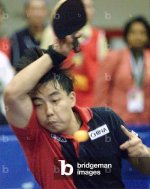
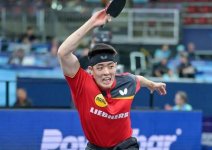
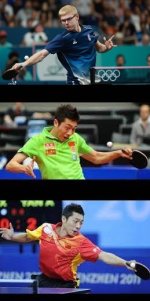
I also think that Liu’s stroke is overall shorter so that as a short pimps player, he can flat hit earlier forcing his opponents away from the table (which he was very good at). Also, in the 38mm era the sport was certainly faster, hence lessened need for such long strokes for power.
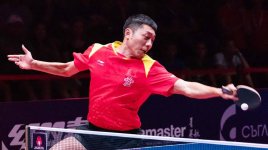
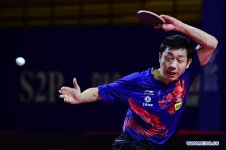
On the other hand, Xu Xin has one of the if not the largest swing in the new ball era. Have a look at his game and his loops are very spinny and has a really high arc. Along with the difference between inverted and short pimps, they have vastly differing forehand strokes.
It is also something to note with forehand strokes in general:
European and Japanese players tend to have more compact forehands with the bent elbow. It gives you slightly more feeling and for the ball, but may lack power in general. It seems that their upper body doesn’t connect to the lower body as well, and they have to compensate with more bat acceleration.
A good example is Timo Bolls waist twist and wrist snap, along with Jun Mizutani’s rather bent elbow, tho Jun seems to have a rather severe case of “chicken wing forehand”.
On the other hand, Chinese players in general keep their arms relaxed before ball contact. Strokes tend to be longer, and start lower from the hip. This allows them to make use of the entire body’s strength, by connecting upper body with the thighs and hip rotation, for more power. This means their strokes tend to be more powerful, but requires greater control and skill.
The tradeoff is that recovery may be a tad slower due to the long stroke, and may affect forehand backhand transitions when not mastered.
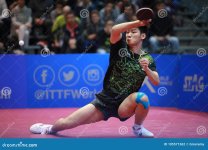
A good example of players using this technique is Ma Long and Fan Zhendong. For the former, Ma Long starts his stroke slightly behind the waist at waist height, and swings forward with a thick brush motion. Fan seems to start his forehand loops from his backside, again showing a longer stroke. Both players relax their arms into a position almost straight.
For their contact, I noticed they don’t snap their wrist, but their forearms and elbows for stability. This can be allowed as the elbows are straight. Elbows have more power than the wrist, so adds to the increased overall forehand power for most Chinese style forehand players.
Along with this, the rubbers also play a part. Chinese rubbers are generally tacky, not very bouncy and have lower throw angles. They require more brush for control and power, and require more technical abilities (less forgiving in weak shots). Japanese and European rubbers tend to be more bouncy, less tacky and have a higher throw angles. This requires less of a brush and allows the person to hit through the ball flatter more, thus a stroke optimised for less brush motion.
Overall, I don’t think there is a correct stroke, but it’s just on the player’sability, style and preference.