This user has no status.
Member
Jan 2024
13
6
26
Hi fellow table tennis enthusiasts,

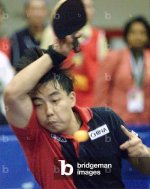
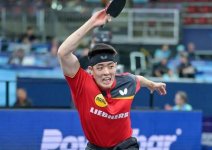
I play penhold, and I noticed the forehand of Xu Xin and Liu Guoliang differs very much in how they look and their technique. I see Liu Guoliang with a very loose wrist, almost limp with his racket creating 90 degrees with his arm.

images-4.jpeg

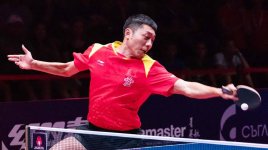
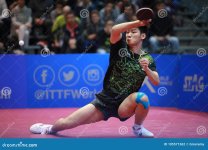
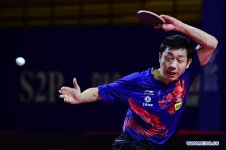
On the other hand, Xu Xin has this straight, firm wrist and uses his whole body into the shot.

images-5.jpeg

What are the advantages/disadvantages of each? And which would be more effective and easier to learn for an intermediate player?

Thanks
 
says penhold dreamer
Liu Guoliang played short pips on the forehand side, therefore his technique is less loop, more like a flat hit.
Xu Xin needed to loop every ball on the forehand, therefore he needs a straight hand for more angular velocity.

Straight arm is definitely more effective, more difficult to master. Almost all CNT players I think have a straight relaxed arm before the forehand shot.
 
I also think that Liu’s stroke is overall shorter so that as a short pimps player, he can flat hit earlier forcing his opponents away from the table (which he was very good at). Also, in the 38mm era the sport was certainly faster, hence lessened need for such long strokes for power.

On the other hand, Xu Xin has one of the if not the largest swing in the new ball era. Have a look at his game and his loops are very spinny and has a really high arc. Along with the difference between inverted and short pimps, they have vastly differing forehand strokes.

It is also something to note with forehand strokes in general:

European and Japanese players tend to have more compact forehands with the bent elbow. It gives you slightly more feeling and for the ball, but may lack power in general. It seems that their upper body doesn’t connect to the lower body as well, and they have to compensate with more bat acceleration.

A good example is Timo Bolls waist twist and wrist snap, along with Jun Mizutani’s rather bent elbow, tho Jun seems to have a rather severe case of “chicken wing forehand”.

On the other hand, Chinese players in general keep their arms relaxed before ball contact. Strokes tend to be longer, and start lower from the hip. This allows them to make use of the entire body’s strength, by connecting upper body with the thighs and hip rotation, for more power. This means their strokes tend to be more powerful, but requires greater control and skill.

The tradeoff is that recovery may be a tad slower due to the long stroke, and may affect forehand backhand transitions when not mastered.

A good example of players using this technique is Ma Long and Fan Zhendong. For the former, Ma Long starts his stroke slightly behind the waist at waist height, and swings forward with a thick brush motion. Fan seems to start his forehand loops from his backside, again showing a longer stroke. Both players relax their arms into a position almost straight.

For their contact, I noticed they don’t snap their wrist, but their forearms and elbows for stability. This can be allowed as the elbows are straight. Elbows have more power than the wrist, so adds to the increased overall forehand power for most Chinese style forehand players.

Along with this, the rubbers also play a part. Chinese rubbers are generally tacky, not very bouncy and have lower throw angles. They require more brush for control and power, and require more technical abilities (less forgiving in weak shots). Japanese and European rubbers tend to be more bouncy, less tacky and have a higher throw angles. This requires less of a brush and allows the person to hit through the ball flatter more, thus a stroke optimised for less brush motion.

Overall, I don’t think there is a correct stroke, but it’s just on the player’sability, style and preference.

 
Last edited:
This user has no status.
I'm an SP penholder and LGL is my favourite player. I have watched several hours of his matches and training. It's really difficult to compare the two FHs because there are many points to consider.


Material:


LGL played with an SP TSP Spinpips, which was banned in the early 2000s because it gave an "unfair" advantage (according to an ITTF resolution regarding the friction and size of the pips). Blade: 7-layer wood (clipper wood).

The ball was 38 mm in diameter and lighter, which made it faster and more susceptible to spin. Playing with an SP forehand has some advantages close to the table: shooting flat and being less sensitive to incoming spin. However, creating spin is also difficult. For this reason, LGL's topspin forehand resembles the "old" Chinese technique: the racket is almost vertical, the swing finishes close to the head, and the wrist is used to generate more spin. Note that LGL's main shot was not the topspin FH, but the flat hit, smash, and TPB.

LGL realised that playing at medium-far distance from the table with an SP was weak, so he developed a racket twist to play with rubber. However, at the top level, that shot was too weak to play against professional players. After the prohibition of Spinpips, the increase in ball size, and the change in sets from 21 to 11 (which affected LGL's tactics), he didn't have an opportunity in the professional circuit.

XX always played with a rubber (please correct me if you have different information) with a 40 mm ball and at a medium-far distance from the table. He used carbon rackets (maybe only wood at first, but later he played with carbon). Considering that the ball is heavier and he is further from the table, the swing should be more towards the front (finishing in front of his body rather than close to his head as with LGL). As the ball is slower and XX has better footwork than LGL, he can play far from the table while still having the technique and power to attack.

I think that if you are a penholder with a rubber, clearly you should follow the XX techniques even if you don't play so far from the table.

If you play SP penholder (we are in extinction in the world !), you will understand that LGL topspin style is necessary, but it should be complemented with other strokes and not be the main weapon.

You can see similar techniques in Ding Yi, He Zhiwen, but LGL has the longest swing of the SP players.
 
This user has no status.
Member
Jan 2024
13
6
26
Overall, I don’t think there is a correct stroke, but it’s just on the player’sability, style and preference.
I wonder if this has anything to do with grip as well?
Because I also noticed that penholders with straighter (or completely straight) back fingers use this forehand motion. Modern penholders such as Dang Qiu has a similar forehand stroke to Xu Xin, whereas curled finger penholders such as Felix has these "loose wrist" forehands; including me, which I found this to be a more natural stroke than the straight-wrist stroke, as someone who holds the racket with curled back fingers. This is just a hunch though, I'm not sure either way.
 
Last edited:
This user has no status.
🏆 Top 1% Commenter
Well-Known Member
Aug 2016
1,007
1,403
3,392
I'm just going to assume the OP didn't know Liu played short pips.

That'd be like comparing Ma Long's stroke to Johnny Huang. What are we doing here?

If you're a penholder and looking for technique, just depends on what you play. If you play inverted, there's only a million good penholder examples to choose from.

Short pips? Liu Guoliang, Jiang Jialiang, HE Zhi Wen and others.
 
This user has no status.
Member
Jan 2024
13
6
26
I'm just going to assume the OP didn't know Liu played short pips.

That'd be like comparing Ma Long's stroke to Johnny Huang. What are we doing here?

If you're a penholder and looking for technique, just depends on what you play. If you play inverted, there's only a million good penholder examples to choose from.

Short pips? Liu Guoliang, Jiang Jialiang, HE Zhi Wen and others.
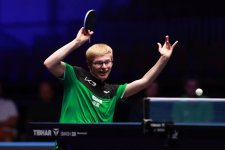
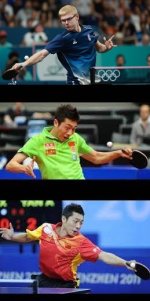
Maybe choosing Liu Guoliang may not be the best example, and some people would take that as a red herring. Here I have several other examples of the "loose wrist" vs "stiff wrist" types of penholders I've been seeing. Felix Lebrun, like I mentioned previously:
images-6.jpeg
And also Xue Fei plays with this "loose wrist".
xue-fei-china-top-spin-xue-fei-china-top-spin-riva-del-garda-italia-nov-winner-ittf-world-juni...jpg

On the other side, like I've mentioned, Xu Xin, and in the modern era, Dang Qiu:
images-7.jpegunnamed.jpg
All with inverted pips. The fact that LGL played with SP doesn't detract from my original question, which is, what are the pros and cons of either styles and the difficulty to achieve either styles?
 
This user has no status.
🏆 Top 1% Commenter
Well-Known Member
Aug 2016
1,007
1,403
3,392
I honestly think you're over thinking this one. I don't see those pictures, look at their wrist angle on that singular shot and say "Oh it's straight, oh it's flexed. They must be playing with X style of wrist in it being loose or stiff". It's just a still frame for that one particular shot in that moment. Maybe the ball was inside a little. Maybe they had to reach a pinch more in that one. Maybe the shot was more of a drive vs a loop. etc.

Example. Here's a picture of Felix with with more extended wrist like Xu Xin that you were contrasting. Furthermore, Here's Xu with different wrist positions.
Felix-Lebrun-2000x1125v2.jpg

And perhaps this is the answer to your question:
Having a relaxed, extended, for centripetal force, & still flexible forehand when playing penhold is all you need to create good whip action and power.

It's the same reason why shakehanders are coached on the FH to bend the wrist down. At the same time, they never talk about having your wrist fixed & locked in this position (ie - stiff wrist). That'd kill your spin. No you need a relaxed wrist. Not like a wet noodle loose or anything like that. Just relaxed. Flexible. It'll naturally rotate through the swing if it's relaxed. That in conjunction with everything else makes spin & power.

So yeah as far as I see it, all these different images are circumstantial of their follow through in that moment. Video for checking form is a better example. Just look at Felix in training close to the start of this video.
 
Last edited:
This user has no status.
🏆 Top 1% Commenter
Well-Known Member
Sep 2013
13,139
15,419
36,968
Read 3 reviews
A grip is a grip,
indeed you are over thinking it
if you want more fh, or more bh, will determine your grip (just like in shake hand).
End of the day, it is based on what your coach tells you and what is more comfortable for you
 
  • Like
Reactions: suds79 and mps
This user has no status.
Member
Jun 2025
128
134
435
Some people pointed out that you are overthinking. But also, this just tells me that penhold is not as natural as the handshake grip, and there are not much good resources (videos or coaches) for you to learn from.

I really like to watch the traditional penhold style, not Xu Xin, but the Ma Lin, Rye Sungmin, He Zhiwen style. But that is going away completely unfortunately.
 
  • Like
Reactions: greenbeanmachine
This user has no status.
🏆 Top 1% Commenter
Well-Known Member
Sep 2013
13,139
15,419
36,968
Read 3 reviews
But also, this just tells me that penhold is not as natural as the handshake grip,
as a chopstick user (and even someone who writes with a pen occasionally), the penhold grip is as natural as I can imagine.
 
This user has no status.
🏆 Top 1% Commenter
Well-Known Member
Aug 2016
1,007
1,403
3,392
Some people pointed out that you are overthinking. But also, this just tells me that penhold is not as natural as the handshake grip, and there are not much good resources (videos or coaches) for you to learn from.

I really like to watch the traditional penhold style, not Xu Xin, but the Ma Lin, Rye Sungmin, He Zhiwen style. But that is going away completely unfortunately.

Has gone away on the pro scene. On the amateur level, you can be easily play this style and be very good if you like.

You probably know this I just think it's important to differentiate the game we see on TV and the game we all play. The possibilities for varying styles for all of us are much greater.
 
This user has no status.
Member
Jun 2025
128
134
435
Has gone away on the pro scene. On the amateur level, you can be easily play this style and be very good if you like.

You probably know this I just think it's important to differentiate the game we see on TV and the game we all play. The possibilities for varying styles for all of us are much greater.
I think it's going away in the amateur world too. I have seen and heard many people switching from penhold to handshake, but never the other way around. and most young players use handshake.
 
This user has no status.
🏆 Top 1% Commenter
Well-Known Member
Aug 2016
1,007
1,403
3,392
I think it's going away in the amateur world too. I have seen and heard many people switching from penhold to handshake, but never the other way around. and most young players use handshake.

Well sure on your last point there. I won't argue that shakehand is far more popular and always will be.

I guess that point I was making that on the pro scene, the type of penholders you said you like who are the oldschool single wing penholders with TPB are certainly dead on the pro scene. Yes. We are 100% in agreement there. But if there is someone where on this board to loves to play and thinks "Man I really like that style", I'm telling that person they can be very good by almost any normal player's standard. Not just alright. But very good. Their cap won't be necessarily the style but rather their skill & ability. Anyways, I think it'd be flawed for that person to think "well pros don't play this style so I shouldn't either" when that person is almost certainly never going to reach remotely close to that level where it becomes a factor. They should play the style that they love and know that they can be very good with that.

At our local club we have generally about 20 ish or so players a week. 3 of them, including myself, play penhold. Two of them the old TPB style. One of them, a new young person who just switched from shakehand to penhold and he's actually better with that, plays the modern RPB style.
 
Last edited:
This user has no status.
Member
Jun 2025
128
134
435
Well sure on your last point there. I won't argue that shakehand is far more popular and always will be.

I guess that point I was making that on the pro scene, the type of penholders you said you like who are the oldschool single wing penholders with TPB are certainly dead on the pro scene. Yes. We are 100% in agreement there. But if there is someone where on this board to loves to play and thinks "Man I really like that style", I'm telling that person they can be very good by almost any normal player's standard. Not just alright. But very good. Their cap won't be necessarily the style but rather their skill & ability. Anyways, I think it'd be flawed for that person to think "well pros don't play this style so I shouldn't either" when that person is almost certainly never going to reach remotely close to that level where it becomes a factor. They should play the style that they love and know that they can be very good with that.

At our local club we have generally about 20 ish or so players a week. 3 of them, including myself, play penhold. Two of them the old TPB style. One of them, a new young person who just switched from shakehand to penhold and he's actually better with that, plays the modern RPB style.
Thanks for sharing. Always happy to see someone playing with penhold. And I agree, one can become very good with the traditional penhold style. It's just not many people choose that path now. My guess is there aren't good resources to learn from.
 
This user has no status.
Thanks for sharing. Always happy to see someone playing with penhold. And I agree, one can become very good with the traditional penhold style. It's just not many people choose that path now. My guess is there aren't good resources to learn from.
I think you're right that there aren't enough resources. Most of them are in Chinese or Japanese, and the AI translations aren't good enough yet to make the explanations understandable.
 
This user has no status.
🏆 Top 1% Commenter
Well-Known Member
Sep 2013
13,139
15,419
36,968
Read 3 reviews
It's just not many people choose that path now. My guess is there aren't good resources to learn from.
most coaches are able to coach it.
unless you are talking about googling and self learning.

speaking about penhold, I spoke to quite a few reputable pro coaches and ask how they see penhold development in France, and if Felix has provided some pull effect and the answer is yes, but the numbers is small, but as one coach said, before it was 0 kids, now at least there are some kids wanting to learn penhold
 
  • Like
Reactions: XpingpingpongpongX
This user has no status.
Member
Jun 2025
128
134
435
most coaches are able to coach it.
unless you are talking about googling and self learning.

speaking about penhold, I spoke to quite a few reputable pro coaches and ask how they see penhold development in France, and if Felix has provided some pull effect and the answer is yes, but the numbers is small, but as one coach said, before it was 0 kids, now at least there are some kids wanting to learn penhold
There is still hope!
Too bad that Tik Tok was not available when Ma Lin, Rye Sungmin, He Zhiwen were at their prime.
 
  • Like
Reactions: Caravenav
This user has no status.
Member
Jan 2024
13
6
26
most coaches are able to coach it.
unless you are talking about googling and self learning.

speaking about penhold, I spoke to quite a few reputable pro coaches and ask how they see penhold development in France, and if Felix has provided some pull effect and the answer is yes, but the numbers is small, but as one coach said, before it was 0 kids, now at least there are some kids wanting to learn penhold
I think overall this is a net good for the world. I am one of those players who "conformed" to shakehand just because everyone else played shakehand. It wasn't until my early twenties that I tried penhold and found it so much more natural and easier. I don't think I'm alone in this and I'm not convinced that the population of people born to be inclined to penhold is that small.

Funny thing is that people always said that penhold is limiting due to footwork and the difficulty in learning RPB. I found it the other way around; I couldn't do a backhand using shakehand for the life of me, meaning I had to be forehand-oriented with way more footwork using shakehand. Switching to penhold, the RPB angle is so natural and now being two-winged, I found that it solved all my problems, and an added bonus of a spinnier forehand too.
 
Top