Daily Table Tennis Chit Chat

says Leave the righteousness to me.
🏆 Top 1% Commenter
Well-Known Member
Nov 2020
1,611
1,467
6,999
Hey, @dingyibvs, I like your approach of deconstructing the stroke and identifying the parts, and seeing it then as an orchestrated composition of the parts, where the timing of them is crucial.

What I'd like to add, is that always when you have parts, there can be, and usually is, multiple ways to join them together. In this case e.g. there is really many ways to join them together and perform a stroke. And for me one crucial point is following. If you imagine it as a set of all possible performances of a given stroke, how do you find the optimal one (stating it kind of mathematically, LOL). And for me the driver to find the optimum is "natural-ness". It's like a guiding principle. It should feel natural. That is also why I like when Anders Lind stresses that you should be relaxed. He doesn't put in those terms like I do above. But being relaxed is the way to make it natural, and that is the way to make it optimal... For me this principle also simplifies things, and lets me not worry about many things, because I now only need to worry about making sure it feels right... Of course being aware of those individual parts is super useful too...
 
says Pimples Schmimples
🏆 Top 1% Commenter
Well-Known Member
Sep 2022
2,041
2,059
8,339
Watch the FZD video again. I took 2 screenshots of his BH stroke when looping backspin, tell me the elbow doesn't move a ton?

View attachment 39873
View attachment 39874
If a coach is good, you shouldn't need to "guess" what he meant. I know exactly what he means.
I think it's difficult to explain in any one perfect way, as evidenced by the many posts from many people on the topic here.
It's hard to convey everything via video or text, much easier in person to person.

Regarding the screenshots you show, the elbow moves to get into position but it is not moving at the time of contact. At contact it is stationary and used as the pivot for forearm.

So I guess its difficult for yourself as much as anyone else to explain it all. Of course you have to move your elbow to get the arm to where it need to be for contact, I was taking this as a given (that is of course the issue in assuming anything 😉) but of course it's good to break everything down too. So it can be said that the elbow moves fwd and up but it's important to state this is prior to contact and that it is stationary at contact as this is so important for the consistency of the shot.
Which is everything you have also said.
Yes, you move the elbow forward/upward (can't do one without the other), i.e. flex the shoulder joint, then you stop (or fix the elbow as they say) near the point of contact to transfer the energy to the forearm. The elbow forward/upward movement to initiate the stroke is critical, it must be done for every stroke, the only question is how much.
👍
That leads to your question of how much backswing to use. The answer IMO is depends on the ball. If it comes fast and/or unexpected, you use a smaller motion, if you have time then you CAN use a bigger motion. There are two keys to recognize here:

One is that while sometimes you HAVE to use a smaller backswing, you don't HAVE to use a bigger backswing even when you have time. Guys like Timo or Jha almost never use a bigger backswing. So long as you use the whole sequence, you'll generate good power. You can generate more with a bigger backswing, but it'll affect your recovery.

Two is that while it's OK to have a smaller backswing, you must have a backswing. As I described in my previous post, the completion of the backswing is actually a part of the forward swing. That is, the completion of the forearm backswing is done by the elbow moving forward while keeping the elbow joint relaxed. To have a backswing then in turn means that you MUST initiate the BH action by moving the elbow forward.
Thanks for elaborating on this. The point of not having to use a bigger backswing is especially good.
I think some/much of what you say about it being dependent on the incoming ball is something I automatically/subconsciously do already but recognising it consciously so as to be able to correct and change it is the challenge.
I will deliberately try the shorter back swing for all shots tonight. It should (I imagine) give me more time, or the feeling of more time in preparing for the shot. I think I can be too often a bit erratic in that regard, especially when the incoming ball is 'half high' on the BH side and I see a kill shot in front of me. Too big a back swing and not enough control is often the result. I have to untrain this.
It might be so short of an action that it's imperceptible in real time (you saw how much FZD moved his elbow and it still didn't seem like he moved it to you), but it must be done.
I knew he had moved it but as I said above, I was kinda stuck on thinking about what was happening at contact rather than step by step from back swing to follow through/finish.

Cheers
 
This user has no status.
🏆 Top 1% Commenter
Well-Known Member
Moderator
Oct 2014
19,975
26,537
70,891
Read 17 reviews
I don't think we really need to debate the elbow position any further. Anyone with eyes can see where the elbow is in one picture and where it is a moment later. You're not gonna gaslight me into thinking it's just some sort of optical illusion. The illusion in fact is the idea that it doesn't move, whether by feel and or by video in some angles.

Now, we can discuss the rest of your points. What you said in the rest of the post I generally agree with. That moving the elbow is important does not mean that other parts of FZD's movement are not important. Similarly, knowing what actually happens biomechanically with a stroke does not lessen the need to know the "feeling" of a stroke either. I certainly don't disagree with any of that.

As for whether someone can teach it well without understanding the ins and outs of everything they teach, I think that's impossible to verify, so we can only talk theories here. My theory is that you do need to know the ins and outs of everything you teach to successfully transform an adult learner with years of bad ingrained habits. This touches on another part of your statement that I partially disagree with. You questioned what is the "essence" of the BH stroke, my opinion is that there isn't really an essence to any stroke. From toe to fingertip everything works together, a chain (of activation) is only as strong as its weakest link.

As Seth Pech (one of the best teachers online IMO) put it, don't think of improving a technique as "improving", think of it as learning a new technique. For your typical adult learner you often have deconstruct their entire stroke, so understanding how every joint and muscle works to contribute to the stroke is IMO a big time-saver. As I'm sure you already know, trying to learn the entirety of a stroke at once is an impossible task. If it can be broken down into parts, and have the students focus on one section at a time with a particular exercise (e.g. Seth's "chair method" for developing the correct BH timing) and then build another onto it one at a time, that'd be IMO a much more efficient way to learn. The specific tactic can vary, e.g. maybe instead of the "chair method" you can use visualization, overcorrection, description of a feeling, etc. depending on the specific individual, but the overall strategy IMO should be the same. In that vein, I'm perfectly OK with a coach teaching fixed elbow to the student, so long as he understands that at some point of time he also needs to teach the student how and when to move it.
The issue is not whether the elbow moves (for example, the Louis Levene video says that keep it still, it is going to move, but you want to avoid a bad plane of motion and make it primarily a pivot point), but whether its movement is driven primarily by active upper arm engagement vs being driven by the core, especially as a source of power. Moreover, is claiming the elbow doesn't move going to hurt a player's ability to learn the technique, which is what you are arguing. A couple of things to note: just about all table tennis techniques are throwing motions. Does throwing engage the upper arm which moves the elbow? If the elbow moves, does it move relative to the body because the upper arm is being engaged to consciously move it or as a result of the momentum from other body parts?

You see it as a conscious decision to engage the upper arm to move the elbow. I do not. If it works for you, it works for you. But I would not teach it that way. And I would not fault a coach who didn't teach it that way. If a coach did and it worked for his student, he should not be faulted either, because the goal is effective technique, not textbooks. But i am fairly confident with my experience teaching the stroke that a lot of backhand effectiveness is easier to understand when you start with a principle of limiting upper arm movement to keep the elbow still. You can learn other things by trying to do full power swings with various finishing positions. I have never had a student who I told to not move the elbow whose elbow didn't move. And I have never had a student whose stroke didn't improve when they were told to not use the upper arm because it restricted the plane of motion in which they used their stroke and increased their spin. Once they got this, the rest really didn't matter.

And I have never learned or understood a stroke as knowing how every joint or muscle works to drive it and in my experience most people would not understand it that way. Biomechanical expertise can help with coaching, but it doesn't necessarily help adult learners without it learn strokes. You have to speak in terms of things they feel and can experience to guide them towards the right result. Now if in some case someone with biomechanical expertise is coaching a student with it, maybe that can work. But coaching is almost never one size fits all. I try to communicate movement patterns and adjust through trial and error.

The most common analogy for a backhand topspin is throwing a frisbee. If one learns to backswing with a reasonable elbow position and then learns to swing out of that with guided instruction (or even unguided instruction but using the frisbee analogy), one will get an effective backhand topspin.
 
says Pimples Schmimples
🏆 Top 1% Commenter
Well-Known Member
Sep 2022
2,041
2,059
8,339
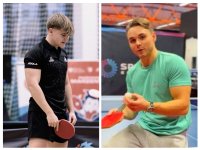
On saturday, The Dane played against my local team :) Cheeky little player, really fun to watch
Wow, he's bulked up a bit since I last saw him. He's starting to look like Malte Möregårdh!
Terrific player tho, I enjoyed watching his matches at TTD
 

Attachments

  • 20260114_154627-COLLAGE.jpg
    20260114_154627-COLLAGE.jpg
    788.7 KB · Views: 56
This user has no status.
🏆 Top 1% Commenter
Well-Known Member
May 2011
2,432
2,906
6,938
Hey, @dingyibvs, I like your approach of deconstructing the stroke and identifying the parts, and seeing it then as an orchestrated composition of the parts, where the timing of them is crucial.

What I'd like to add, is that always when you have parts, there can be, and usually is, multiple ways to join them together. In this case e.g. there is really many ways to join them together and perform a stroke. And for me one crucial point is following. If you imagine it as a set of all possible performances of a given stroke, how do you find the optimal one (stating it kind of mathematically, LOL). And for me the driver to find the optimum is "natural-ness". It's like a guiding principle. It should feel natural. That is also why I like when Anders Lind stresses that you should be relaxed. He doesn't put in those terms like I do above. But being relaxed is the way to make it natural, and that is the way to make it optimal... For me this principle also simplifies things, and lets me not worry about many things, because I now only need to worry about making sure it feels right... Of course being aware of those individual parts is super useful too...
I think if you practice any motion as much as Anders Lind it'll probably feel natural lol. A lot about TT is unnatural IMO. For example, if a ball flies to your right and you mean to catch it, your first reaction would be to reach out your arm/hand. In TT, you need to avoid reaching and your first reaction needs to be to close the distance with your feet instead. I think it should feel as natural as possible...with constraints specific to TT, otherwise most people who play a lot would have good technique.

But yes, there are certainly multiple ways to join those parts together. I don't know if there's an optimal way to do so, it might be different from person to person. I personally prefer to join them together from the bottom up on the FH side, and the opposite on the BH side.
 
  • Like
Reactions: latej
This user has no status.
🏆 Top 1% Commenter
Well-Known Member
May 2011
2,432
2,906
6,938
The issue is not whether the elbow moves (for example, the Louis Levene video says that keep it still, it is going to move, but you want to avoid a bad plane of motion and make it primarily a pivot point), but whether its movement is driven primarily by active upper arm engagement vs being driven by the core, especially as a source of power. Moreover, is claiming the elbow doesn't move going to hurt a player's ability to learn the technique, which is what you are arguing. A couple of things to note: just about all table tennis techniques are throwing motions. Does throwing engage the upper arm which moves the elbow? If the elbow moves, does it move relative to the body because the upper arm is being engaged to consciously move it or as a result of the momentum from other body parts?

You see it as a conscious decision to engage the upper arm to move the elbow. I do not. If it works for you, it works for you. But I would not teach it that way. And I would not fault a coach who didn't teach it that way. If a coach did and it worked for his student, he should not be faulted either, because the goal is effective technique, not textbooks. But i am fairly confident with my experience teaching the stroke that a lot of backhand effectiveness is easier to understand when you start with a principle of limiting upper arm movement to keep the elbow still. You can learn other things by trying to do full power swings with various finishing positions. I have never had a student who I told to not move the elbow whose elbow didn't move. And I have never had a student whose stroke didn't improve when they were told to not use the upper arm because it restricted the plane of motion in which they used their stroke and increased their spin. Once they got this, the rest really didn't matter.

And I have never learned or understood a stroke as knowing how every joint or muscle works to drive it and in my experience most people would not understand it that way. Biomechanical expertise can help with coaching, but it doesn't necessarily help adult learners without it learn strokes. You have to speak in terms of things they feel and can experience to guide them towards the right result. Now if in some case someone with biomechanical expertise is coaching a student with it, maybe that can work. But coaching is almost never one size fits all. I try to communicate movement patterns and adjust through trial and error.

The most common analogy for a backhand topspin is throwing a frisbee. If one learns to backswing with a reasonable elbow position and then learns to swing out of that with guided instruction (or even unguided instruction but using the frisbee analogy), one will get an effective backhand topspin.
Perhaps the difference is in personal coaching vs. online tutorials. You can observe your students' motions, recognize that they're moving their elbows but not at the point of contact and OK it, thus they continue with the correct motion even while not executing your instructions to a tee.

Also, I think it's clear by the abundance of erroneous instructions by high level players/coaches that you don't need to understand a stroke in all its details to learn a stroke. The question I have is whether knowing it can help with coaching. IMO it does. What I think it helps most is in that it allows you to break down the motion into smaller components, so that a student can practice particularly troublesome areas in isolation, perhaps even without a table or even a ball, and thus boost the efficiency of training which is very important for adult learners with time and club access constraints.
 
  • Like
Reactions: blahness
This user has no status.
🏆 Top 1% Commenter
Well-Known Member
May 2011
2,432
2,906
6,938
Tried it out today (Thurs) at the club, the new form is already making a pretty good difference. Just 2 days ago in a practice it was really only useful in service receives, and now it's useful in games, and I didn't even have time to practice the stroke beforehand. I'm constantly amazed by how quickly my BH takes to changes, but conversely also constantly amazed by how slowly my FH takes to changes. Really shows you how much quicker learning a new technique is compared to correcting an old one.

Along the way I've also discovered a few other things about leading the arm stroke with elbow movement. First is that it really, really helps with timing. Even when close to the table when you don't really have time to actually move the elbow any noticeable amount, just by having a stroke that leads with the elbow allows you micro adjustments in timing that allows me to feel like every shot my rubber is solidly holding onto the ball before slinging it out. I feel like so long as I can read the spin correctly and know what angle my stroke should be to deal with it, I can counter anything on my BH side. I'm gonna start doing that more. I'm sure I'll miss a ton in the beginning, but I should be able to learn intuitively to relate certain racket angles to certain incoming balls.

The second thing, and this is in practice only but I suspect it'll hold true in games as well, is that it becomes much, much easier to loop down the line. Just thrust the elbow forward a bit more than usual and the down the line shot becomes very natural. Up to now I've struggled to consistently attack cross table, so haven't even tried to go down the line, but I plan to start doing that more both in practice and in games as I think I have the tools to do so now.

On a separate note, one of the guys I train pretty often with is just as determined of a student as I am, and he gets both more playing time and coaching than I do, so he keeps staying a step ahead of me. With my BH improvement I've closed the gap, maybe even eliminated it, in rallies (he still has a better BH, but I'm better with the FH). However, he's leaped ahead in the service/receive game. His BH flick is starting to become a real problem, and he recently learned a way to push long without looking like he's pushing long. I had just caught up to him in the short push, now he's added this variation that befuddles me. He says the way he does it is with his body, so I can't tell that he intends to push long by his wrist/arm movement. I'd be moving in for a short push and the ball ends up near the baseline. I'll need to learn how to deal with that and how to do that as well, and I also need to start working on my BH flick soon.
 
says Making a beautiful shot is most important; winning is...
🏆 Top 1% Commenter
Well-Known Member
Mar 2021
4,848
5,737
12,094
74ef7cc9-122c-4f63-9707-066a425df47b.jpeg
5743f437-22f3-445b-8bc1-3d00cac989b0.jpeg


NB: Today using BTY SK7 with both side D05
 
Last edited:
This user has no status.
🏆 Top 1% Commenter
Well-Known Member
Moderator
Oct 2014
19,975
26,537
70,891
Read 17 reviews
So my coach has been trying to get me to use my wrist on my backhand better and shorten it but between travelling for Christmas and working on Zyrre and the holidays, I havent had much time to train and I have had no coaching for a while. Saw my coach on MLTT today and smiled. But I have to figure out what I can do in the absence of coaching.

I went back to my old, larger motion and I was killing people with topspins lol. It my old motion I tend to get my elbow out (in my head at least for leverage and unload on the ball with my forearm). I can see that even if I go back to the wrist, this motion has a place in my arsenal, especially for 3rd ball misdirects and kills.

But the biggest thing I need to do is get a coach. The earlier you learn in life that standing still means falling backwards, the smarter your results will be.
 
This user has no status.
🏆 Top 1% Commenter
Well-Known Member
May 2011
2,432
2,906
6,938
So my coach has been trying to get me to use my wrist on my backhand better and shorten it but between travelling for Christmas and working on Zyrre and the holidays, I havent had much time to train and I have had no coaching for a while. Saw my coach on MLTT today and smiled. But I have to figure out what I can do in the absence of coaching.

I went back to my old, larger motion and I was killing people with topspins lol. It my old motion I tend to get my elbow out (in my head at least for leverage and unload on the ball with my forearm). I can see that even if I go back to the wrist, this motion has a place in my arsenal, especially for 3rd ball misdirects and kills.

But the biggest thing I need to do is get a coach. The earlier you learn in life that standing still means falling backwards, the smarter your results will be.
Elbow out with loose wrist that snaps at the end gives you the most powerful shot!
 
This user has no status.
🏆 Top 1% Commenter
Well-Known Member
Moderator
Oct 2014
19,975
26,537
70,891
Read 17 reviews
Elbow out with loose wrist that snaps at the end gives you the most powerful shot!
Getting so coaching again would help resolve some of this. You are right though, maybe I should just get video and start doing some of the hard work myself. And use spinsight.
 
  • Like
Reactions: dingyibvs
This user has no status.
🏆 Top 1% Commenter
Well-Known Member
Oct 2010
2,860
2,798
10,530
Interesting insight - I will certainly try this tomorrow at practice. As someone who has done (and continues to do) a lot of work on the BH I am interested in your perspective on racket height at end backswing/start forward swing vs backspin (open up) I have done a lot of work after a lot of feedback from strong BH players trying to keep the racket at or around table height, which is not that dissimilar to playing a topspin ball. The focus being very much on a forward motion, with a contact point slightly lower than when playing top. It is something I have struggled with - it takes a lot of confidence and commitment to pull off, as opposed to a lower start point and then wrapping over the ball to create the arc. I have attached a short video of Sam Walker demonstrating what he was trying to convey to me.

There are a trick to this. You notice that at max backswing the racket angle is super closed, at contact it is roughly open and then during the followthrough it is closed again. At first i didnt understand it either, but the closed to open movement really helps to lift the ball especially against heavy af underspin so you dont need to go so low with the preparation anymore. You do need to have it closed during the followthrough to get more topspin as you roll the ball forward. FZD and LSD BH does have this kind of structure.

My understanding is that the wrist extension (which acts to open up the racket angle) is responsible for the lifting effect, and the forearm supination creates the spin and closes the racket angle. It is very complex, but i learnt it accidentally when i was attempting chiquita against heavy underspin, and this is pretty much the only way to chiquita heavy underspin without ridiculous movement or force. So it is just applying this to the full BH loop too. Against topspin you simply dont lift the ball with the wrist extension anymore, just focus on supination. So this is why the stroke looks very similar vs underspin and vs topspin coz you are just adjusting the wrist extension somewhat.

In my experience, the wrist extension must activate before the supination otherwise the lifting effect would be completely absent and the ball will go into the net. This requires very precise timing and is hard.
 
  • Like
Reactions: Wrighty67
This user has no status.
🏆 Top 1% Commenter
Well-Known Member
Jan 2022
1,546
1,459
5,139
Read 7 reviews
There are a trick to this. You notice that at max backswing the racket angle is super closed, at contact it is roughly open and then during the followthrough it is closed again. At first i didnt understand it either, but the closed to open movement really helps to lift the ball especially against heavy af underspin so you dont need to go so low with the preparation anymore. You do need to have it closed during the followthrough to get more topspin as you roll the ball forward. FZD and LSD BH does have this kind of structure.

My understanding is that the wrist extension (which acts to open up the racket angle) is responsible for the lifting effect, and the forearm supination creates the spin and closes the racket angle. It is very complex, but i learnt it accidentally when i was attempting chiquita against heavy underspin, and this is pretty much the only way to chiquita heavy underspin without ridiculous movement or force. So it is just applying this to the full BH loop too. Against topspin you simply dont lift the ball with the wrist extension anymore, just focus on supination. So this is why the stroke looks very similar vs underspin and vs topspin coz you are just adjusting the wrist extension somewhat.

In my experience, the wrist extension must activate before the supination otherwise the lifting effect would be completely absent and the ball will go into the net. This requires very precise timing and is hard.
Good observation and I can see that as it happens - often I don't get the final supination on follow through and the ball goes long as a result.
 
This user has no status.
I have given myself five more months to decide on my main blade and rubber combo for the following season. I promise myself to stick to one set up for a full year after that. My three remaining contenders are Stiga pure, Yasaka Ma Lin Extra offensive and Sanwei Inner PBO. For rubbers, I will use the Super FX 1 mm to compare the blades, and Rxton 3 green, Rhyzen Fire, Stiga Mantra Pro, Mercury 2 and Moon 12 as complements. Hard and fun work awaits!
 
This user has no status.
🏆 Top 1% Commenter
Well-Known Member
Moderator
Oct 2014
19,975
26,537
70,891
Read 17 reviews
So Spinsight has given me a new appreciation for my game so far even though I have only used it twice. It has helped me see that my forehand and backhand are almost equal in quality, as crazy as it sounds, and that is my superpower more than anything else. Some may say it means my forehand is crappy or that my backhand is really good, but I will look at it as what my old coach used to call it - extremely balanced.

We did drills on ball quality, and despite being the highest rated player in this group of 3 players, I maxed out at 116 (with averages consistently above 100) in forehand loop to block, while my training partners got closer to 120. So I am appreciating more that my skill is not so much spin but consistent placement. And while I will try to get fitter, I won't focus so much on ball quality as I will on improving the precision of my placement. Work harder on hitting corners and white lines.
 
This user has no status.
🏆 Top 1% Commenter
Well-Known Member
May 2011
2,432
2,906
6,938
So Spinsight has given me a new appreciation for my game so far even though I have only used it twice. It has helped me see that my forehand and backhand are almost equal in quality, as crazy as it sounds, and that is my superpower more than anything else. Some may say it means my forehand is crappy or that my backhand is really good, but I will look at it as what my old coach used to call it - extremely balanced.

We did drills on ball quality, and despite being the highest rated player in this group of 3 players, I maxed out at 116 (with averages consistently above 100) in forehand loop to block, while my training partners got closer to 120. So I am appreciating more that my skill is not so much spin but consistent placement. And while I will try to get fitter, I won't focus so much on ball quality as I will on improving the precision of my placement. Work harder on hitting corners and white lines.
Mine has been somewhat as expected, as my FH is clearly much stronger. I got my spinsight as well and only got to try it out against the robot thus far. My regular BH loop vs backspin is usually in the 110's. Interestingly when I really try to add spin by brushing hard it's still in the 110's, just slower. When I go all out it's in the 120-130 range but the consistency is terrible.

On the FH side OTOH my regular loop drives against backspin is in the 120s while I can get it to the 130's if I loop hard, all with good consistency. These are all against fairly spinny (~40), not super tight but fairly low half long backspins.

Looking at the pros it really gives me an appreciation of how much more I need to work on my BH. They can often generate the highest spin on the BH side, and even speed wise it's just a tad slower. I think the issue is that I'm so FH oriented that I don't feel comfortable getting my body into a completely BH oriented stance.
 
Top