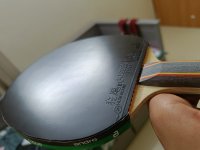
Mmm... honestly not sure if the hinoki aromatic oil would do much., but i do t see the harm in tryi g it either. Just be aware you might ruin your rubber in the process. Hinoki (from memory) gets its scent from
D-limonine, which (again from memory) is the same aromatic chemical that's in lemon peel and lemon grass. Its aromatic, which means its also somewhat volatile, but I dont know if its got the necessary molecular structure to act as a weak rubber solvent.
As for the turpene-impregnated core, I honestly don't know if that would work either. 😂😂 Lots of blades out there have spruce medials but dont have a VOC problem, which tells me that when you slice the stuff that thin, it loses its terpines pretty damn quick due to higb surface area and very low mass and thickness. To have a blade release its VOCs slowly over time, it would need to be thicker than a house brick.
ALTHOUGH....
Holy Shit!
🤯🤯🤯🤯🤯🤯🤯
Your comment and this whole thread combined have just given me a bloody brilliant idea!
...Jesus! I wonder if it would work?? 🤔🤔🤔🤔🤔🤔🤔🤔🤔🤔🤔🤔🤔
Ummm...
Ahh Bugger it -- why not? 🤷♂️🤷♂️
(ahem)
HEY!! ATTENTION PLEASE!!
EVERYBODY OUT THERE IN TTD LAND!
📣📣📣📣📣📣
Can I please have a quick show of hands, via the "like button below?
Hands up all the H3 and Booster users out there, who would like me to develop a "WAKKIBAT BOOSTER HOTBOX"?
..WHICH IS BASICALLY JUST A CONBINATION BAT STORAGE BOX / HOT BOX FOR YOUR BLADES AT HOME.
MADE WITH VERY THICK WALLS FROM NATURALLY HIGH TURPENE TIMBER?
Idea being, your store your blades sporting H3 rubbers hanging in the Booster Box at home between games.
IF YOU THEN PUT IT SOMEWHERE WARM -- IN THEORY, -- IT SHOULD GENTLY COAT YOUR RUBBERS IN NATURALLY OCCURING GASEOUS TURPENES EMITTED FROM THE WOOD -- THEREBY KEEPING THEM SUPER STICKY BETEEEN MATCHES.
It's the perfect product, for all those who don't own a four-story old-growth spruce attic in Nordic lattitudes, and who don't mind bending ITTF rules about modifying your playing rubbers 🤣🤣🤣🤣🤣😉😉
DISCLAIMER:
I've no bloody idea if this invention will work the way I intend yet.
Resinous terpines are not the most cooperative things to harness. There's lots of different types of them, and they are emitted at different times, at different rates, and at different temperatures, depending on their volatility.
Not all of them would necessarily work on every tacky rubber either. There's lots of semi-cured elastomers out there in TT rubber land, and not all of them are going to react the same to the same terpines the exact same way.
Some rubbers may get super sticky over time, others however may end up being a black and red puddle of goo stuck to the bottom of the booster box in a matter of days.
All I can say at this point, is that the science behind it is utterly sound!
Resinous timber terpines are known to chemically alter the composition of certain rubbers, and partially dissolve them.
It's basically the exact same family of chemicals that a lot of boosters are made from anyway.
My disclaimers aside, if this sounds like a good idea to you, please indictate your approval via the like button below. 👇👇
If I get enough interest, I'll start developing one.
It may take me a while to get the mix and proportions of different timbers just right, and it might only have a limited shelf life, as its natural turpine levels are going to naturally decline over time, at which point you may need to put a small saucer of booster in the box as well, in order to get it to work.
But its also far from the dumbest TT Accessory idea ive ever had 🤣🤣🤣
...and I already know the PERFECT timber to start experimenting with, which of course just happens to be Australian, as all the world's best TT woods are... 👇👇👇
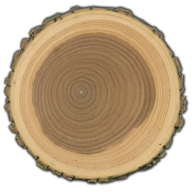
www.wood-database.com
(If you'd like to send me an EOI or pre-order one yourself, please send me a DM to that effect, rather than post in this thread -- ...dont want to derail the thread any more than I already have 😊😊)