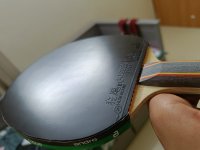
I accidentally made a Chinese rubber insanely tacky — so I started experimenting

Appreciate your scientific research 😂. I had a 10 year old Hurricane 3 Neo Commercial that I stowed away. I was going through my stuff and found it. I was truly surprised that it was still insanely tacky. It was able to hold the ball for several seconds. All I did was clean it with water, put a film over it and put it inside an opened rubber package and film. I glued it on a blade to see how it played. The topsheet’s tack was still gripping but the sponge was completely dead though lmao. I’m not sure if I threw it away or not. But like you, I’ve been trying to find a tacky yet powerful enough rubber. It’s true that the rubbers now don’t have the same amount of tackiness it use to have. Two sheets of Battle 2 Provincial and National Blue Sponge along with two sheets of H3N Commercial have lost there extreme tack from new. I have a Gambler X3 Diamond Gold Label on my Xiom Hayabusa ZXi and it’s about a year going on two years old and the tackiness is still great. It will pull the ball up maybe stick for a couple seconds depending on how clean it is. I always keep a film over it when not played. I met with the owner of Gambler and the guy helping her run it has X3D on his blade but it was completely non tacky. The lady owner commented about how I kept the film over it and preserving the tackiness, I guess the rubber is supposed to feel much lively after the tackiness wears off?? Well I tried to wear it down but I couldn’t. Yet, I honestly think it plays better with the tackiness. I just put another sheet of X3D gold label on my FZD ALC and I’m really liking it way better than the H3N commercial I had on there. I tried the X3D unboosted but it was lacking, after two layers of haifu seamoon (although Gambler says it doesn’t need it) it plays incredibly better. I’m keeping it on my FZD ALC and see how it continues to play. Definitely try it out. The owner says they have asked the manufacturer to tone down the tackiness, so I may need to do a lifetime buy on the current stock if this one plays out great.
 
This user has no status.
Member
Mar 2022
431
680
2,106
Nice thinking, and ambitious post 👏 i think we could get along quite well and have very interesting discussions :LOL:


Very valid and interesting factors that you are bringing up with the gases released by wood.
Below is the answers to some of your questions ---->

1.
The house is indeed a big old house 4 stories high if you count the attic. The attic is about 170 square meters, it is a non insulated area except for a small apartment on about 25 square meters. The house is located in Sweden. Roof height is about 2,5m in the middle where i have the table set up. So the temperatures can reach about 35-40c in the summer and it cools of quite fast during night time due to the lack of insulation.

2. The house was built 1928, all wood is completely exposed in the attic, no laminated materials or mdf so all solid high quality swedish 1920s spurce. even with the shifting temperatures i am pretty sure that the formaldehyd that the wood once contained is gone since long. When it comes to VOC i assume it is the same thing there, the release declines as 100 years go by? But sure, it could still be possible.

3. There are two small round windows in the attic, the light coming in from them could not have affected the rubber since the rubber layed semi face down on a shirt on top of a chair.

4. Pure Linseed oil is made from flaxseed/linseed, the soap i used is based on pure linseed oil, it does not contain rapeseed. But it is interesting that the treatment with the soap actually seemed to have an effect, and i will explore that further as well :)

5. Next summer i will try to reproduce this with several different kind of rubbers, i will make sure to update then :)

Bingo -- that would definitely do it. 😁😁

If the house was built in 1928 and has lots of exposed spruce timber, then the house would quite possibly be made of old-growth, forest grown spruce (if so then also -- niiiiice! 🥰🥰)

Old growth timber has old wood grain -- it's denser, stronger and has tighter growth rings to it, so a greater proportion of the wood is made up of latewood than you see with the younger plantation grown stuff. This means that the terpine count would naturally be a lot higher than with young plantation wood.

Also, there are some timbers that continue to produce terpines as they age -- and IIRC, some types of spruce fall into this category. So that also tracks. Plus old spruce timber beams from 1920 construction would be both bloody huge and very thick... and the thicker a beam of resinous softwood is, the slower it loses its terpenes (this is why the hinok roof beams you see in 600 year old Japanese temples can still smell of D-Limonine centuries after being harvested, as it's still gassing off from the timber.

Being built in a snow-prone country means the attic had a steep roof pitch to shed snow. This creates a narrow and tight but deep roof space, which helps concentrate gaseous volate extractives in the air to higher than normal levels.... just like the pitched roof of a fume tent.

The presence of the window just means that UV radiation can enter the room, and help raise the internal temperature of the air in tbe room, and/or shine directly on the floorboards, encouraging the terpenes in the wood to gass off through raising the wood's temperature. If the sunlight was shining directly on the blade that might have affected its ability to absorb VOCs as the outside of the rubber would harden and become crusty as its own VOCs escaped from its surface. But as you like tacky rubbers I guessed you'd know to keep them out of the sun. Plus it also means you robably wouldn't have set your blade down in a mound of dust. The dust would have reduced the surface area of the rubber, and prevented it from absorbing quite as many VOCs from the surrounding wood.

If the room was hugely humid that would have also prevented some of the terpines from leaving the wood, as moist air doesnt draw so many VOCs out of the timber as dry air would.

Additionally, the presense of the towel (EDIT: shirt sorry) may have had an effect too, as it might have soaked up some if the terpines itself and acted as a bit of a reservoir for them.

The shirt would have a much larger surface area than the rubber which aids absorbing-- plus If it was a cotton shirt then that also fits, as cotton is pure cellulose fibers - it's hugely absorbent stuff and has a predisposition towards sucking up VOCs as well as water.

Did the shirt (or the room itself) have any lingering, piney, timber-like smell to it when you went to collect the blade? If so then its almost a certainty your rubber either absorbed some of the terpines in the air which started dissolving the rubber, or else it became coated with precipitated spruce rosin, which itself is hugely sticky. 😎😎

Only reason I know all this is because as I make my blades from aussie timbers, I have to be very mindful of their terpene content, which can sometimes be quite high.

If i wasnt mindfull of this sort of stuff, a player could conceivably be chucked out of an ITTF tournament for having too many VOCs being emitted from their rubber or blade, through no fault of their own. 😁😁
 
Last edited:
  • Wow
Reactions: barusu
This user has no status.
🏆 Top 1% Commenter
Well-Known Member
Jan 2024
2,419
3,200
7,653
Read 2 reviews
Bingo -- that would definitely do it. 😁😁

If the house was built in 1928 and has lots of exposed spruce timber, then the house would quite posdibly be made of old-growth, forrest grown spruce (if so then also -- niiiiice! 🥰🥰)

Old growth timber has old wood grain -- it's denser, stronger and would have tighter growth rings than you see with the younger plantation grown stuff. This means that yhe terpine count would naturally be a lot higher than with you g plantation wood.

Also, there are some timbers that continue to produce terpines as they age -- IIRC spruce I think is one of them. So that also tracks.

Being built in a snow-prone country means a steep roof pitch to shed snow. This means a narrow tight roof space, which would helps concentrate gaseous volate extractives in the air to higher than normal levels.

The presense of the window just means that UV radiation can enter the room, and help raise the internal temperature of the air in tbe roo.. this also encourages the wood in the atic to start releasing its natural VOCs into the surrounding air. If the sunlight was shining directly on the blade that might have affected its ability to absorb VOCs as the outside of the rubber would harden and beco e crusty as its own VOCs escaped from its surface.

If the room was hugely humid that would have also prevented some of the terpines from leaving the wood.

Additionally, the presense of the towel may have had an effect, as it might have soaked up some if the terpines itself and acted as a bit of a reservoir for the terpines, as it would have a much larger surface area than the rubber. If it was a cotton towel then that also could ts, as cotton is hugely absorbent stuff.

Did the towel (or the room itself) have a lingering, piney timber-like smell to it when you went to collect the blade? If so then its almost a certainty your rubber either absorbed some of the terpines in the air which started dissolving the rubber, or else it became coated with precipitated spruce rosin, which itself is hugely sticky. 😎😎

This stuff is absolutely gold
 
  • Love
Reactions: Wakkibatty
This user has no status.
Member
Mar 2022
431
680
2,106
I have some hinoki aromatic oil from japan. Should i try to rub it on a rubber 🤔?

As a wood expert you should also create a booster infused blade so that we dont need to reboost for 600 years 😋
Mmm... honestly not sure if the hinoki aromatic oil would do much., but i do t see the harm in tryi g it either. Just be aware you might ruin your rubber in the process. Hinoki (from memory) gets its scent from
D-limonine, which (again from memory) is the same aromatic chemical that's in lemon peel and lemon grass. Its aromatic, which means its also somewhat volatile, but I dont know if its got the necessary molecular structure to act as a weak rubber solvent.

As for the turpene-impregnated core, I honestly don't know if that would work either. 😂😂 Lots of blades out there have spruce medials but dont have a VOC problem, which tells me that when you slice the stuff that thin, it loses its terpines pretty damn quick due to higb surface area and very low mass and thickness. To have a blade release its VOCs slowly over time, it would need to be thicker than a house brick.

ALTHOUGH....

Holy Shit!

🤯🤯🤯🤯🤯🤯🤯


Your comment and this whole thread combined have just given me a bloody brilliant idea!

...Jesus! I wonder if it would work?? 🤔🤔🤔🤔🤔🤔🤔🤔🤔🤔🤔🤔🤔

Ummm...

Ahh Bugger it -- why not? 🤷‍♂️🤷‍♂️

(ahem)

HEY!! ATTENTION PLEASE!!
EVERYBODY OUT THERE IN TTD LAND!
📣📣📣📣📣📣

Can I please have a quick show of hands, via the "like button below?

Hands up all the H3 and Booster users out there, who would like me to develop a "WAKKIBAT BOOSTER HOTBOX"?

..WHICH IS BASICALLY JUST A CONBINATION BAT STORAGE BOX / HOT BOX FOR YOUR BLADES AT HOME.

MADE WITH VERY THICK WALLS FROM NATURALLY HIGH TURPENE TIMBER?

Idea being, your store your blades sporting H3 rubbers hanging in the Booster Box at home between games.

IF YOU THEN PUT IT SOMEWHERE WARM -- IN THEORY, -- IT SHOULD GENTLY COAT YOUR RUBBERS IN NATURALLY OCCURING GASEOUS TURPENES EMITTED FROM THE WOOD -- THEREBY KEEPING THEM SUPER STICKY BETEEEN MATCHES.

It's the perfect product, for all those who don't own a four-story old-growth spruce attic in Nordic lattitudes, and who don't mind bending ITTF rules about modifying your playing rubbers 🤣🤣🤣🤣🤣😉😉


DISCLAIMER:
I've no bloody idea if this invention will work the way I intend yet.

Resinous terpines are not the most cooperative things to harness. There's lots of different types of them, and they are emitted at different times, at different rates, and at different temperatures, depending on their volatility.

Not all of them would necessarily work on every tacky rubber either. There's lots of semi-cured elastomers out there in TT rubber land, and not all of them are going to react the same to the same terpines the exact same way.

Some rubbers may get super sticky over time, others however may end up being a black and red puddle of goo stuck to the bottom of the booster box in a matter of days.

All I can say at this point, is that the science behind it is utterly sound!

Resinous timber terpines are known to chemically alter the composition of certain rubbers, and partially dissolve them.

It's basically the exact same family of chemicals that a lot of boosters are made from anyway.

My disclaimers aside, if this sounds like a good idea to you, please indictate your approval via the like button below. 👇👇

If I get enough interest, I'll start developing one.

It may take me a while to get the mix and proportions of different timbers just right, and it might only have a limited shelf life, as its natural turpine levels are going to naturally decline over time, at which point you may need to put a small saucer of booster in the box as well, in order to get it to work.

But its also far from the dumbest TT Accessory idea ive ever had 🤣🤣🤣

...and I already know the PERFECT timber to start experimenting with, which of course just happens to be Australian, as all the world's best TT woods are... 👇👇👇
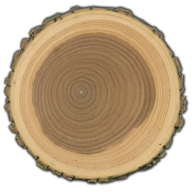

(If you'd like to send me an EOI or pre-order one yourself, please send me a DM to that effect, rather than post in this thread -- ...dont want to derail the thread any more than I already have 😊😊)

 
Last edited:
  • Wow
Reactions: Archosaurus
This user has no status.
🏆 Top 1% Commenter
Well-Known Member
Jan 2024
2,419
3,200
7,653
Read 2 reviews
So what you're saying @Wakkibatty is I should build a sauna hut so I can store my TT gear there? :p nice and thick timber but constructed with a lot of surface are exposed in order to work quickly.
 
Top