

SDC Handmade Blades

SDC

This user has no status.

SDC

This user has no status.
🏆 Top 1% Commenter
Well-Known Member
Dec 2011
1,789
3,532
5,922
Not sure if this is going towards derailing the topic, so please let me know if it does and I'll take it elsewhere.
The connection between Stiga blades' loud feedback and the wood used dawned on me today. Spruce and Ayous are pretty close in general density as well as hardness, and that would make vibration travel pretty easily through the core and medial layers.
Am I spewing nonsense here, or is that part of the signature Stiga feedback?
Does limba/limba/ayous leave the vibration more in the top layers, and limba/ayous/ayous bring it more to the core?
Such an interesting topic...
The other day I played a couple of balls with a butterfly Joo Sae Hyuk, but that's planchonello/koto/ayous and similar to the diode V except for the thickness. I found it to be very familiar to my taste of limba/limba blades, so now I'm thinking my preference may be for blades with similar veneers in top and medial layers.
It's fine 🙂.

Well, not really... "Spruce" is a very generic term that, us TT players, use to describe a bunch of woods that are have a similar appearance (grain structure), but may have very distinct properties. Spruce itself has many varieties, Engelmann and Sitka are the most commonly used and they are close to Ayous, but then we have many other species that look like Spruce but aren't, such as Hemlock, Douglas Fir, WRC, Cypress, Pine... Some of these have very distinct properties. So, it's important to identify which blades you are talking about, because not all of them use Spruce, for example Stiga uses Douglas Fir a lot, and it can be much harder than Spruce, so that's not the correlation. The thing that Stiga does in most of their blades is to use a thick core and thin outer layers, and that's where it comes from.

As for the second part of the question, I've wrote this many times but here it goes again. "Planchonello" is not a wood species, it's not even a word, it doesn't exist outside the TT world because someone made it up. "Planchonella", on the other hand, exists, but it's also not a wood species, it's a genus (family of trees), but you still need to identify the sub-species. Out of these, the most commonly used in TT (and only that comes to mind) is Planchonella pachycarpa aka Goiabao. Goiabao is very hard and heavy, nothing like the top ply of the JSH. The top ply of the JSH is relatively soft and light, I know this because I've removed from a blade once and saw the medial layer as well (which is definitely Koto). Here I don't have a definitive answer, but I believe the wood is some sort of variation of Meranti, Meranti is usually more red but the grain is very similar. So maybe this was even the reason to discontinue the blade, the material may have become hard to find. However, most of the JSH's touch comes in fact from the relatively thick Koto medial.

So, what it seems to me, is that you favor blades with thinner cores and thicker medial and outer layers, instead of thick cores and thin medial and outer.
 
This user has no status.
It's fine 🙂.

As for the second part of the question, I've wrote this many times but here it goes again. "Planchonello" is not a wood species, it's not even a word, it doesn't exist outside the TT world because someone made it up. "Planchonella", on the other hand, exists, but it's also not a wood species, it's a genus (family of trees), but you still need to identify the sub-species. Out of these, the most commonly used in TT (and only that comes to mind) is Planchonella pachycarpa aka Goiabao. Goiabao is very hard and heavy, nothing like the top ply of the JSH. The top ply of the JSH is relatively soft and light, I know this because I've removed from a blade once and saw the medial layer as well (which is definitely Koto). Here I don't have a definitive answer, but I believe the wood is some sort of variation of Meranti, Meranti is usually more red but the grain is very similar. So maybe this was even the reason to discontinue the blade, the material may have become hard to find. However, most of the JSH's touch comes in fact from the relatively thick Koto medial.

So, what it seems to me, is that you favor blades with thinner cores and thicker medial and outer layers, instead of thick cores and thin medial and outer.

I think I found your plywood sample on sale - as well as some other things that might seem interesting, they are waiting for you on Instagram.
And yes, in the end, it's probably Meranti (light red, for my taste).
I hope it will be useful to you :)
 
  • Like
Reactions: SDC

SDC

This user has no status.

SDC

This user has no status.
🏆 Top 1% Commenter
Well-Known Member
Dec 2011
1,789
3,532
5,922
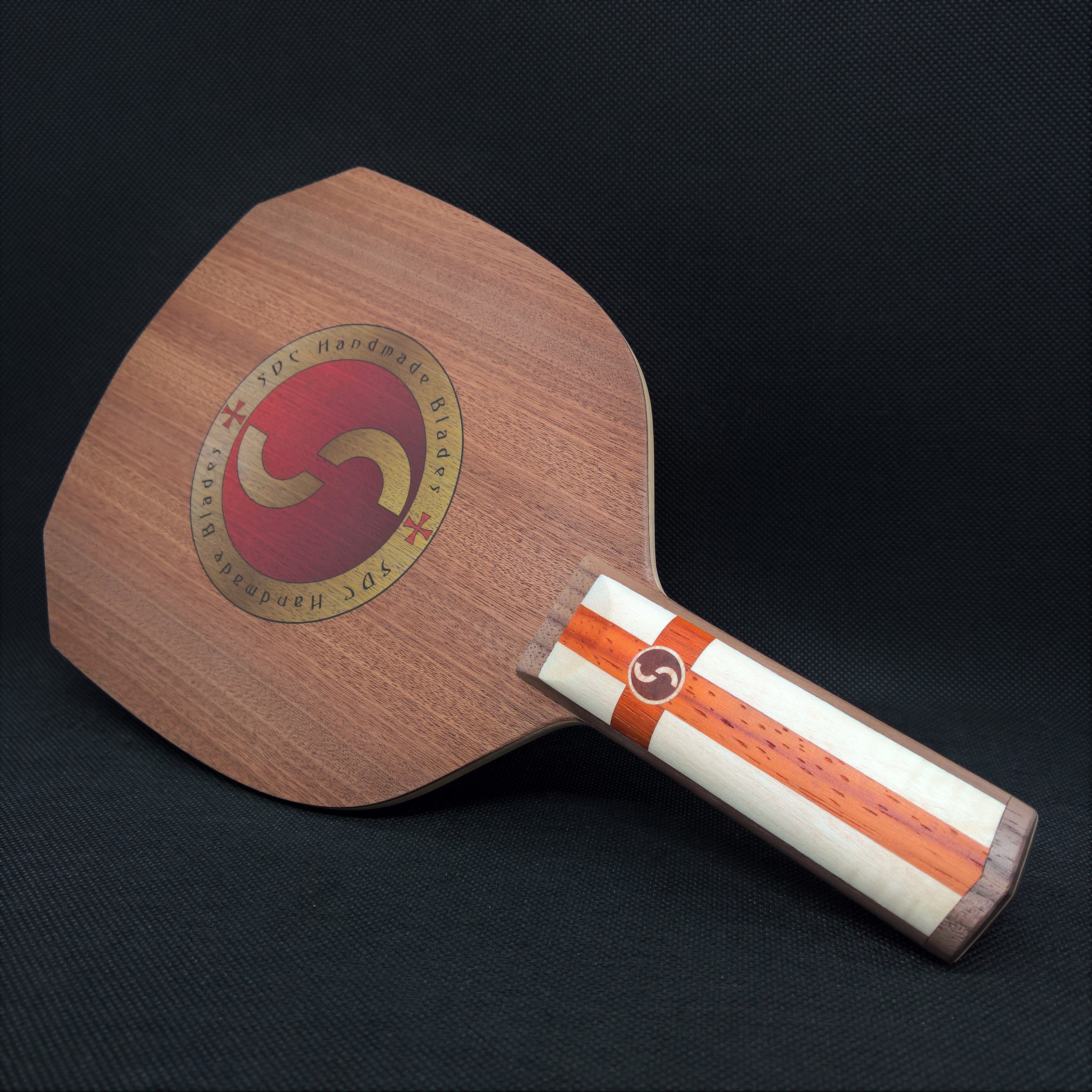
Can we have a round shape which would achieve these cyber-shape benefits?
Sometimes I forget about things I already made.

490-1.jpg


The "Shield" is somewhat what I was saying, but it can be modified a bit by rounding the upper edges and reducing the area on the bottom part.
 
This user has no status.
Member
Mar 2022
420
677
2,038
It's fine 🙂.

Well, not really... "Spruce" is a very generic term that, us TT players, use to describe a bunch of woods that are have a similar appearance (grain structure), but may have very distinct properties. Spruce itself has many varieties, Engelmann and Sitka are the most commonly used and they are close to Ayous, but then we have many other species that look like Spruce but aren't, such as Hemlock, Douglas Fir, WRC, Cypress, Pine... Some of these have very distinct properties. So, it's important to identify which blades you are talking about, because not all of them use Spruce, for example Stiga uses Douglas Fir a lot, and it can be much harder than Spruce, so that's not the correlation. The thing that Stiga does in most of their blades is to use a thick core and thin outer layers, and that's where it comes from.

As for the second part of the question, I've wrote this many times but here it goes again. "Planchonello" is not a wood species, it's not even a word, it doesn't exist outside the TT world because someone made it up. "Planchonella", on the other hand, exists, but it's also not a wood species, it's a genus (family of trees), but you still need to identify the sub-species. Out of these, the most commonly used in TT (and only that comes to mind) is Planchonella pachycarpa aka Goiabao. Goiabao is very hard and heavy, nothing like the top ply of the JSH. The top ply of the JSH is relatively soft and light, I know this because I've removed from a blade once and saw the medial layer as well (which is definitely Koto). Here I don't have a definitive answer, but I believe the wood is some sort of variation of Meranti, Meranti is usually more red but the grain is very similar. So maybe this was even the reason to discontinue the blade, the material may have become hard to find. However, most of the JSH's touch comes in fact from the relatively thick Koto medial.

So, what it seems to me, is that you favor blades with thinner cores and thicker medial and outer layers, instead of thick cores and thin medial and outer.

Plus one on all the above about Planchonella. I have also gone looking for a commercial supply of ANY genus of Planchonella myself in the past, and found nothing (and numerous species of the stuff grows all over the top end of Australia). The Planchonella genus is *not* in commercial cultivation anywhere in Australia to the best of my knowledge, and I haven't found any supplies of it overseas either. If you want Planchonella, or ever manage to find some, then it most likely either came from private land or else fell off the back of a tropical rainforest (ie: wild-felled or illegally logged).

Having never seen a JSH up close I can't comment on the hardness of the outers, but I have no reason to doubt Sergio's assessment, as it rings entirely true to me as well -- having super hard outers and softer medials on a defensive blade is a pretty odd decision frankly, but putting soft outers over thick koto medials makes enormous sense.

As for the JSH's outer being Meranti, that is also entirely possible.... But it depends on what type you're using -- unfortunately much like Planchonello, there actually is no such thing as a Meranti tree.

Meranti is not one species, but several. Meranti is the Timber industry's name for about 30-50 different species of Shorea, an entire genus of over 80 separate species tropical hardwoods. Shorea is native to places/ climates like Papua New Guinea and (from memory) The Philippines. The stuff is classified by its weight, colour and stiffness as opposed to being a particular species.

Light Red Meranti for example is made up of at least 8 different species of Shorea, and the light bit in its name refers to it's weight, not it's colour. (Most of the time it's also not actually red at all, as opposed to a dirty flecked cream colour, graduating to light powdery grey, then to powder pink at the other extreme). Very little LRM is actually red.

LRM *can* make a really lovely core or medial, as some of it is very similar to Ayous in density. It could conceivably be used in an outer too, but it depends on which of it's various species you end up getting, as for blade making purposes, LRM's properties varies HUGELY. The powder pink variety for sale locally for example is too soft to be used as an outer. In terms of hardness and consistency, it is probably better described as 'very dense and slightly hard powder pink balsa".

The grey stuff can make a really nice core if you can find it, but that particular subset of Shorea seems to be getting rarer and rarer with various wood wholesalers, which makes me wonder at times just how sustainably some of this stuff is sourced.

Long story short, I completely agree with Sergio re: playing feel -- don't fixate too much on the outer woods alone, as it's always about the entire blade, not just one layer.
 
Last edited:
Before I got into table tennis I spent many years geeking out over details in electric guitars and their materials/construction.

In that time I've developed the strong opinion that guitar people are dorks! 🤣 Because so many of them believe 1 wood is capable of this or that sound and another wood isn't.

Through years of playing, listening and experiencing, I'm more certain than ever that it's the construction of a guitar that matters more, over the materials to achieve certain signature sounds.

But debates still rage on about maple or rosewood fretboards and ash or mahogany bodies. Largely in my opinion, due to historical marketing and accepted ideas cemented in the early days of electric guitars in the 50s and 60s and passed down generations through 'folk belief' and not necessarily objective fact.

So I wonder if something similar is happening in TT with how people believe one blade is capable of certain things over another because they have a different outer ply, as an example.

The thing that bugs me most often is the belief that koto or limba makes a significant difference, when so often the examples given are completely different constructions e.g VIS Vs W968.

So @hipnotic and @Wakkibatty as blade makers do you think construction or wood species is more important for a blade to achieve it's signature performance?

Assuming the same ply dimensions etc:

Would a VIS structure blade still perform recognisably like a viscaria if it was built with ayous core and limba top ply?

Would a clipper style blade perform recognisably like a clipper if made with 5 layers of Kiri and koto outer plys?

Curious to see what you think. Thanks for any insight you can share.

And bonus question for everyone: do you think TT players are dorks? 😂
 
This user has no status.
🏆 Top 1% Commenter
Well-Known Member
Jan 2024
2,210
2,885
6,904
Read 2 reviews
I think the keyword here is electric. The body and neck of an electric guitar play but a tiny role in its sound. A sound which is largely influenced by the amplifier used even if we forget about effects.
The electronics in it make up most of the variables in sound.

In general terms, yes, an outer carbon blade is an archetype with partial behaviour that remains the same throughout each individual blade. The composite layer activates early in the force curve

In similar regards, any 7-ply blade will have a larger sweet spot and stiffness than a 5-ply made in the same materials and total thickness.

This doesn't mean you can't put long pimples on a Viscaria. Or play a flex-based topspin stroke with a stiff 7-ply. It just doesn't work as well.

Also, yes, you can play country on a Spanish guitar, even if we're talking acoustic guitars. That doesn't make it the best suited guitar for the particular sound. But, do you need the best suited guitar, or can you just select one that looks and feels good?
 
This user has no status.
Member
Mar 2022
420
677
2,038
Before I got into table tennis I spent many years geeking out over details in electric guitars and their materials/construction.

In that time I've developed the strong opinion that guitar people are dorks! 🤣 Because so many of them believe 1 wood is capable of this or that sound and another wood isn't.

Through years of playing, listening and experiencing, I'm more certain than ever that it's the construction of a guitar that matters more, over the materials to achieve certain signature sounds.

But debates still rage on about maple or rosewood fretboards and ash or mahogany bodies. Largely in my opinion, due to historical marketing and accepted ideas cemented in the early days of electric guitars in the 50s and 60s and passed down generations through 'folk belief' and not necessarily objective fact.

So I wonder if something similar is happening in TT with how people believe one blade is capable of certain things over another because they have a different outer ply, as an example.

The thing that bugs me most often is the belief that koto or limba makes a significant difference, when so often the examples given are completely different constructions e.g VIS Vs W968.

So @hipnotic and @Wakkibatty as blade makers do you think construction or wood species is more important for a blade to achieve it's signature performance?

Assuming the same ply dimensions etc:

Would a VIS structure blade still perform recognisably like a viscaria if it was built with ayous core and limba top ply?

Would a clipper style blade perform recognisably like a clipper if made with 5 layers of Kiri and koto outer plys?

Curious to see what you think. Thanks for any insight you can share.

And bonus question for everyone: do you think TT players are dorks? 😂
It's both really.... It's construction variables, AND the wood that matters.

Sometimes a wood is easily replaceable, sometimes it isn't, depending on the timber's properties.

For example, I've tried finding commercially available alternatives to balsa, and thee aren't any. There's a few alternatives out there to Kiri, but again, the issue is finding a regular supply.

Ultimately it's never just one factor though, such as the wood you use (or at least very, very rarely is it just one major factor).

A blade is always more than the sum of its parts, plus the care, knowledge, skill and technique of its maker.

The rubbers you choose to whack on it also changes the end result. No one rubber will work equally well on every single blade out there, and vice versa.

(Rumour has it, the person hanging onto the end of the thing and swinging it through the air, also has a bit of a role to play in how a blade performs 😜😜)
 
says Leave the righteousness to me.
🏆 Top 1% Commenter
Well-Known Member
Nov 2020
1,611
1,467
6,999
(Rumour has it, the person hanging onto the end of the thing and swinging it through the air, also has a bit of a role to play in how a blade performs 😜😜)

Pure rumour, you sound like conspiracy theorist here...
 
  • Haha
Reactions: Wakkibatty
I think the keyword here is electric. The body and neck of an electric guitar play but a tiny role in its sound. A sound which is largely influenced by the amplifier used even if we forget about effects.
The electronics in it make up most of the variables in sound.
I entirely agree with this, but I don't think you've followed my example as I meant it. Of course the electronics and the chosen amplification and effects make differences. However what I'm suggesting in guitar example is that when using the same amp and effects but changing a wooden material aspect of the guitar in isolation eg an ash body Vs same guitar with mahogany body the guitar's sound is ostensibly the same because of the method and quality of the construction, not necessarily the choice of woods.

You can make a Fender Stratocaster entirely from mahogany and it will still sound like a Fender Stratocaster. Yes maybe a little darker and mid range focused than a Strat made with the usual ash/alder body and maple neck. But ultimately it will sound like a Stratocaster.

It's both really.... It's construction variables, AND the wood that matters.

...

A blade is always more than the sum of its parts, plus the care, knowledge, skill and technique of its maker.

I understand it's always a mix of things that matters. I'm just particularly curious whether the materials or the engineering hold more sway in the end result.

(Rumour has it, the person hanging onto the end of the thing and swinging it through the air, also has a bit of a role to play in how a blade performs 😜😜)

No, this is why you need the right blade to do the work for you. It's because we all have unique swings and as humans it's impossible for us to learn or adapt. And because carbon is sentient and can somehow "activate" if it likes the smell of the particular ink on a particular type of ball...... 🤔
 
This user has no status.
Member
Mar 2022
420
677
2,038
I understand it's always a mix of things that matters. I'm just particularly curious whether the materials or the engineering hold more sway in the end result.
In the case of a blade, materials and engineering are indivisible. The materials guide the engineering and vice versa.

Can you substitute timber? Sure... But if you don't use the same timber every time then you don't get the same result, and most good players can spot the difference very quickly.

Is it possible to get the exact same results with different timbers? Yes, but not necessarily with the same engineering.

Look at it this way: it is technically possible to build a bridge from either copper or steel, so technically speaking yes, you can change the material you use to make a bridge.

But in order to make an all copper bridge as strong as an all steel one, you also need to change the design and construction of it. So technically speaking no, you can't just substitute materials willy nilly.

A material's mechanical properties guide your engineering decisions. And your engineering decisions need to accommodate your material choices. They are two sides of the same coin -- Arguing which side is more important is (forgive me for saying it) frankly a little misguided... You're barking up the wrong tree entirely there.

A far, FAR more important consideration for blade making (and engineering in general), is how much will your materials cost you, and how much can you sell the end result for? Good wood really isn't cheap stuff nowadays. 😜
 
Last edited:
says Leave the righteousness to me.
🏆 Top 1% Commenter
Well-Known Member
Nov 2020
1,611
1,467
6,999
Sometimes I forget about things I already made.

490-1.jpg


The "Shield" is somewhat what I was saying, but it can be modified a bit by rounding the upper edges and reducing the area on the bottom part.

Yes, if you can make it round, I'd prefer it... I like round things...

OK, seriously, if you can make it, while keeping things, which you understand as benefits of cyber-shape, that would be great...

Taken from my point of view: As you know, I like slightly bigger head, and I love the dense ayous core (even though I recognize for serve receive more absorbing wood is better, but that's on me). Now my last setup is 204g, blade is now 92g, DFVP 56, O7P 51, glue 4g (1g is lost in rounding), and if I can keep the benefits, while being slightly lighter, that would be good, mostly for the BH. I think it's worth trying... Cheers.
 
  • Like
Reactions: SDC

SDC

This user has no status.

SDC

This user has no status.
🏆 Top 1% Commenter
Well-Known Member
Dec 2011
1,789
3,532
5,922
Before I got into table tennis I spent many years geeking out over details in electric guitars and their materials/construction.

In that time I've developed the strong opinion that guitar people are dorks! 🤣 Because so many of them believe 1 wood is capable of this or that sound and another wood isn't.

Through years of playing, listening and experiencing, I'm more certain than ever that it's the construction of a guitar that matters more, over the materials to achieve certain signature sounds.

But debates still rage on about maple or rosewood fretboards and ash or mahogany bodies. Largely in my opinion, due to historical marketing and accepted ideas cemented in the early days of electric guitars in the 50s and 60s and passed down generations through 'folk belief' and not necessarily objective fact.

So I wonder if something similar is happening in TT with how people believe one blade is capable of certain things over another because they have a different outer ply, as an example.

The thing that bugs me most often is the belief that koto or limba makes a significant difference, when so often the examples given are completely different constructions e.g VIS Vs W968.

So @hipnotic and @Wakkibatty as blade makers do you think construction or wood species is more important for a blade to achieve it's signature performance?

Assuming the same ply dimensions etc:

Would a VIS structure blade still perform recognisably like a viscaria if it was built with ayous core and limba top ply?

Would a clipper style blade perform recognisably like a clipper if made with 5 layers of Kiri and koto outer plys?

Curious to see what you think. Thanks for any insight you can share.

And bonus question for everyone: do you think TT players are dorks? 😂
I partly agree with you.

I also play guitar and built/repaired a few. I wouldn't say they are dorks, I think there are many snobs, as in every field in life. You get different points of view in all kinds of sports, music, etc... You have it in TT too, but I think the base for all of this is misinformation. There is not a lot of concrete knowledge in TT equipment (speaking in terms of blades) out there, and before I started building them I was asking silly questions too. I'm going to be very blunt here, just keep in mind that I'm not attacking anyone, just speaking in general terms. I feel that people have a hard time understanding basic concepts like stiffness and hardness. However, nowadays people talk very confidently about things they don't know, or at least that they think they know. Ok, fair enough, if you think the information you possess is correct, but then they don't accept it when they are corrected by someone who knows more than them. I used to intervene more in here, I stopped doing it because some people don't care about facts, they like to live in their own little realities, and they get triggered when their dogmas are shattered...

Is there an objective difference between Limba and Koto? Yes. Is it quantifiable? Depends... and it depends on many things. First off, not all wood is the same, even from the same species. I have 5 or 6 different batches of Limba, and they all have slightly different density and properties. It depends on the construction, I can make a blade feel significantly different, using the same exact materials, just by changing the construction method. It depends on the player of course, and just like I cannot get inside someone's head, to know if they actually hear a difference between a Maple and a Rosewood fretboard, I also cannot know if a player actually feels the difference they describe. I don't doubt many do, there are good players out there, and some people have more sensitivity/feeling than others. The question for me is (and like you say), if they attribute this difference to the right thing. It does make my brain itch a bit when I hear someone say: "that blade has a soft touch because it has a limba top layer". There are blades with a limba top which feel hard, and there are blades with limba top which feel soft. Like @Wakkibatty said, the design and material goes hand in hand, you design a specific blade, with a specific goal, with a specific material in mind by knowing its properties. Doesn't mean that Limba top can't be replaced by Tola for example, and still have a similar outcome.

So, although I hear your Vis and W968 comparison quite a lot, and obviously there are way too many differences in construction for them to be comparable, a more fair comparison would be Vis and Freitas for example. And here yes, the Limba top on Freitas does make it feel and play a little differently. So yes to both your questions.

In similar regards, any 7-ply blade will have a larger sweet spot and stiffness than a 5-ply made in the same materials and total thickness.
This is not true, or at least partly incorrect. In TT blades the primary bending mode is in the longitudinal direction, so when we speak of stiffness we are talking about the blade's resistance to bending in the longitudinal direction. If everything else is the same, and if we consider the 3 inner layers on the 7 ply, the same thickness as the core on the 5 ply, the 7 ply will have less stiffness than the 5 ply. You are taking a single layer and splitting it into 3, then you rotate the middle one. You have less material in the major bending direction, so less stiffness, and more material in the transverse direction, which means more lateral stiffness aka sweetspot.
 

SDC

This user has no status.

SDC

This user has no status.
🏆 Top 1% Commenter
Well-Known Member
Dec 2011
1,789
3,532
5,922
Yes, if you can make it round, I'd prefer it... I like round things...

OK, seriously, if you can make it, while keeping things, which you understand as benefits of cyber-shape, that would be great...

Taken from my point of view: As you know, I like slightly bigger head, and I love the dense ayous core (even though I recognize for serve receive more absorbing wood is better, but that's on me). Now my last setup is 204g, blade is now 92g, DFVP 56, O7P 51, glue 4g (1g is lost in rounding), and if I can keep the benefits, while being slightly lighter, that would be good, mostly for the BH. I think it's worth trying... Cheers.
If the goal is to make it more head heavy, without increasing the total mass, then we can do that. It doesn't need to be too extreme, it's just a matter of taking some material from the bottom of the blade's face, and putting it on the top, while keeping the same overall area. Same area = same weight, but higher cg = more momentum = more power.
 
  • Like
Reactions: latej

SDC

This user has no status.

SDC

This user has no status.
🏆 Top 1% Commenter
Well-Known Member
Dec 2011
1,789
3,532
5,922
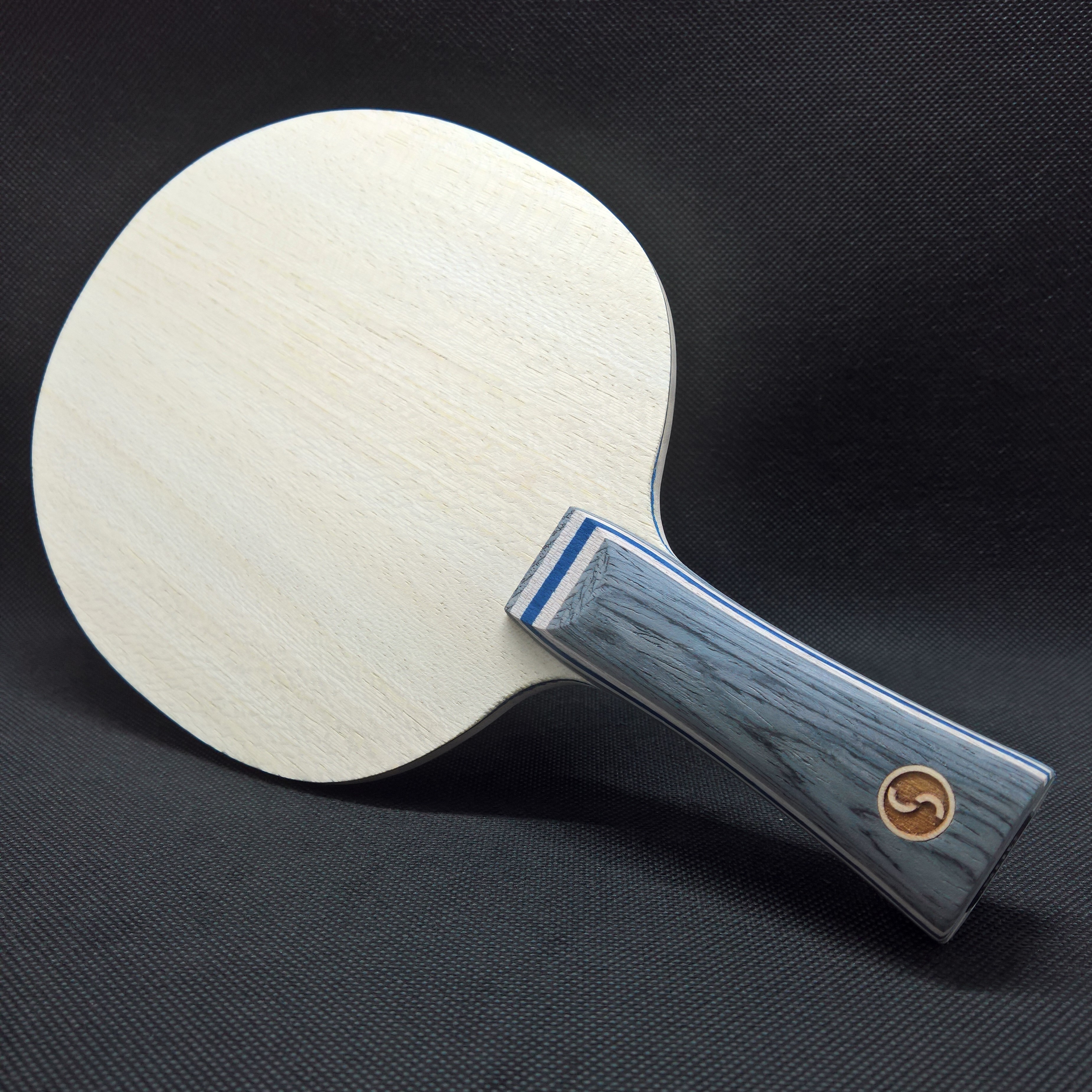
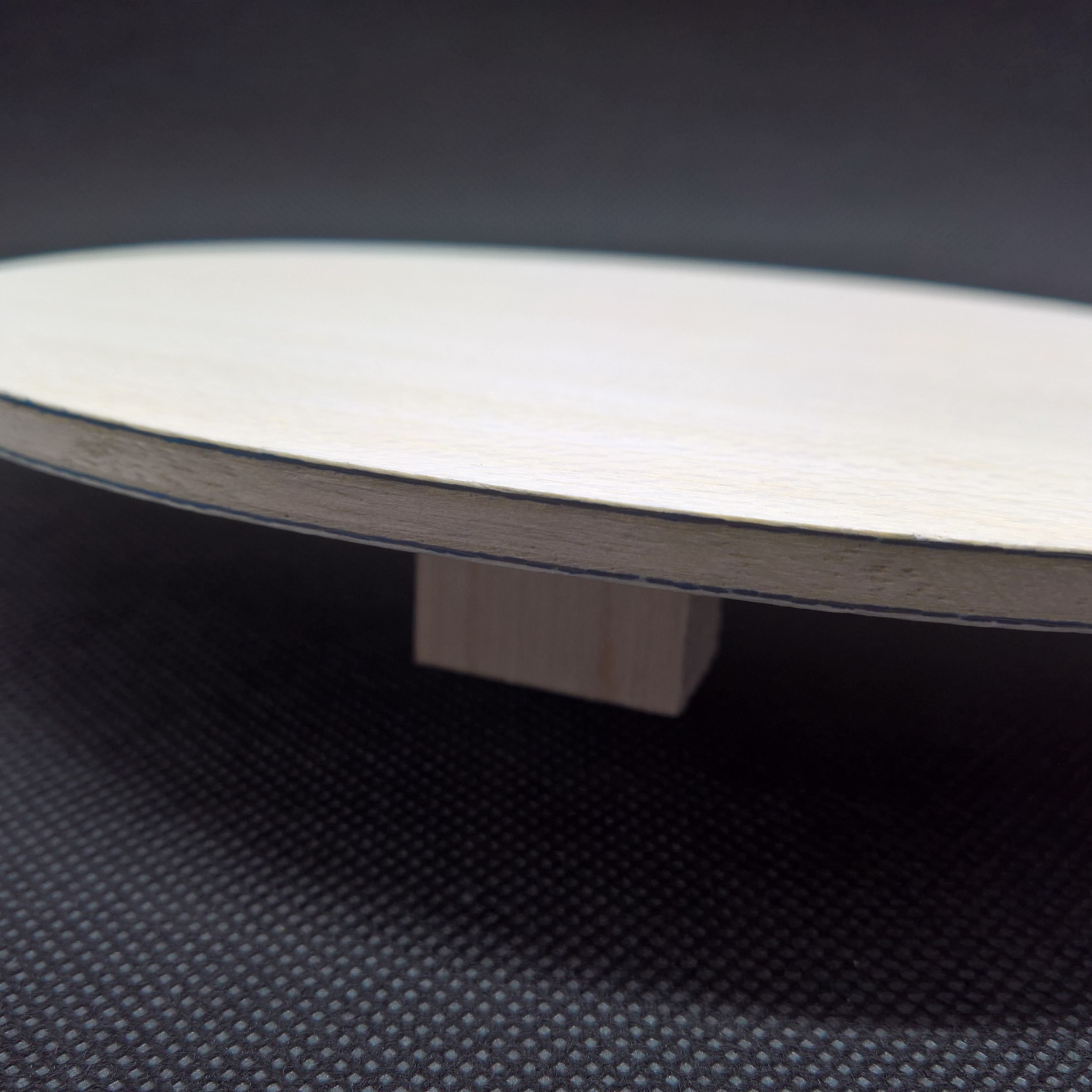
#1208 - Outer S-AxC- OFF-

Relatively stiff but soft blade. The composition itself is light, with a light Koto outer, so the blade is not fast just because it uses S-AxC, the fiber is there to give it stiffness and predictability. The handle is heavy, not hollowed, so it provides a low balance, which makes this blade perfect for over the table play with medium hard rubbers.

Available FS.

- Koto / S-AxC / Ayous / Kiri core
- 84.1g
- 5.5mm
- 157x150mm
- FL (100x24.8-22.8mm)
- Balance: 2.3cm (Low)

1208-1.jpg


1208-2.jpg


1208-3.jpg
 
This user has no status.
Member
Mar 2023
53
53
226
Hello, excuse my English. I have a few questions. The Cibershape blade has weights that can be added to the handle. How does the blade's response change? On other blades, with the same blade weight, how does it respond if the handle is heavier? How does it respond if the head is heavier? In what case is the curve of the ball taller and shorter? And vice versa? Thank you.
 
says Leave the righteousness to me.
🏆 Top 1% Commenter
Well-Known Member
Nov 2020
1,611
1,467
6,999
If the goal is to make it more head heavy, without increasing the total mass, then we can do that. It doesn't need to be too extreme, it's just a matter of taking some material from the bottom of the blade's face, and putting it on the top, while keeping the same overall area. Same area = same weight, but higher cg = more momentum = more power.

I was thinking more in the direction of optimizing the BH. In my current blade I have enough momentum/power in the FH, but sometimes in the BH it is a bit heavy. But I don't want to sacrifice FH power much. I mean I hoped that we could have slightly less area (thus lighter), but not lose much FH power, because at top there is more area. But I guess my thinking is not completely logical. Because the head heaviness would still increase. The head heaviness makes my BH a bit tired sometimes. Maybe we can make the handle heavier a bit. Not sure, it's just loud thinking... But I'm looking forward what comes out of it ;-)
 
  • Like
Reactions: Khimmi
This user has no status.
🏆 Top 1% Commenter
Well-Known Member
Oct 2018
1,686
2,055
4,224
I was thinking more in the direction of optimizing the BH. In my current blade I have enough momentum/power in the FH, but sometimes in the BH it is a bit heavy. But I don't want to sacrifice FH power much. I mean I hoped that we could have slightly less area (thus lighter), but not lose much FH power, because at top there is more area. But I guess my thinking is not completely logical. Because the head heaviness would still increase. The head heaviness makes my BH a bit tired sometimes. Maybe we can make the handle heavier a bit. Not sure, it's just loud thinking... But I'm looking forward what comes out of it ;-)
I wonder if anyone made blades with active weight shift system. For lack of my creativity I imagine someone puts a water capsule into the handle which is maybe 30% full, other 70% is air. So if you hold your racket upright the water flows to the bottom and you have a handle heavy blade, if you let your arm down(point your racket down) like for forehand loop, drive, topspin etc the water flows to the front making your blade balance shift towards the head.
 
This user has no status.
🏆 Top 1% Commenter
Well-Known Member
Jan 2024
2,210
2,885
6,904
Read 2 reviews
#1208 - Outer S-AxC- OFF-

Relatively stiff but soft blade. The composition itself is light, with a light Koto outer, so the blade is not fast just because it uses S-AxC, the fiber is there to give it stiffness and predictability. The handle is heavy, not hollowed, so it provides a low balance, which makes this blade perfect for over the table play with medium hard rubbers.

Available FS.

- Koto / S-AxC / Ayous / Kiri core
- 84.1g
- 5.5mm
- 157x150mm
- FL (100x24.8-22.8mm)
- Balance: 2.3cm (Low)

1208-1.jpg


1208-2.jpg


1208-3.jpg
This is the closest I've been to jumping the gun on a blade of yours. Congratulations, another beautiful piece that really looks like a performer too.
 
  • Love
Reactions: SDC
says Leave the righteousness to me.
🏆 Top 1% Commenter
Well-Known Member
Nov 2020
1,611
1,467
6,999
I wonder if anyone made blades with active weight shift system. For lack of my creativity I imagine someone puts a water capsule into the handle which is maybe 30% full, other 70% is air. So if you hold your racket upright the water flows to the bottom and you have a handle heavy blade, if you let your arm down(point your racket down) like for forehand loop, drive, topspin etc the water flows to the front making your blade balance shift towards the head.

;-) Either that, or I need to improve my BH technique ;-) I mean, I can put a lot of power into FH, and my arm will not be tired. OK, the whole body will be, but not the arm... But BH - nope, the wrist can be tired, even shoulder... It must be technique issue... Cheers.
 
Top