


This user has no status.

This user has no status.
🏆 Top 1% Commenter
Well-Known Member
Well-Known Member



It's fine 🙂.Not sure if this is going towards derailing the topic, so please let me know if it does and I'll take it elsewhere.
The connection between Stiga blades' loud feedback and the wood used dawned on me today. Spruce and Ayous are pretty close in general density as well as hardness, and that would make vibration travel pretty easily through the core and medial layers.
Am I spewing nonsense here, or is that part of the signature Stiga feedback?
Does limba/limba/ayous leave the vibration more in the top layers, and limba/ayous/ayous bring it more to the core?
Such an interesting topic...
The other day I played a couple of balls with a butterfly Joo Sae Hyuk, but that's planchonello/koto/ayous and similar to the diode V except for the thickness. I found it to be very familiar to my taste of limba/limba blades, so now I'm thinking my preference may be for blades with similar veneers in top and medial layers.
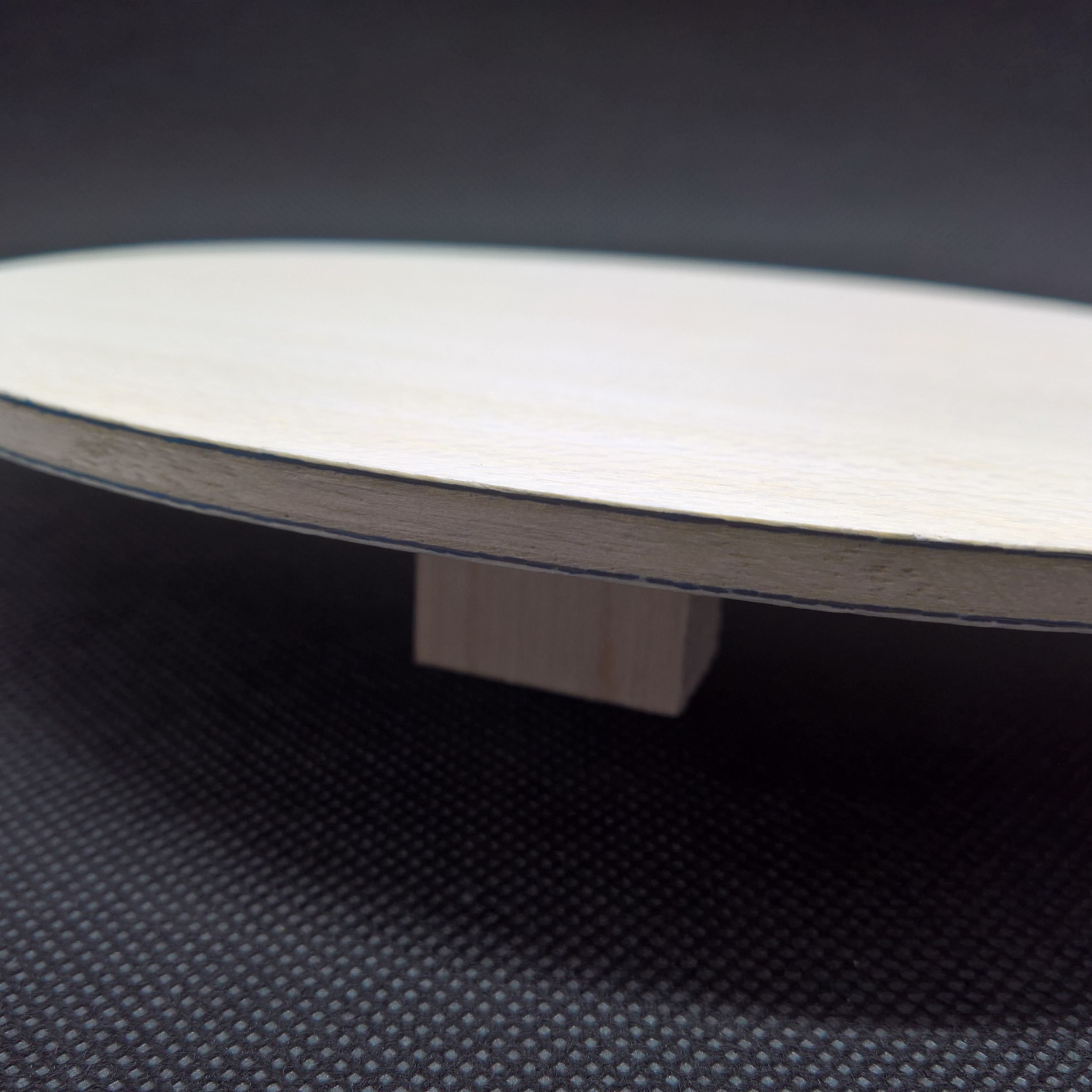
Well, not really... "Spruce" is a very generic term that, us TT players, use to describe a bunch of woods that are have a similar appearance (grain structure), but may have very distinct properties. Spruce itself has many varieties, Engelmann and Sitka are the most commonly used and they are close to Ayous, but then we have many other species that look like Spruce but aren't, such as Hemlock, Douglas Fir, WRC, Cypress, Pine... Some of these have very distinct properties. So, it's important to identify which blades you are talking about, because not all of them use Spruce, for example Stiga uses Douglas Fir a lot, and it can be much harder than Spruce, so that's not the correlation. The thing that Stiga does in most of their blades is to use a thick core and thin outer layers, and that's where it comes from.
As for the second part of the question, I've wrote this many times but here it goes again. "Planchonello" is not a wood species, it's not even a word, it doesn't exist outside the TT world because someone made it up. "Planchonella", on the other hand, exists, but it's also not a wood species, it's a genus (family of trees), but you still need to identify the sub-species. Out of these, the most commonly used in TT (and only that comes to mind) is Planchonella pachycarpa aka Goiabao. Goiabao is very hard and heavy, nothing like the top ply of the JSH. The top ply of the JSH is relatively soft and light, I know this because I've removed from a blade once and saw the medial layer as well (which is definitely Koto). Here I don't have a definitive answer, but I believe the wood is some sort of variation of Meranti, Meranti is usually more red but the grain is very similar. So maybe this was even the reason to discontinue the blade, the material may have become hard to find. However, most of the JSH's touch comes in fact from the relatively thick Koto medial.
So, what it seems to me, is that you favor blades with thinner cores and thicker medial and outer layers, instead of thick cores and thin medial and outer.