2026 #02 Executive Board Meeting minutes
https://documents.ittf.sport/sites/default/files/public/2026-04/2026-02-27_ITTF_EB_Minutes.pdf
0. Welcome from the ITTF President
...
Turning to WTT, the President underscored the importance of achieving both financial
sustainability and effective governance oversight.
She recalled the Board’s earlier
support for increased ITTF representation within WTT governance structures and
formally indicated her intention to assume the Chair of the WTT Board, noting that such
leadership is both appropriate and necessary given ITTF’s majority ownership.
On organisational matters, the President noted that the leadership transition initiated in
November 2025 is approaching completion.
She described the emerging structure as
leaner, more focused, and better aligned with the needs of Member Associations,
emphasising that service to members must remain at the core of the organisation’s
purpose.
Finally, she informed the Board that the CAS appeal challenging the ITTF Presidential
Election had been withdrawn, marking a significant step toward institutional stability.
She framed this, together with the financial and governance reforms underway, as part
of a broader effort to establish a solid foundation from which the ITTF can move forward
with clarity and confidence.
...
3. Operations
3.1 Finances
The Executive Board proceeded to an extensive and detailed discussion on the financial
position of both ITTF and WTT, beginning with an update on the 2025 financial results
and the ongoing audit process.
The ITTF Director of Operations, together with the WTT CEO, and the WTT Executive
Director (Operations & Strategy), joined the meeting for this item. The Board was
informed that the group audit for the 2025 financial year had formally commenced in
March, with PricewaterhouseCoopers (PwC) acting as external auditors. It was confirmed
that the audit process was on track for ITTF AGM 2026, notwithstanding the increased
complexity arising from personnel changes within the finance function and the scope of
review.
Turning to the financial results themselves, the ITTF Director of Operations reported that
the ITTF’s net position had not materially changed since the previous reporting
presented at the Chengdu meeting. While 2025 had been widely recognised as a difficult
financial year, the organisation had managed to stabilise its position, in part due to
additional income streams that had partially offset operational pressures. However, he
noted that the overall outcome remained below expectations.
The discussion then shifted to WTT’s financial performance, with WTT CEO and WTT
Executive Director (Operations and Strategy) providing further detail.
It was explained
that, compared to earlier projections presented at the AGM, WTT’s results had
deteriorated primarily due to a reduction in partnership revenues, notably the loss of a
global premier partner, and an increase in event-related expenditures associated with an
expanded calendar, including the US and Europe Smash events.
The WTT CEO elaborated that, while the financial outcome remained negative, there had
been some improvement compared to earlier forecasts, particularly due to stronger-than-
expected performance of the Hong Kong event, which generated profits exceeding initial
projections. Nevertheless, he stated that the overall 2025 result was not good, attributing
this primarily to the strategic decision to invest heavily in new markets and flagship
events.
A significant portion of the discussion focused on the interplay between financial
performance and the broader political context within the ITTF during 2025.
WTT CEO
noted that the internal instability experienced during that period had materially affected
commercial negotiations, with potential sponsors and partners expressing reluctance to
commit in an environment perceived as uncertain. He indicated that this had resulted in
a reduction in partnership revenues, despite the expansion of the event calendar.
The Board highlighted the importance of ensuring that Board members have full visibility
of WTT’s financial data in order to effectively fulfil their responsibilities. In response, WTT
CEO reaffirmed that WTT financial information is fully accessible to the Board and
emphasised that there are no restrictions on transparency.
The discussion then moved to the 2026–2027 budget and forward-looking financial
projections.
The Board also discussed the implications of the audit process in this context. The
President noted that the auditors have indicated that the absence of a confirmed
investment could affect their ability to issue a clean audit opinion, further underlining the
urgency of resolving the investment discussions.
Throughout the discussion, there was a clear consensus among Board members on the
need to strengthen both financial discipline and communication. Members emphasised
that, while strategic investments in new markets and events are necessary for the long-
term development of the sport, these must be accompanied by robust cost control and
clear performance metrics, and a coherent narrative that can be communicated to
stakeholders with credibility and confidence.
3.2 WTT Investment
The Executive Board then engaged in a detailed and substantive discussion on the
ongoing efforts to secure additional investment in WTT, recognising this as a critical
priority for both short-term liquidity and long-term financial sustainability.
WTT CEO introduced the item by recalling that, following the ITTF AGM in November
2025, discussions had been initiated with existing shareholders regarding the need to
strengthen WTT’s capital structure. He explained that these discussions were driven by
the recognition that 2025 had been a financially challenging year, characterised by
increased investment in key events and reduced commercial income, and that additional
capital would be required to stabilise operations and support the transition toward
profitability.
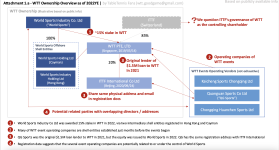
He further noted that, at its meeting in Chengdu in December 2025, the Executive Board
had formally mandated management to explore investment opportunities, with a clear
set of parameters designed to protect ITTF’s strategic interests. These included
maintaining ITTF as the majority shareholder, preserving appropriate governance and
control mechanisms, limiting any divestment to a minority stake, and securing a solution
within a timeframe compatible with the organisation’s liquidity needs.
The ITTF Executive Vice-President (Finance) provided a detailed overview of the process
undertaken since that mandate was granted. She explained that external legal counsel
in Singapore had been engaged to provide advice on the implications of Singapore
corporate law, under which WTT is incorporated, and to assess the legal and financial
structure of the proposed investment. In parallel, Deloitte had been engaged to conduct
an independent valuation of WTT, while PwC had provided financial advisory support.
She emphasised that the review process had been more extensive and time-consuming
than initially anticipated, but that this was necessary to ensure that the Board is fully
informed and that the proposed transaction adequately protects ITTF’s interests.
WTT CEO further explained that, while discussions with the potential investor are the
most advanced and represent the most immediate opportunity to secure funding, WTT
has also explored alternative investment options. These include engagements with
private equity firms, sports marketing agencies, and other potential investors. However,
he cautioned that these alternatives would require significantly longer timelines.
The President noted that, compared to earlier discussions in December and January, the
current proposal represents a clear improvement. She emphasised the importance of
having engaged Singapore-based legal counsel, given the jurisdictional context, and
expressed confidence that the Board is now in a more informed and secure position to
assess the proposal.
The Board engaged in a thorough discussion on both the opportunities and risks
associated with the investment. Members acknowledged the necessity of securing
additional capital in the short term, particularly in light of the cash flow pressures
discussed. At the same time, they stressed the importance of ensuring that any
investment structure does not compromise ITTF’s strategic control or long-term vision
for WTT.
It was emphasised that the long-term goal is for WTT to function as a sustainable and
strong commercial vehicle, capable of generating revenue and value for the sport, while
remaining aligned with ITTF’s governance framework.
The Board also recognised that the successful completion of the investment process is
closely linked to other critical factors, including the audit outcome and the organisation’s
ability to maintain operational stability in the coming months.
To be continued in next post