"wrapping" the ball.

This user has no status.
🏆 Top 1% Commenter
Well-Known Member
Jul 2017
1,784
879
2,985
The ball contact is not a point, take a new ball, make a hit, and you can see the area is like 15 mm in diameter.

If the ball travels 72 km/h, it is 20 mm/ms. The hand can also travel that fast to give that impuls/speed to non-moving ball.

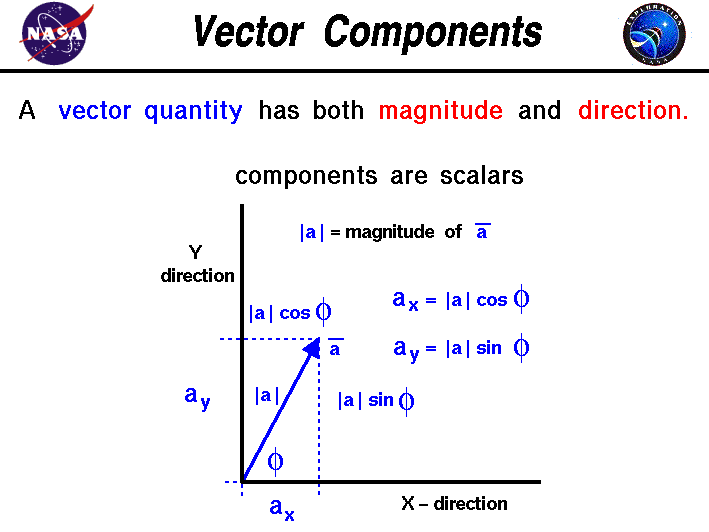
Now FZD does some wrapping (pronation/supination, I'm not sure which is which.), we can see that during the stroke the angle changes, let's say it changes 30 degress on 30 cm stroke, which is 1 degree on 10 mm. Since arm speed is 20 mm/ms, we get his angular speed is 2 degree/ms. (There is a big range obv.)
Excellent! Someone latej is trying to solve this "wrapping" issue.
I accept your numbers.

Even if we estimate the ball contact time to be 1ms.
That is close enough for this discussion.

Actually I think what happens during the ball contact is super complex. But even if we estimate the ball contact to be 1ms, and we know its diameter 40mm, and we know FZD's angular wrapping speed 2 degree/ms. That wrapping during that time on that diameter produces a length, which is "comparable" to ball contact area diameter 15 mm, it can easily make 5% of it.
I see the paddle only wrapping 2% of the ball. That is not a lot. I don't see where you come up with 5%

I've made these crude calculations to myself, I am convinced now, these things are real. Now, for the next season my goal to improve my ranking percentile by 5%.

EDIT: I wrote it before I read your last post zeio. Imagine the delight when I read that the contact time is 1ms ;-)
I think you are in the ball park but I don't see how you get 5%.

Now here is the question for everyone. Do you think FZD can time the contact to the millisecond? What if contact is made a millisecond sooner or later than optimal?

Zeio and Nextlevel are still doing the flail and fail.

 
says Leave the righteousness to me.
🏆 Top 1% Commenter
Well-Known Member
Nov 2020
1,611
1,467
6,999
I think you are in the ball park but I don't see how you get 5%.

The wrapping speed is 2 deg/ms and contact time is 1 ms, so during contact we have "wrapping" 2deg. That on ball diameter 40mm is Pi*D*2/360 = 0,7mm. Now the ball contact area has diameter 15 mm (let's take 14 for now). And here is the 5% = 0,7 mm / 14 mm.

Now here is the question for everyone. Do you think FZD can time the contact to the millisecond? What if contact is made a millisecond sooner or later than optimal?

Noone claimed FZD is trying to time it, he just does it during the stroke, he changes is bat angle for those, let's say, 30 deg during his 30 cm BH stroke.

Zeio and Nextlevel are still doing the flail and fail.

I'm afraid everyone sees it differently.
 
  • Like
Reactions: blahness
This user has no status.
🏆 Top 1% Commenter
Well-Known Member
Oct 2010
2,859
2,798
10,527
it will be interesting for someone to calculate the error % on mistimings for a circular stroke with shoulder internal rotation and pronation (bat angle gradually closing) vs a tangential linear stroke - my personal experience is that the tangential linear stroke is much more likely to miss vs the circular stroke with any kind of mistiming of the ball.

The more tangential a stroke is the higher the error % imo...

One of the biggest advantage of a circular stroke imo is that you can hit the ball square on (thus reducing timing errors) while still spinning the ball significantly.
 
Last edited:
says Leave the righteousness to me.
🏆 Top 1% Commenter
Well-Known Member
Nov 2020
1,611
1,467
6,999
it will be interesting for someone to calculate the error % on mistimings for a circular stroke with shoulder internal rotation and pronation (bat angle gradually closing) vs a tangential linear stroke - my personal experience is that the tangential linear stroke is much more likely to miss vs the circular stroke with any kind of mistiming of the ball.

The more tangential a stroke is the higher the error % imo...

One of the biggest advantage of a circular stroke imo is that you can hit the ball square on (thus reducing timing errors) while still spinning the ball significantly.

I don't know what is the error, but if we take that wrapping 2 deg during that 1 ms contact time, as established before. Imagine what height does the angle 2 deg on the length 2 m - the approx. distance from the hit to the net. That makes tan(2deg) * 2m = 7cm. And 7 cm height difference on the net, in case wrapping vs non-wrapping, you know, these are big numbers. Definitely not something negligible.

EDIT: To clarify, I really had to convince myself that when something like that "wrapping" is happening DURING the very short ball contact time, it can have a real effect. I simply was not sure, and I was open for both ways. But now I am sure. Our TT universe is tuned so that it really does have an effect. Now obviously this is a 2-sided sword, because when we are changing the angle during the whole stroke, then the angle at which we hit the ball - the angle at start of the contact - is harder to time precisely. That I agree with. But this is a separate problem. We see FZD and others are changing the angle during the stroke (not only during contact), and we see they consistently land it on the table. I don't know how they do it as good as they do. If I knew, I'd keep it for myself for a while. Imagine how it would look like, if I leak it here.
 
Last edited:
This user has no status.
🏆 Top 1% Commenter
Well-Known Member
Jul 2017
1,784
879
2,985
it will be interesting for someone to calculate the error % on mistimings for a circular stroke with shoulder internal rotation and pronation (bat angle gradually closing) vs a tangential linear stroke - my personal experience is that the tangential linear stroke is much more likely to miss vs the circular stroke with any kind of mistiming of the ball.
I have done that and posted it here, but everyone ignored it. I can post the plots again, but it will have to wait till I get back from my dad's place. He is 96.5. I just turned 70

The more tangential a stroke is the higher the error % imo...

One of the biggest advantage of a circular stroke imo is that you can hit the ball square on (thus reducing timing errors) while still spinning the ball signifi
I don't know what you mean but one of my greatest failing is not keeping the orientation of the paddle constant during the time the ball may hit the paddle. This ensures that the ball will go in the right direction if I hit the ball a millisecond early or late and my timing probably isn't near that good.
 
says Leave the righteousness to me.
🏆 Top 1% Commenter
Well-Known Member
Nov 2020
1,611
1,467
6,999
One question, if wrapping the ball is what you want, can you feel it when your racket contact the ball?

No, it's not my goal. If you refer to those 5%, it was meant jokingly. Also, I don't think one can feel it. I think it happens naturally, we don't have to "strive" for it that much. My goal is more that my movement is bio-mechanically natural and sound (hopefully no flame war on that). And e.g. things which influence whether or not you can more easily do the movement in a natural way - e.g. the angle of the feet, wide is better for me... things like that.

This whole thread is just a theoretical exercise, and just about anything else is more important for the real play, imo. But it has its place too.

For example, when I make my assumption, and say that obviously the optimal time of the hit is when the blade has max speed, and zero acceleration, it can be made more precise by knowledgeable people like zeio, who say, yes, but...... You know, he makes it more precise, more detailed. And that is very useful too, at least for me. Here too, we dive into a level of detail. It has not that much implication for the real play, but it doesn't make it any less true. And it definitely is not right, when a guy comes and tells repeatedly to others that they don't know what they speak about!
 
Last edited:
This user has no status.
Just tryed the following:
With your free hand throw the ball up a little (from the height of your waist), than chop the ball down towards the floor. Keep moving on while changing the racket angle and direction till it faces the other way around. The ball will go upwards in the end.
What is this if not wrapping?
 
This user has no status.
🏆 Top 1% Commenter
Well-Known Member
Oct 2010
2,859
2,798
10,527
I don't know what is the error, but if we take that wrapping 2 deg during that 1 ms contact time, as established before. Imagine what height does the angle 2 deg on the length 2 m - the approx. distance from the hit to the net. That makes tan(2deg) * 2m = 7cm. And 7 cm height difference on the net, in case wrapping vs non-wrapping, you know, these are big numbers. Definitely not something negligible.

EDIT: To clarify, I really had to convince myself that when something like that "wrapping" is happening DURING the very short ball contact time, it can have a real effect. I simply was not sure, and I was open for both ways. But now I am sure. Our TT universe is tuned so that it really does have an effect. Now obviously this is a 2-sided sword, because when we are changing the angle during the whole stroke, then the angle at which we hit the ball - the angle at start of the contact - is harder to time precisely. That I agree with. But this is a separate problem. We see FZD and others are changing the angle during the stroke (not only during contact), and we see they consistently land it on the table. I don't know how they do it as good as they do. If I knew, I'd keep it for myself for a while. Imagine how it would look like, if I leak it here.
My thoughts here.

If the racket was directly perpendicular to the ball and travelling in the exact opposite path of the ball, any mistiming would never result in missing the ball and will still result in a solid ball contact (the analogy is a head on collision) . However we all know that is what a flat hit does and unfortunately flat hits do not produce the Magnus effect that drags the ball down to the table which is what actually gives loops the amount of penetration and security it does.

If the racket path was say completely tangential to the ball path, it'll be like a T bone collision (which can be avoided if any car went slower or faster), any mistiming and the ball may hit the edge of the bat (if the ball was few mm deeper than anticipated), or completely miss (if the ball was few mm shorter than anticipated). This is precisely the most problematic part of the "linear" stroke crowd - I know players who loop like that and they always have this problem in their ball contact. No one is that precise all the time after all. This is why Fang Bo in his channel always advises against thin contacts in almost every stroke (yes even counterloops!)

Everything else is in between.

Hence that is why the circular or pronating (FH)/supinating (BH) contact is superior and you see clearly how players like Fan Zhendong use it to its max (you can see how many mistakes he makes during the training, close to none!). You hit the ball close to full on (similar to a flat hit) which means less issues with mistiming, but because you start closing the bat angle throughout the contact, the ball will still rotate strongly due to the nature of your impact. In fact, you can contact the bottom of the ball and still produce a heavy topspin (my suspicion is that brokenball has absolutely no idea how to execute this technique - he might get mindblown at this concept). Not just the security of the impact, you also enjoy the power similar to a flat hit, while retaining the advantages of having the Magnus effect.

In terms of mistiming the "wrapping", sure there's issues with that but because of the Magnus effect those variations are not as bad because the ball will eventually be dragged down to the table (it is a huge contributor to consistency).

For eg latej calculates 7cm error, even if I mistime the ball and the ball height is 7cm higher when clearing the net it is still gonna land on the table as maybe a deeper, higher topspin if I get a lot of topspin on it. And it may not even be an easy shot to deal with for the opponent.
 
Last edited:
  • Like
Reactions: latej and NextLevel
This user has no status.
🏆 Top 1% Commenter
Well-Known Member
Jul 2017
1,784
879
2,985
If the paddle angle varies by 2 degrees side to side then 3m*sin(2deg)=0.105m. That is a HUGE error. I am assuming the ball is only being hit 3 meters. Of course it you hit the ball from farther back the error will be much more. That isn't too much more than blahness's calculation which is still a big error.

What do Zeio and Nextlevel have to say to that? Can they time each contact to +/- 1 ms? I doubt it.
 
says Shoo...nothing to see here. - zeio
🏆 Top 1% Commenter
Well-Known Member
Jan 2018
12,914
12,858
28,945
After sifting through my little database, I dug out one study from 2018 that I never gave a good read (a shoutout to Jslick89) by Japan Sport Council that measured the "slip distance", how much the ball moves on the rubber during contact (though technically speaking, slip means the ball loses grip).

Planning for the project started in 2017 and the candidates that likely took part could be: Uda (4/2014-?), Harimoto (4/2016-3/2019), Kato (4/2012-?), Hirano (4/2013-4/2018), Nagasaki (4/2015-3/2021), Kihara (4/2017-1/2023), among others.

The differences in slip distance between different balls and rubbers at different velocities kind of explain all the "conflicting" opinions about equipment. The slip distance with R1/P1 is easily over 2mm at all velocities. The difference between R1/P1 and R1/P3 is over 2 times at 30km/h (8.3m/s) and over 4 times at 90km/h (25m/s). There is no clear trend, and certainly no right or wrong here.

P1/2/3: Official plastic balls for competitions (not specified)
R1/2: 2 types of rubber (not specified)
Test conditions: 6 JOC Elite Academy players (3 male and 3 female), only FH shots played with crossover step and pivot step. Captured with high speed camera at 20,000 fps, VICON motion capture and force plate.
https://i.imgur.com/m6MAEe5.png
 
Last edited:
  • Like
Reactions: latej and blahness
says Shoo...nothing to see here. - zeio
🏆 Top 1% Commenter
Well-Known Member
Jan 2018
12,914
12,858
28,945
What do Zeio and Nextlevel have to say to that? Can they time each contact to +/- 1 ms? I doubt it.
Can you time each contact to ±100ms? Prove it.

眼是一把尺,量人先量己
The eye is a rule, measure yourself before measuring others.

 
  • Like
  • Haha
Reactions: latej and blahness
This user has no status.
🏆 Top 1% Commenter
Well-Known Member
Jul 2017
1,784
879
2,985
Can you time each contact to ±100ms? Prove it.
No one could hit the ball if they were that bad.
Again, Zeio just wants to detract.

眼是一把尺,量人先量己
The eye is a rule, measure yourself before measuring others.
Is this some kind of Chinese wisdom?

Zeio and Nextlevel still have no answers.
They can't backup what concave or convex strokes are good.
Would you want them as coaches? I wonder how many students Nextlevel has set back years in development.

It has been fun giving you two the opportunity to trash yourselves out.
 
This user has no status.
🏆 Top 1% Commenter
Well-Known Member
Moderator
Oct 2014
19,974
26,534
70,870
Read 17 reviews
If the paddle angle varies by 2 degrees side to side then 3m*sin(2deg)=0.105m. That is a HUGE error. I am assuming the ball is only being hit 3 meters. Of course it you hit the ball from farther back the error will be much more. That isn't too much more than blahness's calculation which is still a big error.

What do Zeio and Nextlevel have to say to that? Can they time each contact to +/- 1 ms? I doubt it.

As I have said numerous times, your framing of the problem repeatedly shows you don't understand enough table tennis to analyze the issue. Blahness already pointed out some of the missing issues, but the most obvious one is that the awing. the trajectory is not the same thing as the racket angle. I will leave it at that. The swing trajectory is a far bigger determinant of the exit of the ball than the racket angle. Applying a racket angle calculation to something largely determined by the swing trajectory is just bad modeling.
 
This user has no status.
Active Member
Nov 2019
837
757
3,039
Read 1 reviews
If we allow the racket-face angle to change dramatically through contact, say, “rolling over” such that the strings are pointing towards the sky at the beginning, and towards the ground after contact, then our margin for error evaporates; if we hit the ball slightly too early, our overly open strings will send the ball flying out, and if we hit the ball a little too late, our closed strings will smother it down into the net. If we don’t time it perfectly, we’ll miss. By instead keeping the angle consistent through the contact zone, we allow ourselves to consistently strike the ball with the proper up-and-forward diagonal contact, even in cases when the swing is slightly mistimed.

That's about tennis but I don't see why this should be different in TT.

Can you time each contact to ±100ms? Prove it.

眼是一把尺,量人先量己
The eye is a rule, measure yourself before measuring others.

...

Some rough estimates:
- racket speeds: easily over 10 m/s = 36 km/h ~ 22.4 mph
- blade width = 0.15 m, "sweet spot" maybe 0.1 m
Now counter loop close to the table i.e. racket face is close to parallel to the floor when contacting the ball ->
0,1 m / 10 m/s = 10 ms.

Edit: Forgot the obvious... not only the racket moves but also the ball. Let's say it does with 10 m/s than the 10 ms from above reduce to just 5 ms...

Timing an Attacking Forehand Drive in Table Tennis
Table 2 "Means and Standard Deviations of the Direction of Travel of the Bat (Dir) and Its Rate of Change (Vdir) at the Moment of Ball Contact, and the Timing Accuracy (Tim. Ace.) at Contact Calculated as the Quotient of the Standard Deviation of Dir and the Mean Vdir."
2.03 ms to 4.72 ms. This is what can be expected if one looks at the numbers from above or at ones rubbers/main hitting area after a training session.
 
Last edited:
  • Like
Reactions: latej
This user has no status.
🏆 Top 1% Commenter
Well-Known Member
Oct 2010
2,859
2,798
10,527
As I have said numerous times, your framing of the problem repeatedly shows you don't understand enough table tennis to analyze the issue. Blahness already pointed out some of the missing issues, but the most obvious one is that the awing. the trajectory is not the same thing as the racket angle. I will leave it at that. The swing trajectory is a far bigger determinant of the exit of the ball than the racket angle. Applying a racket angle calculation to something largely determined by the swing trajectory is just bad modeling.
Yes - there was a Ryu Seung Min video which when someone asked him about racket angle, he actually said it doesn't matter, and demonstrated looping it out with a closed angle, and looping into the net with an open angle. Instead what mattered was where the swing begins (in his case he was talking about looping against underspin so he emphasized getting low relative to the ball).
 
This user has no status.
🏆 Top 1% Commenter
Well-Known Member
Oct 2010
2,859
2,798
10,527

That's about tennis but I don't see why this should be different in TT.

TT is very different from tennis because the inverted rubber (sponge, topsheet) system hitting the ball is very different to strings hitting a ball. Hence the hitting technique and dynamics are also very different.

If you took a tennis racket and tried to make a table tennis ball spin you wouldn't be able to get any significant spin at all.
 
  • Like
Reactions: NextLevel
This user has no status.
🏆 Top 1% Commenter
Well-Known Member
Moderator
Oct 2014
19,974
26,534
70,870
Read 17 reviews

That's about tennis but I don't see why this should be different in TT.
If we are playing hardbat, maybe, but even then, there are differences due to the ball size and table size there as well. Moreover, no one changes the angle radically during the ball contact. What most people do is swing fast through a trajectory that often incorporates angle changes because of pronation of the arm, upward and downward weight transfer etc. The point is that the follow through is part of the path of the stroke and not completely independent of it in TT pedagogy. You can test it yourself empirically to see whether your follow through had an effect on your ball trajectory.
 
Top