12 A POINT
12.1 Decision
12.1.1 Each rally that is not a let results in the award of a point and the laws specify the various
reasons for which a point is scored. The decisive stage of a rally is usually that at which the
ball goes out of play and the umpire should beware of making a decision based on what he
or she expects to happen, without allowing for the possibility that the rally may be ended in
some quite different way that may invalidate his or her decision.
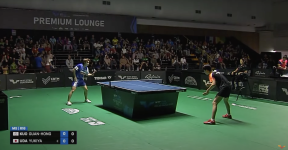
12.1.2 For instance, the ball may be returned by a player, well wide of the table, so that it is clear
that it will not touch the opponent’s court; but the rally does not end until the ball goes out
of play and either player may still win the point. If, in these circumstances, the opponent
moves the playing surface while the ball is in play, it is the player who struck the wide return
who wins the point, even though the return was unlikely to be good. The rule regarding
moving the playing surface is more than 50 years old and comes from a time where we had
no rollaway tables; nowadays tables have hinges and a light push or even stamping on the
floor can move the playing surface. Because of this, most umpires do not apply the rule
strictly and it would be impossible to play wheelchair table tennis if “moving the playing
surface” was enforced. Only lifting, permanent shifting, displacement, or intentional shaking
the tabletop should result in the awarding of a point.
12.1.3 Not all points are scored for reasons directly related to play, such as the failure to make a
good service or a good return. For example, if while making a potentially winning hit a player
accidentally touches the playing surface with his or her free hand or moves the table while
the ball is in play, his or her opponent will score a point, whether or not he or she is likely
to be able to make a good return.