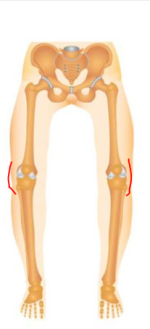
What do people do wrong in their weight transfer that could cause the side of their knees to hurt afterwards?

This user has no status.
Member
Oct 2024
16
3
21
After playing table tennis, these red areas in my knees hurt, and I think it is because of my weight transfer in forehand topspins or loops. Some people have told me that this happens because I do wrong movements. What do people do wrong in their weight transfer that could cause the side of their knees to hurt afterwards, and how should they fix it?
1730483450387.png
 
  • Like
Reactions: doppelganger_LT
says Spin and more spin.
🏆 Top 1% Commenter
Well-Known Member
Moderator
Dec 2010
16,640
18,534
56,964
Read 11 reviews
After playing table tennis, these red areas in my knees hurt, and I think it is because of my weight transfer in forehand topspins or loops. Some people have told me that this happens because I do wrong movements. What do people do wrong in their weight transfer that could cause the side of their knees to hurt afterwards, and how should they fix it?
View attachment 32872

I am not sure it is an issue of wrong and right. The rotational force of a stroke in many racket sports puts torque on your knees. Therefore it can be hard on your knees. But the more your feet are allowed to move with the stroke, the less torque you will put in your knees.

Can you post footage of some FH strokes? Not much: maybe a few counterhits, a few larger drives and a few loops. Footage where we can see your feet?

If your feet are planted and don't move enough that puts more torque on your knees.
 
Last edited:
This user has no status.
🏆 Top 1% Commenter
Well-Known Member
Nov 2022
2,022
3,248
7,959
Your technique might be fine but you'll still suffer from an overuse injury you have too much training volume than your body can handle. If you went from being completely sedentary to playing a few hours a day, a few times a week, this is sometimes enough volume to cause issues without taking some sort of recovery break.

Take a week or so off, then see how you feel. If the pain disappears, that means you've recovered and you can likely handle slightly more training volume now. When you start feeling joint pain again, then rest again. Rinse and repeat.
 
This user has no status.
Member
Apr 2024
203
118
813
Reviving this thread as I am trying to figure out this problem myself. In the last couple of months, I have finally been able to feel my way into using more of my body versus my arm. Feeling my hip was a good sign but more recently, my knee has started feeling sore.

I looked around, read a bit and prompted an LLM based on how my right foot is rotating and found some interesting bits which confirmed an intuition about my error.

Could anyone help assess whether the following advice is true when it comes to rotation:
  • "During the Backswing (Loading): Your back foot is mostly flat, absorbing the weight. Your hips turn back, and your back knee points slightly outward (aligned with your toes).
  • During the Forward Swing (The Shift): As you push off the ball of your back foot to drive your hips forward, your weight shifts toward your front foot.
  • At Contact & Follow-Through (The Release): Your back heel must come off the ground. Your back knee, thigh, and foot all rotate inward together as a single unit. By the end of the swing, you should be up on the ball/toes of your back foot, with your back heel pointing out behind you.
  • The Golden Rule: Your knee and your toes must always point in the exact same direction. If your knee rotates inward, your toes must rotate inward with it. Lifting the heel is what makes this synchronized rotation possible."
I shadow trained my FH using this my knee felt under less stress. Is this golden rule really golden?

 
says what [IMG]
says what [IMG]
🏆 Top 1% Commenter
Well-Known Member
Feb 2016
2,470
1,520
5,098
Read 2 reviews
Reviving this thread as I am trying to figure out this problem myself. In the last couple of months, I have finally been able to feel my way into using more of my body versus my arm. Feeling my hip was a good sign but more recently, my knee has started feeling sore.

I looked around, read a bit and prompted an LLM based on how my right foot is rotating and found some interesting bits which confirmed an intuition about my error.

Could anyone help assess whether the following advice is true when it comes to rotation:
  • "During the Backswing (Loading): Your back foot is mostly flat, absorbing the weight. Your hips turn back, and your back knee points slightly outward (aligned with your toes).
  • During the Forward Swing (The Shift): As you push off the ball of your back foot to drive your hips forward, your weight shifts toward your front foot.
  • At Contact & Follow-Through (The Release): Your back heel must come off the ground. Your back knee, thigh, and foot all rotate inward together as a single unit. By the end of the swing, you should be up on the ball/toes of your back foot, with your back heel pointing out behind you.
  • The Golden Rule: Your knee and your toes must always point in the exact same direction. If your knee rotates inward, your toes must rotate inward with it. Lifting the heel is what makes this synchronized rotation possible."
I shadow trained my FH using this my knee felt under less stress. Is this golden rule really golden?
All the LLM will do is regurgitate forums. You might as well just ask directly.

If you want to catch the large mistakes, find a video of a player with a similar build doing the swing, then film yourself from the same angle and compare. There's probably more going on in your swing than you think. That's why personally I don't feel comfortable giving potentially-harmful advice without more context.

In general I would say feet being more mobile is more likely to be okay than feet being anchored, like Carl said earlier.
 
This user has no status.
🏆 Top 1% Commenter
Well-Known Member
Oct 2016
2,028
1,753
4,159
I do not think players always rotate so much so the heal is off the ground on the right foot. I do think that before players had a lot of forehand feet, with left feet in front of the right. Some players still do. If you do not i believe you need to turn the right foot to the right or at least have it so it can move naturally on the floor. I agreee that if feet are hard planted in the floor aiming forward it probably make it harder to turn hip and waist.
But i also do think this is not so black and white. Almost all pros have more or less body in forehand but solve it in different ways. Maybe more common today to just turn the waist more since the game is faster and more backhand oriented?

I work as a physiotherapist but not so much with pain and injuried. All joints need to stabilize, for that we have passive parts the ligaments and active parts the muscle. When we move the body and turning it the hip and knees need to work to stabilize and tense muscles. I think that if we are too muscles this could cause pain afterwards. You also put a lot of strain and pressure on hip and knees only when you walk and even more so in tabletennis, not the least when you bouncing which is hard on the joints. Probably very important with muscles in general but muscles that stabilize the joint as well, good shoes that take up the bounces, not weight to much and try to be light on the toes.
 
says Leave the righteousness to me.
🏆 Top 1% Commenter
Well-Known Member
Nov 2020
1,611
1,467
6,999
I shadow trained my FH using this my knee felt under less stress. Is this golden rule really golden?

I'd say it can be formulated like that, but for me a simpler, more plain, formulation is: have your feet point more side-ways, or in another words, have your hips more open - have wider angle between the legs (assuming you then don't twist the feet back). Also note that having wider angle naturally makes slightly wider stance (distance between feet).

Have a look at WCQ, he is an example of this wider stance (both angle and distance), and compare with others.
 
This user has no status.
Member
May 2024
68
45
139
There was a coach on Youtube that said for amateurs and older people is more easy to rotate the right knee to the right (and the foot also) when leaving your weight on it, when you rotate the body for forehands. For pros they have a lot of conditioning, flexibility training, so keeping the foot forward is not a problem and allows them to be fast and move quickly. But they are trained athletes.
Also, when knees hurt, try a more static style like shown on the series for elders on WRM https://www.youtube.com/@WRM-TV/search?query=60
 
says Fighting the EJ bug again...
Member
Mar 2025
340
456
2,117
Read 1 reviews
I do not think players always rotate so much so the heal is off the ground on the right foot. I do think that before players had a lot of forehand feet, with left feet in front of the right. Some players still do. If you do not i believe you need to turn the right foot to the right or at least have it so it can move naturally on the floor. I agreee that if feet are hard planted in the floor aiming forward it probably make it harder to turn hip and waist.
But i also do think this is not so black and white. Almost all pros have more or less body in forehand but solve it in different ways. Maybe more common today to just turn the waist more since the game is faster and more backhand oriented?

I work as a physiotherapist but not so much with pain and injuried. All joints need to stabilize, for that we have passive parts the ligaments and active parts the muscle. When we move the body and turning it the hip and knees need to work to stabilize and tense muscles. I think that if we are too muscles this could cause pain afterwards. You also put a lot of strain and pressure on hip and knees only when you walk and even more so in tabletennis, not the least when you bouncing which is hard on the joints. Probably very important with muscles in general but muscles that stabilize the joint as well, good shoes that take up the bounces, not weight to much and try to be light on the toes.
This is the best answer so far, from someone who struggled with this for months before going to see an orthopedic doctor.

Injury is one thing, but if you're not injured then lack of joint support is the most likely cause of pain in the knees. I always thought I had strong legs so I was surprised. Turns out my quads were pretty strong but everything else in the chain (glutes, hamstrings, knee ligaments, ankle) were either weak or tight and not supporting proper knee mobility. A couple months of PT to strengthen certain muscles and work on mobilizing my kneecaps a bit and I was able to get rid of the brace I'd been using and haven't had any issues since. I went from almost daily NSAID use to none. From someone who hates "gym exercises": It was worth it. (And the exercises were all simple things at the PT or home, not a true gym.)

I can't stress enough that I am not a medical professional but my point is to encourage anyone dealing with this type of issue to see an orthopedic doctor to assess if PT can clear up the pain or if you have an actual injury or chronic issue.
 
This user has no status.
🏆 Top 1% Commenter
Well-Known Member
Oct 2010
2,860
2,798
10,527
One thing to note is if you do a lunge with your knee exceeding your toes then the knee will be under a huge amount of stress.

Also in a FH loop, if your whole body has a lot of rotational energy in it but your feet dont rotate then the knees have to bend and shear which of course it doesnt like. Unless of course the right foot is already unloaded.

Some people like to imitate the pros who sometimes go into some compromising positions in their feet but that usually happens because they have already unloaded the feet so it is safe. If you still have weight on the foot (for eg incomplete weight transfer) and are still in this compromising position then it could also be an injury magnet. If you put load on something it has to have a strong position.

Also, if you put a huge amount of rotational energy into the stroke, you need to figure out how the deceleration (and braking) happens. It will be terrible for any joint if the braking happens while it is in a position where freedom of movement is limited which forces the joint to take the brunt of the braking force.

For eg in backhand if you straighten your elbow completely during the stroke probably your elbow will get hurt eventually because the joint cant straighten any more so the full braking force goes into the elbow joint rather than to the muscles.

So in a FH loop it is also best to figure out which muscles are used to brake the stroke. For me it is mostly bending at the left hip which absorbs the incoming rotational energy, which also conveniently puts me back into a good athletic crouched position.
 
This user has no status.
Member
Jul 2024
328
273
1,758
28
If you think its beacause of your weight transfer you could show a video. Right now everybody is guessing.

Outside where you pointed out, there are only ligaments from muscels or ligamnets to stabelize your knee.

You might overrotate your knee while your feet are stuck to the ground causing to much stretch on those ligaments.
 
This user has no status.
Member
Oct 2025
102
108
260
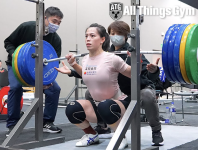
One thing to note is if you do a lunge with your knee exceeding your toes then the knee will be under a huge amount of stress.
And there's absolutely nothing wrong with that.
bahrain_2024-783_d89c1ea8-c7d8-4b95-9639-1e08f883dae1.jpg
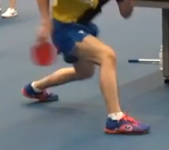
Screenshot 2026-05-22 at 14.15.40.png
I can't stress enough that I am not a medical professional but my point is to encourage anyone dealing with this type of issue to see an orthopedic doctor to assess if PT can clear up the pain or if you have an actual injury or chronic issue.
I am and there's a reason we do our best to encourage meeting with a professional. But in most cases, people just need some sort of strengthening of the joint in all axes of movement, and I mean that in the most colloquial way possible.

Sports performance at the highest level (my domain), much like equipment, are kind of irrelevant to the average person. There are always principles you can take away but most people just need the most basic of things.
 
Last edited:
This user has no status.
Member
Dec 2017
100
71
205
I am an older guy who plays 3 times a week. I have recently had a painful right knee (I am a right hander) and the pain is on the inside of the knee. I suspect this was due to the increased number of matches and tournaments at the end of the season and reaching for shots on the far forehand. I eventually went to a sports physio who is doing a 3 stage recovery 1) ice and gentle bends to get the swelling down. 2) if swelling reduced specific exercises to repair the knee then 3) special exercises to strengthen my legs for table tennis to prevent injury.
Conclusion- it is often good to get advice from an expert.
 
This user has no status.
Member
Apr 2024
203
118
813
Thank you all for responding. I truly appreciate the time all of you took to respond. I have gone through all of them. The following has happened since I posted/been reading the answers:
  1. Some context: I recently entered my middle middle years. I eat okay, my weight is not an issue and even though I am still generally agile, I would not call myself super fit. I have a suspicion that when I started playing TT seriously a couple of years ago, my right knee may have been weaker than my left (I have bumped it a lot in my life)

  2. I will be going to a physical therapist for this

  3. I do actually record 90%+ of my games/training (just uncomfortable putting it out there presently). It has helped me identify terrible technique, bad TT habits, etc. But for whatever reason, I never thought to look at that before posting here about the knees and reading some of the answers here lol. What I found though was that I rotate/over-rotate while my feet is still stuck on the floor as @sebi and @Lula had mentioned

  4. This happens less so when I am opening against underspin (even though it still happens) and more so when I am hitting against topspin balls.

  5. I played some games this week and did shadow training and I have a felt an improvement when I lift my heel during rotation. It does feel a little strange and maybe I do have to fine-tune the degree of lift for my topspin

  6. The issue at least as I have diagnosed before I see a professional in a couple of weeks seems to have been a combination of: age + rotational shear due to not lifting my heel properly + weak legs, more specifically uneven muscle support for knee throughout the chain)
I do not think players always rotate so much so the heal is off the ground on the right foot. I do think that before players had a lot of forehand feet, with left feet in front of the right. Some players still do. Some players still do. If you do not i believe you need to turn the right foot to the right or at least have it so it can move naturally on the floor. I agreee that if feet are hard planted in the floor aiming forward it probably make it harder to turn hip and waist.
As a right-hander, I still have my left foot in front of the right foot. Generally I do place my right foot more horizontally but as I mention above, more often than not, I then rotate it against the floor instead of lifting it.
If you want to catch the large mistakes, find a video of a player with a similar build doing the swing, then film yourself from the same angle and compare. There's probably more going on in your swing than you think. That's why personally I don't feel comfortable giving potentially-harmful advice without more context.
I appreciate the well-meaning concern. What I find hilarious is that I actually record most of my training/games and yet, until I posted on the forum, I had not really focused on it. Strange are the follies of the human mind (at least mine!) lol

Injury is one thing, but if you're not injured then lack of joint support is the most likely cause of pain in the knees. I always thought I had strong legs so I was surprised. Turns out my quads were pretty strong but everything else in the chain (glutes, hamstrings, knee ligaments, ankle) were either weak or tight and not supporting proper knee mobility. A couple months of PT to strengthen certain muscles and work on mobilizing my kneecaps a bit and I was able to get rid of the brace I'd been using and haven't had any issues since. I went from almost daily NSAID use to none. From someone who hates "gym exercises": It was worth it. (And the exercises were all simple things at the PT or home, not a true gym.)
So I am not a young spring chicken anymore and despite being someone who used to go to the gym, I was never a leg guy any more. I will be in visiting a physical therapist soon but in the time, what you say here is exactly what I have come to a realization off. Even though I do squats/lunges everyday, the components of the chain are developed jaggedly clearly. In the time since I have posted, I have been doing a range of different "home-gym" exercises
 
  • Love
Reactions: golden_son
This user has no status.
Member
Apr 2024
203
118
813
I am an older guy who plays 3 times a week. I have recently had a painful right knee (I am a right hander) and the pain is on the inside of the knee. I suspect this was due to the increased number of matches and tournaments at the end of the season and reaching for shots on the far forehand. I eventually went to a sports physio who is doing a 3 stage recovery 1) ice and gentle bends to get the swelling down. 2) if swelling reduced specific exercises to repair the knee then 3) special exercises to strengthen my legs for table tennis to prevent injury.
Conclusion- it is often good to get advice from an expert.
Definitely agree re: advice from an expert.

What exercises have you been prescribed, if you don't mind my asking?
 
This user has no status.
🏆 Top 1% Commenter
Well-Known Member
Oct 2010
2,860
2,798
10,527
And there's absolutely nothing wrong with that.
bahrain_2024-783_d89c1ea8-c7d8-4b95-9639-1e08f883dae1.jpg
View attachment 41691

I am and there's a reason we do our best to encourage meeting with a professional. But in most cases, people just need some sort of strengthening of the joint in all axes of movement, and I mean that in the most colloquial way possible.

Sports performance at the highest level (my domain), much like equipment, are kind of irrelevant to the average person. There are always principles you can take away but most people just need the most basic of things.
Those are squats, not lunges...
 
Top