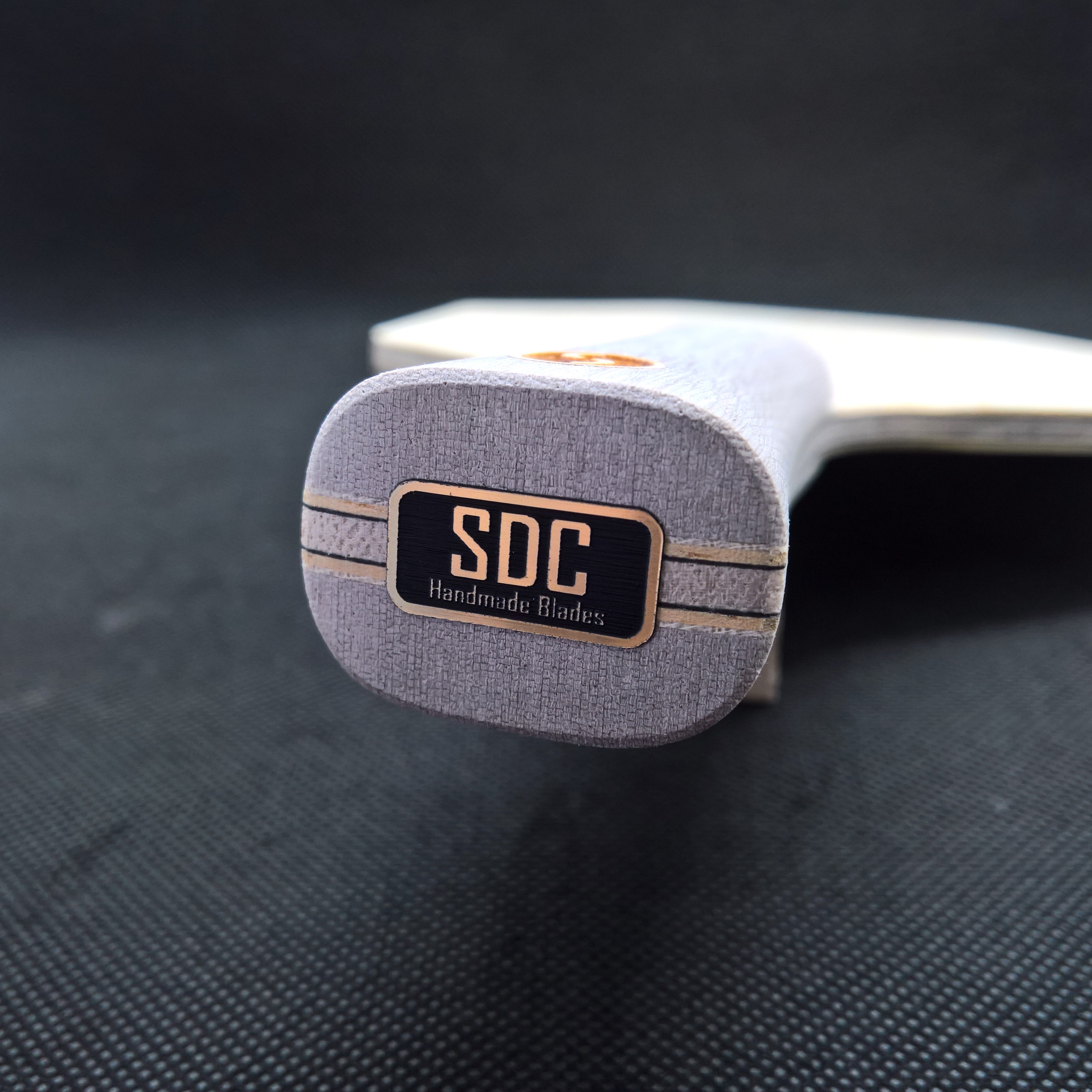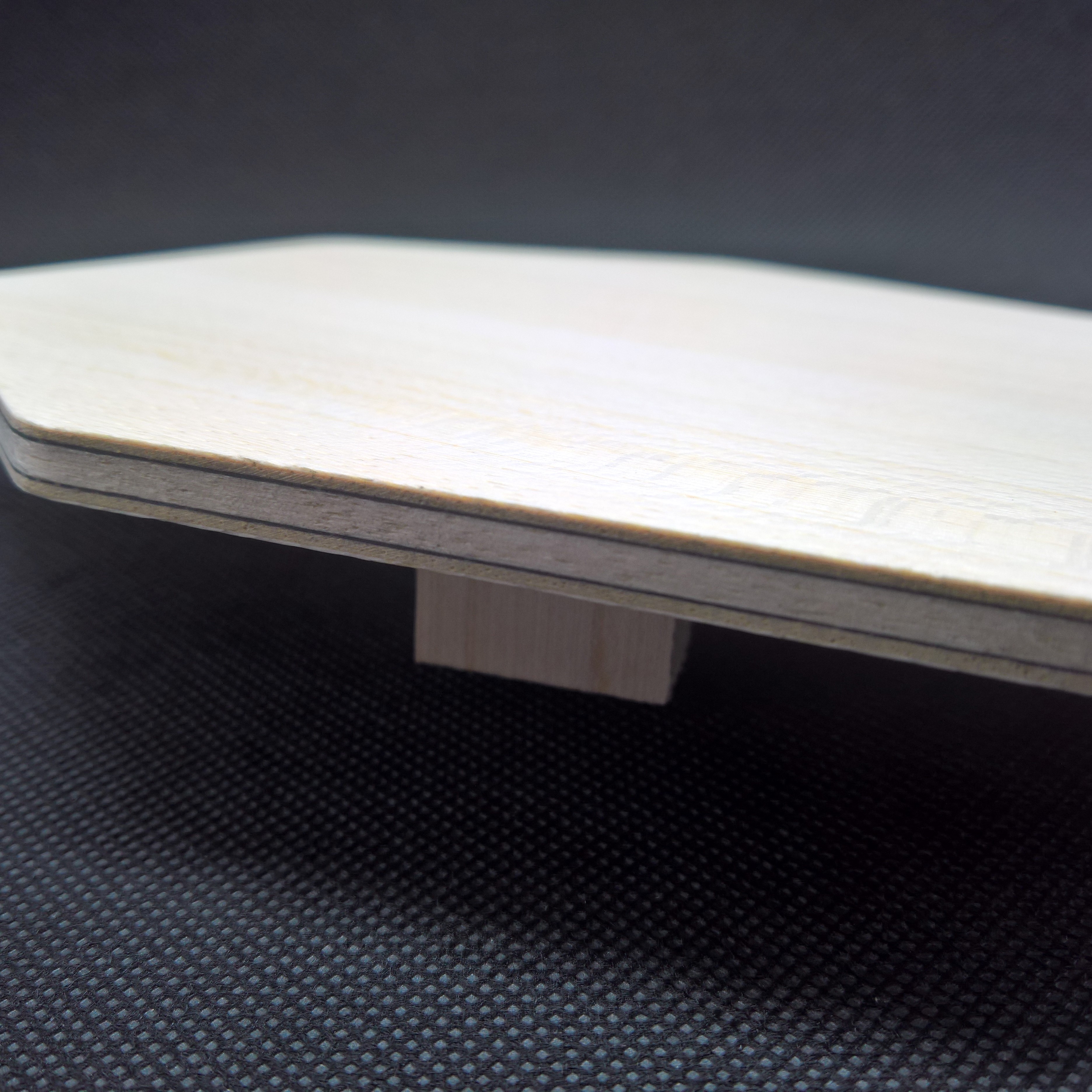

SDC Handmade Blades

SDC

This user has no status.

SDC

This user has no status.
🏆 Top 1% Commenter
Well-Known Member
Dec 2011
1,789
3,532
5,922
@hipnotic i always thought that black limba is slightly harder than white limba?
I can be sometimes, but it also can be less. That has to do with the particular tree, and not with the fact that it's black or white. From the same tree they can get both, and they will both have the same average density. Some time ago I had a batch of Black Limba that was really light, lighter than all the White Limba I have, at the moment all my Black Limba is heavier. I also have some sheets with a very sharp distinction in the middle, like the Poplar shown here, those halves weigh the same.
 
  • Like
Reactions: K.K

K.K

This user has no status.

K.K

This user has no status.
Member
Aug 2024
368
378
1,011
I can be sometimes, but it also can be less. That has to do with the particular tree, and not with the fact that it's black or white. From the same tree they can get both, and they will both have the same average density. Some time ago I had a batch of Black Limba that was really light, lighter than all the White Limba I have, at the moment all my Black Limba is heavier. I also have some sheets with a very sharp distinction in the middle, like the Poplar shown here, those halves weigh the same.
thank you for clarifying!
 
  • Like
Reactions: SDC
This user has no status.
Member
Aug 2021
329
318
699
Read 1 reviews
@hipnotic

Your hand made blades are beautiful. And you are not afraid to use "exotic" woods. What I meant by "exotic" is the type of woods that are not commonly used in table tennis.

I have few questions:

1. Let's say you want to design and make a new blade. Let's say you pick one type of wood (not commonly used) as the top ply, or middle ply. Before you make the blade, did you have certain characteristics that you want to achieve by choosing the exotic woods? (meaning that you already want to build the blade with certain characteristics, thus you choose that type of wood).

Or you just make one and then check the resulting characteristics (kind of trial and error)?

2. If the answer is yes to #1 (you already know the final product's characteristics), then I guess you can estimate the "behavior" of the wood just by its properties?

3. If you can guess the characteristic just by knowing the wood's properties, can you guess/estimate the final result of these compositions (they are all common woods used in TT):

a. hinoki - mahogany - kiri - mahogany - hinoki (with total thickness of 5.8 - 5.9 mm)
b. hinoki - koto - kiri - koto - hinoki (with same thickness as above)
c. What if the core is changed from Kiri to Ayous? Is it more bouncy?

I am just curious. But if you hesitate to answer because it might reveal your "trade secret", it's OK.

Thank you for your kind attention.
 
  • Like
Reactions: joesan-tt
This user has no status.
🏆 Top 1% Commenter
Well-Known Member
Jan 2024
2,210
2,885
6,904
Read 2 reviews
@mightymouse I have read in the past that there's actual modeling and material science involved. Maybe not for every model when the material is familiar already.

Of course reality will always be different from a model but the general direction will definitely be predictable based on the wood properties.
 

SDC

This user has no status.

SDC

This user has no status.
🏆 Top 1% Commenter
Well-Known Member
Dec 2011
1,789
3,532
5,922
@hipnotic

Your hand made blades are beautiful. And you are not afraid to use "exotic" woods. What I meant by "exotic" is the type of woods that are not commonly used in table tennis.

I have few questions:

1. Let's say you want to design and make a new blade. Let's say you pick one type of wood (not commonly used) as the top ply, or middle ply. Before you make the blade, did you have certain characteristics that you want to achieve by choosing the exotic woods? (meaning that you already want to build the blade with certain characteristics, thus you choose that type of wood).

Or you just make one and then check the resulting characteristics (kind of trial and error)?

2. If the answer is yes to #1 (you already know the final product's characteristics), then I guess you can estimate the "behavior" of the wood just by its properties?

3. If you can guess the characteristic just by knowing the wood's properties, can you guess/estimate the final result of these compositions (they are all common woods used in TT):

a. hinoki - mahogany - kiri - mahogany - hinoki (with total thickness of 5.8 - 5.9 mm)
b. hinoki - koto - kiri - koto - hinoki (with same thickness as above)
c. What if the core is changed from Kiri to Ayous? Is it more bouncy?

I am just curious. But if you hesitate to answer because it might reveal your "trade secret", it's OK.

Thank you for your kind attention.
Ok, let's see if I can answer this.

With wood, the mechanical properties are usually proportional to the density, meaning that stuff like the elastic modulus and hardness, which are the two main ones that contribute to the blade's performance, will increase if the density increases. It's not always the case, but it's usually true, the grain structure also plays a part. So, the most important thing is recognizing where those woods sit in terms of these properties, when compared to other commonly used woods such as Limba or Koto.

To me it doesn't make sense to use an exotic wood in the medial layer just for the sake of being different (when I say exotic I mean woods like rosewood, which are endangered). I will avoid it if we can substitute it for something with similar characteristics, but more widely available.

There are some basic rules that are independent of the wood species, they are only affected by the mechanical properties. I will not explained them all, not because it's a secret, but because it's too much text 😅; if we know these rules we can predict the behavior of a blade to some extent. Of course this is also empirical, and it comes from making thousands of blades, sometimes it's just a gut feeling or a comparison to something I have done in the past.

In this case I don't have enough information to answer your questions about the compositions because, as important as the total thickness, is the thickness of the individual layers.
 

SDC

This user has no status.

SDC

This user has no status.
🏆 Top 1% Commenter
Well-Known Member
Dec 2011
1,789
3,532
5,922
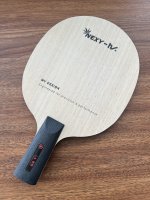
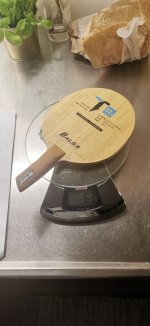
#1209 - Inner SC - OFF

The white Cyberthingy.

- Koto / Ayous / SC / Kiri core
- 90.7g
- 6.2mm
- FL (100x25.7-23.4mm)
- Balance: 3.1cm (Med)

1209-1.jpg


1209-2.jpg


1209-3.jpg
 
  • Like
Reactions: Haraold and Giangt
This user has no status.
Member
Aug 2021
329
318
699
Read 1 reviews
Ok, let's see if I can answer this.

With wood, the mechanical properties are usually proportional to the density, meaning that stuff like the elastic modulus and hardness, which are the two main ones that contribute to the blade's performance, will increase if the density increases. It's not always the case, but it's usually true, the grain structure also plays a part. So, the most important thing is recognizing where those woods sit in terms of these properties, when compared to other commonly used woods such as Limba or Koto.

To me it doesn't make sense to use an exotic wood in the medial layer just for the sake of being different (when I say exotic I mean woods like rosewood, which are endangered). I will avoid it if we can substitute it for something with similar characteristics, but more widely available.

There are some basic rules that are independent of the wood species, they are only affected by the mechanical properties. I will not explained them all, not because it's a secret, but because it's too much text 😅; if we know these rules we can predict the behavior of a blade to some extent. Of course this is also empirical, and it comes from making thousands of blades, sometimes it's just a gut feeling or a comparison to something I have done in the past.

In this case I don't have enough information to answer your questions about the compositions because, as important as the total thickness, is the thickness of the individual layers.

Thank you for your excellent explanation. I always wonder how the TT Technician design a blade, which woods to use and which composite to use. Not only from the point of view of materials used, but also the design of the head sizes, head shapes, etc. Currently, I don't exactly know if the Hexagonal shape introduced by Stiga is actually beneficial or not. Also the JO shape which is used by Waldner, which I have used but can't really tell if it has the extra advantage compared to the usual round shape.

Regarding the prediction of composition, I think you are correct, it's not only the total thickness but also the thickness of each ply.

Anyway, thank you again for the reply. (y)
 

SDC

This user has no status.

SDC

This user has no status.
🏆 Top 1% Commenter
Well-Known Member
Dec 2011
1,789
3,532
5,922
Thank you for your excellent explanation. I always wonder how the TT Technician design a blade, which woods to use and which composite to use. Not only from the point of view of materials used, but also the design of the head sizes, head shapes, etc. Currently, I don't exactly know if the Hexagonal shape introduced by Stiga is actually beneficial or not. Also the JO shape which is used by Waldner, which I have used but can't really tell if it has the extra advantage compared to the usual round shape.

Regarding the prediction of composition, I think you are correct, it's not only the total thickness but also the thickness of each ply.

Anyway, thank you again for the reply. (y)
I can give an hypothetical scenario for the compositions, in fact I recently posted a blade like this, but it has thicker: https://www.tabletennisdaily.com/forum/topics/sdc-handmade-blades.19018/post-515167

Even with 6.4mm, this one is barely in the OFF- range, but it does have 1.12mm outer layers and a 3mm core. If we decreased the total thickness to 5.9mm but keeping the same ply proportion, it would only get slower. Of course we could decrease the thickness of the outer and increase the core, and then it would be faster, but it would lose the Hinoki feel. We could also decrease the outer, keep the core and increase the medial, this would be the least bouncy combination, but possibly with the highest top end, but also the hardest feeling. For the medial layer, the hardness of the material is the most important aspect, and Mahogany is just a tad harder than Koto so it would be slightly softer and lighter.

Changing the core to Ayous would produce an increase in weight in all combinations, and for the last one for example it might get too heavy depending on the exact density. Essentially it would give a more solid feeling, and more kick on harder shots.

This is my view on the cybershape:

There's two reasons to use the cyber shape, one is the different aesthetic (nothing wrong with that), and the other is the actual practical difference in performance. All marketing "data" aside, what the cyber shape really provides, is a clever way to increase the center of gravity of the blade, without actually increasing the mass. Head heavy blades have their place, they are harder to manage but they provide more momentum, which equals more power. Up until now, the only way to achieve more head heaviness was to either increase the density of the layers, which has some impact on the playing properties too, or to use a bigger head size, but that also increases the total weight. So, the purpose of the cyber shape is to be more head heavy while keeping the same overall mass.

Their marketing strategy is actually brilliant, they introduce a more head heavy blade by nature, and then they introduce a redundant balancing system that only brings a solution to a "problem" they have created in the first place.
 
This user has no status.
Member
Sep 2014
51
52
196
Up until now, the only way to achieve more head heaviness was to either increase the density of the layers, which has some impact on the playing properties too, or to use a bigger head size, but that also increases the total weight
How about using lighter wood for the handle or hollowing it out? What are the downsides of such approaches?
 
says Leave the righteousness to me.
🏆 Top 1% Commenter
Well-Known Member
Nov 2020
1,611
1,467
6,999
This is my view on the cybershape:

There's two reasons to use the cyber shape, one is the different aesthetic (nothing wrong with that), and the other is the actual practical difference in performance. All marketing "data" aside, what the cyber shape really provides, is a clever way to increase the center of gravity of the blade, without actually increasing the mass. Head heavy blades have their place, they are harder to manage but they provide more momentum, which equals more power. Up until now, the only way to achieve more head heaviness was to either increase the density of the layers, which has some impact on the playing properties too, or to use a bigger head size, but that also increases the total weight. So, the purpose of the cyber shape is to be more head heavy while keeping the same overall mass.

Can we have a round shape which would achieve these cyber-shape benefits?
 

SDC

This user has no status.

SDC

This user has no status.
🏆 Top 1% Commenter
Well-Known Member
Dec 2011
1,789
3,532
5,922
How about using lighter wood for the handle or hollowing it out? What are the downsides of such approaches?
This is already what manufacturers do, many blades out there (mostly with Ayous core) have hollowed handles, even if they don't advertise it. Anyway, it doesn't achieve the same thing as using a different shape does.

Can we have a round shape which would achieve these cyber-shape benefits?
Technically you can, but it's going to look very weird. Basically it needs to look like a tear drop, but in order to have the same cm2 in the blade face, the proportions would look weird. The cyber shape is a good optimization of this concept.

Isn't that basically what the classic Jpen shape is?
Not really, a classic Jpen has nearly parallel edges, this doesn't shift the mass upwards like the cyber shape does.
 
says Leave the righteousness to me.
🏆 Top 1% Commenter
Well-Known Member
Nov 2020
1,611
1,467
6,999
Technically you can, but it's going to look very weird. Basically it needs to look like a tear drop, but in order to have the same cm2 in the blade face, the proportions would look weird. The cyber shape is a good optimization of this concept.

OK, I trust you... Considering taking that shape for the next blade...
 
  • Like
Reactions: SDC

SDC

This user has no status.

SDC

This user has no status.
🏆 Top 1% Commenter
Well-Known Member
Dec 2011
1,789
3,532
5,922
If you want speed then you need stiffness, you can increase the stiffness by either increasing the total thickness or increasing the stiffness of the individual plies (using composites for example). Both approaches add weight to the composition so, disregarding other variables, because Kiri is lighter than Ayous, it's easier to use while keeping the weight reasonable.
 
  • Like
Reactions: joesan-tt
This user has no status.
🏆 Top 1% Commenter
Well-Known Member
Jan 2024
2,210
2,885
6,904
Read 2 reviews
Not sure if this is going towards derailing the topic, so please let me know if it does and I'll take it elsewhere.
The connection between Stiga blades' loud feedback and the wood used dawned on me today. Spruce and Ayous are pretty close in general density as well as hardness, and that would make vibration travel pretty easily through the core and medial layers.
Am I spewing nonsense here, or is that part of the signature Stiga feedback?
Does limba/limba/ayous leave the vibration more in the top layers, and limba/ayous/ayous bring it more to the core?
Such an interesting topic...
The other day I played a couple of balls with a butterfly Joo Sae Hyuk, but that's planchonello/koto/ayous and similar to the diode V except for the thickness. I found it to be very familiar to my taste of limba/limba blades, so now I'm thinking my preference may be for blades with similar veneers in top and medial layers.
 
Top