
Politics - Any and All Political Discussions Not Really Related to TT
- Thread starter zeio
- Start date



You are using an out of date browser. It may not display this or other websites correctly.
You should upgrade or use an alternative browser.
You should upgrade or use an alternative browser.



says
Shoo...nothing to see here. - zeio

says
Shoo...nothing to see here. - zeio
🏆 Top 1% Commenter
Well-Known Member
Well-Known Member
Oh, I wouldn't be surprised if she does, just like the Epstein survivors couldn't believe how the DOJ exposed them while at the same time protecting the perpetrators. So, hi pot, meet kettle.I suppose peng shuai might see it differently
Epstein victims are furious over redaction failures
https://www.youtube.com/shorts/hSmYODyr5Xg
What Was Redacted in the Epstein Files
https://www.youtube.com/shorts/xNOhFjl-McQ
How the Epstein files exposed victims but protected the powerful | By the Numbers
https://www.youtube.com/shorts/mexi6U_n9HA
Epstein Victim, Trump Accuser Goes Into HIDING As Trump DOJ Redactions Face Judge’s Deadline!!
https://www.youtube.com/watch?v=CHHYfCB4K2E
2022/1/17
Osaka 'proud' of WTA handling of Peng Shuai case - Sports - Business Recorder
https://www.brecorder.com/news/40147743/osaka-proud-of-wta-handling-of-peng-shuai-case
2023/4/13
WTA to make China return in September, admits boycott over Peng Shuai claims ‘did not work’
https://www.scmp.com/sport/tennis/a...s-boycott-over-peng-shuai-claims-did-not-work
The WTA to resume tournaments in China this fall
https://www.wtatennis.com/news/3147537/the-wta-to-resume-tournaments-in-china-this-fall
2026/1/12
WTA renews Migu and Tencent deals amid Chinese audience growth
https://www.sportspro.com/news/broa...-migu-tencent-tv-rights-renewal-january-2026/
says
Shoo...nothing to see here. - zeio
says
Shoo...nothing to see here. - zeio
🏆 Top 1% Commenter
Well-Known Member
Well-Known Member
Why Western Narratives About China Don’t Work Anymore | Daniel Dumbrill
https://youtu.be/2BeE4upMjxw?t=3045
Yeah. [sighs] I don't know. I I I reflect on these things and I'm just like, you know, I think sometimes I think to some people hearing us, you know, talk about the US are like, "Oh, you're just talking shit about the US, right?" And it's almost implied going back to that pro-China label again. They think if you're pro-China then auto automatically means you're anti- US. I don't know. I I don't like that's not that's not it at all. At least for me it's I mean we want the world to come together, right? We want more peace. We want like there would be I say this all the time. I don't like in terms of like a real life realworld utopia situation and not some like fantastical dream of a utopia but like grounded in reality wouldn't like the US and China actually being friendly partners in the world be the closest thing we can think of to like world peace. I mean that's the most realistic thing I can think of.
Yeah. I wonder if it's impossible because potentially the you know the wealth of the US is based more than people realize on uh the exploitation and subjugation of the rest of the world. Um and if that's the case, how can you have friendly relationships with a country and say you're going to come together together for the you know betterment of the planet and still do those things? Maybe they know they're like there's no way to have you know everything's being produced in China now. uh so much of the innovation is happening here now like is this just the logical thing for them to do because there's there's nothing else and and is is a complete collapse of America required before as as difficult as that is to for for for you to hear for anybody here who doesn't want to see that is that is what is required for a a hard reset of America to really build themselves back up on something a little bit more sustainable that doesn't involve them subjugating the rest of the world I don't know I I'm just thinking out loud, but would that resemble in any way the fall of the British Empire? You know, is that what we're talking about kind of like that type of transition or is it something more drastic you're you're thinking? When I say a reset, I I don't know. I that could that could really mean anything. Like I don't know what degree of of of a crash, so so to speak, would be required for that reset. So, so I'm not sure, but just enough of to to send them back to the drawing board and say, "Okay, we've got to completely reinvent the way that we do things. This is not how we're going to, you know, um, build our wealth anymore." So, I don't I don't know. Again, I'm just thinking out loud about, you know, what is it possibly uh what is the possible required catalyst for a better America and a better world?
https://youtu.be/2BeE4upMjxw?t=3045
Yeah. I wonder if it's impossible because potentially the you know the wealth of the US is based more than people realize on uh the exploitation and subjugation of the rest of the world. Um and if that's the case, how can you have friendly relationships with a country and say you're going to come together together for the you know betterment of the planet and still do those things? Maybe they know they're like there's no way to have you know everything's being produced in China now. uh so much of the innovation is happening here now like is this just the logical thing for them to do because there's there's nothing else and and is is a complete collapse of America required before as as difficult as that is to for for for you to hear for anybody here who doesn't want to see that is that is what is required for a a hard reset of America to really build themselves back up on something a little bit more sustainable that doesn't involve them subjugating the rest of the world I don't know I I'm just thinking out loud, but would that resemble in any way the fall of the British Empire? You know, is that what we're talking about kind of like that type of transition or is it something more drastic you're you're thinking? When I say a reset, I I don't know. I that could that could really mean anything. Like I don't know what degree of of of a crash, so so to speak, would be required for that reset. So, so I'm not sure, but just enough of to to send them back to the drawing board and say, "Okay, we've got to completely reinvent the way that we do things. This is not how we're going to, you know, um, build our wealth anymore." So, I don't I don't know. Again, I'm just thinking out loud about, you know, what is it possibly uh what is the possible required catalyst for a better America and a better world?
says
Shoo...nothing to see here. - zeio
says
Shoo...nothing to see here. - zeio
🏆 Top 1% Commenter
Well-Known Member
Well-Known Member
Why Is the West Becoming Obsessed With China? | Aaron Bastani Meets Yi–Ling Liu
https://www.youtube.com/watch?v=xYPxnbmSWTM
https://www.youtube.com/watch?v=xYPxnbmSWTM&lc=UgwFHogueY9FKMeuNJx4AaABAg
@ly8078
2 months ago
I grew up in mainland China, and I would say that “the century of humiliation” is more of a simplified framing for an English-speaking audience; in China, it is rarely presented this way. Yi-Ling is right to point out the emphasis on agency over victimhood, and I would add that the history curriculum on this period is not one-sided in the mainland either.
To start, a more commonly used term for that period is 救亡图存 (save the nation from subjugation and strive for survival), which is closely aligned with Sun Yat-sen’s message during the ROC period and still resonates with the KMT in Taiwan. The orientation is toward strengthening the country, restoring dignity for Chinese people, and securing China’s sovereignty.
This is reflected in how the fall of the Qing dynasty is presented. As both republics (the ROC and the PRC) emerged following the failure of the Qing dynasty, the narrative emphasis is naturally on how that system failed in the face of both internal and external challenges. The history curriculum covers a wide range of reform efforts and competing ideologies in the late 19th and early 20th centuries—from modernization without altering the political structure, to constitutional monarchy, federalism, nationalism, anarchism, and communism. The emphasis remains on historical processes and human agency, rather than resentment toward the West or nostalgia for the last imperial dynasty. It is also worth noting that the Qing ruling house was an ethnic minority in China. As a result, the public has little identification with the ruling house and some even attribute more responsibility to it than warranted. For pragmatic and ideological reasons, both the PRC and the ROC have actively managed this undercurrent by emphasizing multi-ethnic national unity, drawing on both left-wing frameworks (class over ethnicity) and nationalist ones (national identity over ethnic difference).
As a side note, there has been a gradual shift in sentiment toward the West over the past decade. There is now a stronger sense that even when China becomes stronger, this does not necessarily translate into respect from the West. White exceptionalism, U.S. imperialism, Eurocentric arrogance and double standards are experienced as ongoing rather than historical, and the internet has made them far more immediate and salient.
Secondly, while the West often projects backward or "radical" ideologies onto the Chinese government, the PRC is actually rather progressive on multiculturalism and gender equality, often more so than segments of the general public. Those commitments have been embedded in the PRC’s constitution since its founding; today, right-wing extremism and hate speech are moderated more firmly on Chinese social platforms than U.S.-owned ones. The government actively and consistently promotes inter-ethnic engagement, multicultural representation, and multi-ethnic solidarity. If that's considered propaganda, I do not object to it.
https://www.youtube.com/watch?v=xYPxnbmSWTM&lc=Ugw1ho8aU57b4SB5_xF4AaABAg
@xye-NYC
2 months ago
Feels so strange watching her describe Chinese propaganda from a negative perspective because when i watched them, they were positive naratives about progress and improvements while here in the US, the propaganda we see are negative narratives using words such as Chinese censorship and authoritarian governence. We may be free to insult our government or politicians but we are powerless to do anything to change their policies - like 100% tarriffs on Chinese EVs so that affordable $10k cars charged using affordable Chinese solar panels are impossible to buy here. Isn't what we have here a worse form of authoritarianism because at least over there, people's lives have been improving dramatically? She is like a female version of Dan Wang - they look Chinese but view the world from the Western media perspective.
https://www.youtube.com/watch?v=xYPxnbmSWTM
https://www.youtube.com/watch?v=xYPxnbmSWTM&lc=UgwFHogueY9FKMeuNJx4AaABAg
@ly8078
2 months ago
I grew up in mainland China, and I would say that “the century of humiliation” is more of a simplified framing for an English-speaking audience; in China, it is rarely presented this way. Yi-Ling is right to point out the emphasis on agency over victimhood, and I would add that the history curriculum on this period is not one-sided in the mainland either.
To start, a more commonly used term for that period is 救亡图存 (save the nation from subjugation and strive for survival), which is closely aligned with Sun Yat-sen’s message during the ROC period and still resonates with the KMT in Taiwan. The orientation is toward strengthening the country, restoring dignity for Chinese people, and securing China’s sovereignty.
This is reflected in how the fall of the Qing dynasty is presented. As both republics (the ROC and the PRC) emerged following the failure of the Qing dynasty, the narrative emphasis is naturally on how that system failed in the face of both internal and external challenges. The history curriculum covers a wide range of reform efforts and competing ideologies in the late 19th and early 20th centuries—from modernization without altering the political structure, to constitutional monarchy, federalism, nationalism, anarchism, and communism. The emphasis remains on historical processes and human agency, rather than resentment toward the West or nostalgia for the last imperial dynasty. It is also worth noting that the Qing ruling house was an ethnic minority in China. As a result, the public has little identification with the ruling house and some even attribute more responsibility to it than warranted. For pragmatic and ideological reasons, both the PRC and the ROC have actively managed this undercurrent by emphasizing multi-ethnic national unity, drawing on both left-wing frameworks (class over ethnicity) and nationalist ones (national identity over ethnic difference).
As a side note, there has been a gradual shift in sentiment toward the West over the past decade. There is now a stronger sense that even when China becomes stronger, this does not necessarily translate into respect from the West. White exceptionalism, U.S. imperialism, Eurocentric arrogance and double standards are experienced as ongoing rather than historical, and the internet has made them far more immediate and salient.
Secondly, while the West often projects backward or "radical" ideologies onto the Chinese government, the PRC is actually rather progressive on multiculturalism and gender equality, often more so than segments of the general public. Those commitments have been embedded in the PRC’s constitution since its founding; today, right-wing extremism and hate speech are moderated more firmly on Chinese social platforms than U.S.-owned ones. The government actively and consistently promotes inter-ethnic engagement, multicultural representation, and multi-ethnic solidarity. If that's considered propaganda, I do not object to it.
https://www.youtube.com/watch?v=xYPxnbmSWTM&lc=Ugw1ho8aU57b4SB5_xF4AaABAg
@xye-NYC
2 months ago
Feels so strange watching her describe Chinese propaganda from a negative perspective because when i watched them, they were positive naratives about progress and improvements while here in the US, the propaganda we see are negative narratives using words such as Chinese censorship and authoritarian governence. We may be free to insult our government or politicians but we are powerless to do anything to change their policies - like 100% tarriffs on Chinese EVs so that affordable $10k cars charged using affordable Chinese solar panels are impossible to buy here. Isn't what we have here a worse form of authoritarianism because at least over there, people's lives have been improving dramatically? She is like a female version of Dan Wang - they look Chinese but view the world from the Western media perspective.
Last edited:
says
Shoo...nothing to see here. - zeio
says
Shoo...nothing to see here. - zeio
🏆 Top 1% Commenter
Well-Known Member
Well-Known Member
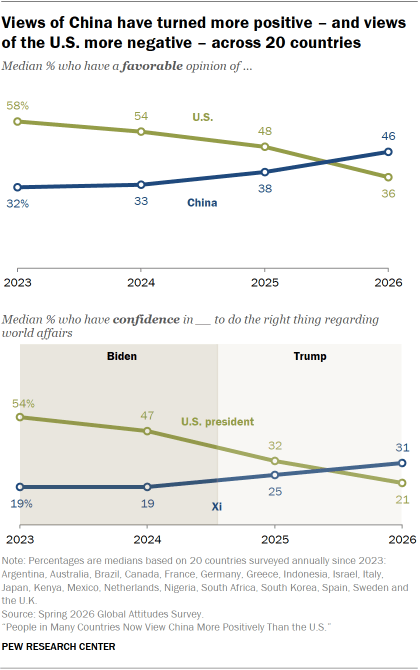
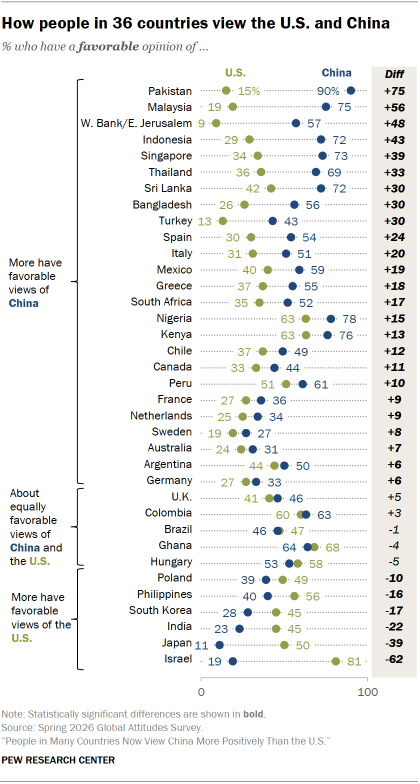
World: CHN good
JPN/ISR/IND/KOR/POL/PHL: USA good
2002: Axis of Evil...
2026: Axis of Denial...
People in Many Countries Now View China More Positively Than the U.S.
More also have confidence in Xi than Trump, according to a survey in three dozen countries
https://www.pewresearch.org/global/...-now-view-china-more-positively-than-the-u-s/
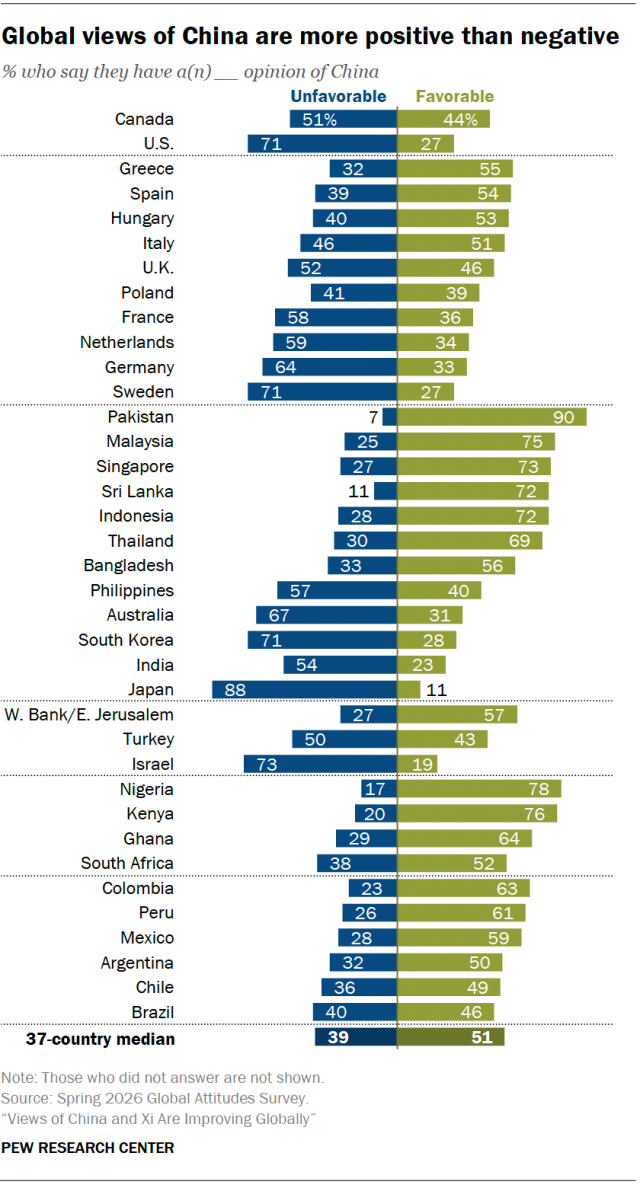
Views of China and Xi Are Improving Globally
But opinions are much less positive in wealthier nations, a 37-country survey finds
https://www.pewresearch.org/global/2026/07/15/views-of-china-and-xi-are-improving-globally/
Hong Kong Billionaire on China, America and Building Wealth From 0
https://youtu.be/LCXnDh4AiTo?t=905
You know western democracy was a system that everybody should look up to. If you look at the west right now US is kind of a mess. you know 250 years which they will be celebrating u on Donald Trump's birthday with the UFC UFC with the fight that I'll be building on the White House whatever to each his own but uh you know so if you look at the US you look at Canada you look at uh UK mess you look at Germany commy's not good you look at France communy's not good...
A US Citizen in China for 25 Years
https://youtu.be/yv7lmDSmykc?t=2942
You are going to have the United States has gotten itself due to its corrupt government practices due to terrible malfeasants uh by the Senate and the Democrats and the Oval Office. They have just wrecked that society over there. They have created such massive problems and and now they're turning to say, well, how are we going to fix this? And where are they looking? Well, they're looking at the number one most successful society on planet and economy. The number one, let me say it please. China. Okay. the largest safe, stable, successful, capable and civilized economy and society on the planet. That's what China is. Okay. 100% factually evidently true. Okay. And so now where So then whatam is Europe is Italy that? No, not even close. Italyy's a mess. England's a mess. France is a mess. Germanyy's a mess. Okay. China is the largest safe, stable, successful, capable civil society and economy on the planet.
JPN/ISR/IND/KOR/POL/PHL: USA good
2002: Axis of Evil...
2026: Axis of Denial...
People in Many Countries Now View China More Positively Than the U.S.
More also have confidence in Xi than Trump, according to a survey in three dozen countries
https://www.pewresearch.org/global/...-now-view-china-more-positively-than-the-u-s/
Views of China and Xi Are Improving Globally
But opinions are much less positive in wealthier nations, a 37-country survey finds
https://www.pewresearch.org/global/2026/07/15/views-of-china-and-xi-are-improving-globally/
Hong Kong Billionaire on China, America and Building Wealth From 0
https://youtu.be/LCXnDh4AiTo?t=905
A US Citizen in China for 25 Years
https://youtu.be/yv7lmDSmykc?t=2942
This user has no status.

This user has no status.
🏆 Top 1% Commenter
Well-Known Member
Well-Known Member


says
Shoo...nothing to see here. - zeio
says
Shoo...nothing to see here. - zeio
🏆 Top 1% Commenter
Well-Known Member
Well-Known Member
A follow-up post for future reference.
PsyopAnime - WW3 - Episode 3
https://youtu.be/MciXXdZFJzM?t=214
Ray Dalio: 'Expect a Tribute System' as China Influence Grows
https://youtu.be/iB2eApp0Kmo?t=277
You're seeing a number of leaders go up to China and essentially have, uh, uh, essentially have relations, but it's like the tribute system, but also in the region. There's the recognition in their view, that there is an environment where, uh, the countries in the region, I have to recognize and respect that power. And so now you're seeing that happen. That tribute system is not a, um, oppressive controlling system. It's much more like there is the purse. The more powerful have an obligation to behave well with, the less powerful and the less powerful have an obligation to recognize, the more powerful, and they should operate in a harmonious way.
Can the United States really annex Canada? | Unravelled
https://www.youtube.com/watch?v=2zamxJsU5kA
Pea sales to China strong despite new starch tariff
https://www.producer.com/markets/pea-sales-to-china-strong-despite-new-starch-tariff/
PsyopAnime - WW3 - Episode 3
https://youtu.be/MciXXdZFJzM?t=214
Ray Dalio: 'Expect a Tribute System' as China Influence Grows
https://youtu.be/iB2eApp0Kmo?t=277
Can the United States really annex Canada? | Unravelled
https://www.youtube.com/watch?v=2zamxJsU5kA
Pea sales to China strong despite new starch tariff
https://www.producer.com/markets/pea-sales-to-china-strong-despite-new-starch-tariff/
“The political environment, the context we’re working in with respect to China, has been trending in a positive direction (in the pulse sector),” Cherewyk said from his office in Winnipeg.
In March 2025, China unveiled a 100 per cent tariff on Canadian peas, effectively shutting the door to the biggest market in the world for pea imports.
Sales to China dropped to almost nothing, which was a massive loss for Canada’s pulse industry.
From March 1 until the end of July, Canada will ship about 500,000 tonnes of peas to China.
That’s an excellent pace of exports because Canada typically sells 1.6 million tonnes of yellow peas to China in a year.
“It’s very significant to have that market re-opened,” Cherewyk said.
says
Shoo...nothing to see here. - zeio
says
Shoo...nothing to see here. - zeio
🏆 Top 1% Commenter
Well-Known Member
Well-Known Member
You could use some Buddhism.
Take a listen to this monk's "propaganda" from Taiwan back in 2011 on Sun Yat-sen's ideals, the dude quoted in the OP.
外國人應當向中國學習 (Foreigners should learn from China)
https://www.youtube.com/watch?v=oY9SH6v81Js
The Chinese have wisdom in education, teaching methods, experience, and achievements. Of the world's four ancient civilizations, China still exists—that is an achievement. If we abandon these, this last ancient civilization may disappear, cease to exist altogether. Now, fewer and fewer people are truly studying Buddhism. The biggest difficulty in studying Buddhism is letting go of desires, which is extremely difficult for people today. If you can't let go of wealth, lust, fame, food, and sleep, you can't truly enter into Buddhism; you'll only learn a little, scratching the surface. Only after letting go can you truly enter, which is extremely difficult. But with so many people in the world, I think finding two or three hundred shouldn't be a problem. With two or three hundred people, Buddhism worldwide can be revived. We know that when Shakyamuni Buddha founded his teachings in Deer Park, there were only six people—himself and five students—that's how he started. Today, with sixty or six hundred people, how could Buddhism not revive? It certainly will. In the past, in China, a single monastery was a large Buddhist academic group, with thousands of members. This is something we must know. Knowing this, we should also learn from the aspiration of Bhikkhu Dharmakara; his aspiration was great—to establish the Pure Land of Ultimate Bliss, and he succeeded.
says
Shoo...nothing to see here. - zeio
says
Shoo...nothing to see here. - zeio
🏆 Top 1% Commenter
Well-Known Member
Well-Known Member
This interview has gone viral in China and because of that now makes its way to back to the West.
Be sure to check out the comments if you have a chance. How come so many in the comment section feel that no Western journalists can get this right nowadays?
Christopher Nolan talks narrative decisions, film critics and whether he Christianised The Odyssey
https://youtu.be/wa4I8Ch2TRo
@viviaan-ut1zi
12 days ago (edited)
The woman who interviewed Nolan is Zhong Shu. Fluent in Ancient Greek, German ,she works as a translator and teaches political philosophy at a university in the United States. Her Chinese-language podcast boasts 900,000 followers. Calm, incisive and witty, she wields considerable influence among serious listeners. Staff at Universal Pictures caught her podcast episode from last year dissecting how to read Homer’s The Odyssey, which led them to invite her to interview Director Nolan. I absolutely loved this interview—her questions were sharp, and his responses equally compelling. I’m definitely going to watch the film, and I hope it’s a massive box-office hit!
https://www.youtube.com/watch?v=wa4...Ag.AZy0in-F1vyA_1gFmOTNDs&pp=0gcJCSIANpG00pGi
@markusbunders
11 days ago (edited)
She is a prime example of a Chinese professional today. I am from Europe, but live in China and spend summers in the US. I have had the same impression of many other Chinese from medical doctors to economists. The crystal clear, cut straight to the point argumentation with homework done approach is intrinsic to them. They are a blessing for anyone interested of their field of expertise.
https://www.youtube.com/watch?v=wa4I8Ch2TRo&lc=Ugw_MDiosVjxxb3UON54AaABAg
@chengchao-danieltao1253
9 days ago
In her lastest podcast, Zhongshu shared her thoughts on how her interview with Nolan went viral across the Western internet: " ...those who reposts me is just borrowing my face to say what they already wanted to say. My interview with Nolan is no longer a simple film interview; it has been crammed full of different narratives — the narrative of American cultural decline, China’s rise, media anti-intellectualism, the battle to defend classical culture, left-right ideology conflict in Hollywood, and even the debate over whether American education has failed. In just seventeen minutes, the interview video has been carved up by different tribes of the internet like a whale being devoured, each slicing off the piece they needed most."
Be sure to check out the comments if you have a chance. How come so many in the comment section feel that no Western journalists can get this right nowadays?
Christopher Nolan talks narrative decisions, film critics and whether he Christianised The Odyssey
https://youtu.be/wa4I8Ch2TRo
https://www.youtube.com/watch?v=wa4I8Ch2TRo&lc=UgyGByX8be8__To-EvJ4AaABAg仲树/Zhong Shu: We live in an age that demands apology from greatness.
@viviaan-ut1zi
12 days ago (edited)
The woman who interviewed Nolan is Zhong Shu. Fluent in Ancient Greek, German ,she works as a translator and teaches political philosophy at a university in the United States. Her Chinese-language podcast boasts 900,000 followers. Calm, incisive and witty, she wields considerable influence among serious listeners. Staff at Universal Pictures caught her podcast episode from last year dissecting how to read Homer’s The Odyssey, which led them to invite her to interview Director Nolan. I absolutely loved this interview—her questions were sharp, and his responses equally compelling. I’m definitely going to watch the film, and I hope it’s a massive box-office hit!
https://www.youtube.com/watch?v=wa4...Ag.AZy0in-F1vyA_1gFmOTNDs&pp=0gcJCSIANpG00pGi
@markusbunders
11 days ago (edited)
She is a prime example of a Chinese professional today. I am from Europe, but live in China and spend summers in the US. I have had the same impression of many other Chinese from medical doctors to economists. The crystal clear, cut straight to the point argumentation with homework done approach is intrinsic to them. They are a blessing for anyone interested of their field of expertise.
https://www.youtube.com/watch?v=wa4I8Ch2TRo&lc=Ugw_MDiosVjxxb3UON54AaABAg
@chengchao-danieltao1253
9 days ago
In her lastest podcast, Zhongshu shared her thoughts on how her interview with Nolan went viral across the Western internet: " ...those who reposts me is just borrowing my face to say what they already wanted to say. My interview with Nolan is no longer a simple film interview; it has been crammed full of different narratives — the narrative of American cultural decline, China’s rise, media anti-intellectualism, the battle to defend classical culture, left-right ideology conflict in Hollywood, and even the debate over whether American education has failed. In just seventeen minutes, the interview video has been carved up by different tribes of the internet like a whale being devoured, each slicing off the piece they needed most."
Last edited:
says
Shoo...nothing to see here. - zeio
says
Shoo...nothing to see here. - zeio
🏆 Top 1% Commenter
Well-Known Member
Well-Known Member
US propaganda against China is working in the latter's favor...
Gen Z Isn't Concerned About China
https://globalaffairs.org/research/public-opinion-survey/gen-z-isnt-concerned-about-china
Gen Z Isn't Concerned About China
https://globalaffairs.org/research/public-opinion-survey/gen-z-isnt-concerned-about-china
Key Findings
- Minorities of Millennials (43%) and Generation Zers (34%), compared to majorities of Boomers (62%) and Generation Xers (56%), view the development of China as a world power as a critical threat to the United States.
- Majorities of Gen Zers (59%) and Millennials (58%), compared to half of Boomers and Gen Xers (48% each), favor a policy of friendly cooperation and engagement with China.
- A quarter of Gen Z respondents (25%) say China is not a threat to the United States, compared to much smaller shares of older cohorts.
- Millennials (49%) and Gen Zers (43%) are less likely than Boomers (69%) and Gen Xers (64%) to view China as a rival or an adversary.
- Americans across generations believe imposing tariffs on China has increased the cost of living in the United States, but they diverge on whether the tariffs have harmed China’s economy.
- Millennials and Gen Zers show strong opposition to restrictive policies targeting Chinese students, higher tariffs, and reduced trade overall.
says
Shoo...nothing to see here. - zeio
says
Shoo...nothing to see here. - zeio
🏆 Top 1% Commenter
Well-Known Member
Well-Known Member
Japan needs more people like this writer, 富坂 聡/TOMISAKA Satoshi.
中国已经改变,日本为什么不知道?|富坂聪谈“一强时代” (China has changed, why doesn't Japan know? | Tomisaka Satoshi discusses the "Era of a One-Power Country")
https://www.youtube.com/watch?v=7aRCjzXDo68
当中国不再选择日本,日本怎么办?|富坂聪谈中日关系 (What will Japan do when China no longer chooses it? | Tomisaka Satoshi discusses Sino-Japanese relations)
https://www.youtube.com/watch?v=-2yMwCGnTNw
中国已经改变,日本为什么不知道?|富坂聪谈“一强时代” (China has changed, why doesn't Japan know? | Tomisaka Satoshi discusses the "Era of a One-Power Country")
https://www.youtube.com/watch?v=7aRCjzXDo68
当中国不再选择日本,日本怎么办?|富坂聪谈中日关系 (What will Japan do when China no longer chooses it? | Tomisaka Satoshi discusses Sino-Japanese relations)
https://www.youtube.com/watch?v=-2yMwCGnTNw
This user has no status.
This user has no status.
🏆 Top 1% Commenter
Well-Known Member
Well-Known Member

US propaganda against China is working in the latter's favor...
Gen Z Isn't Concerned About China
https://globalaffairs.org/research/public-opinion-survey/gen-z-isnt-concerned-about-china
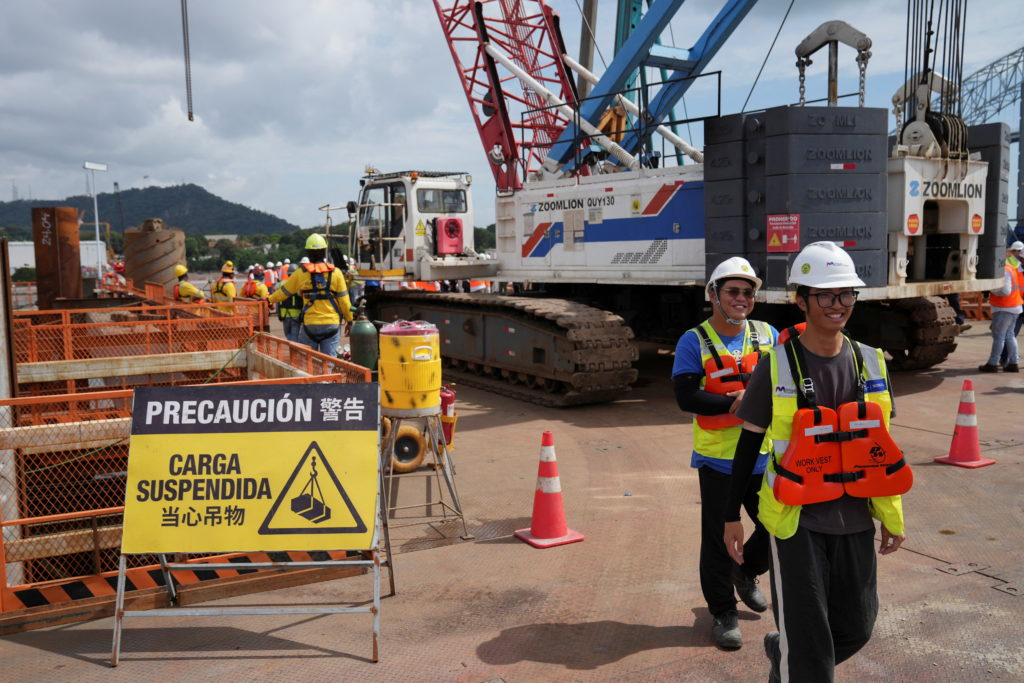
U.S. looks to boost anti-China spending worldwide by hundreds of millions of dollars, documents say
Many of the proposed programs are designed to "reclaim diplomatic leverage" through investments in areas where the U.S. had previously been spending money but stopped.
 www.pbs.org
This is why Gen Z is not concerned about China.
Imagine having to spend hundreds of millions of dollars just to talk bad about a country. The anti-China talk might work for the boomers/millennials but for the Gen Z and young ones they aren’t getting fooled by it.

A global Chinese disinformation initiative could threaten international security, U.S. officials warn
The State Department in a first-of-its-kind report has laid out Beijing’s growing efforts to reshape the global narrative on China, while spending billions of dollars to do so.
www.pbs.org

The US bill that could turn up the heat in the anti-China propaganda war
The US is upping the ante in its information war with China, with the House of Representatives backing a bill to spend US$1.6 billion within five years to promote anti-China propaganda, according to observers. The "Countering the PRC Malign Influence Fund Authorisation Act of 2023" was passed...
 finance.yahoo.com
says
Certified USATT Coach

says
Certified USATT Coach
🏆 Top 1% Commenter
Well-Known Member
Well-Known Member

The overwhelming preponderance of Chinese citizens are great, the representative government, not so much.
USA has some similarities too with the elected leaders not voting with the will of the people on the 80/20 or 90/10 issues.
USA has some similarities too with the elected leaders not voting with the will of the people on the 80/20 or 90/10 issues.
This user has no status.
This user has no status.
Active Member

3 things americans from the US should definitely avoid talking about:
- politics, inside their own country
- geopolitics: recently one self-claimed "strategist in geopolitics" on youtube said no navy outside the US could do what they do. Ok... and he even went further "the rest of the world just have navy for their coastal patrolling and that's all". France and the UK must have appreciated that ignorance.
- so therefore, ethics, and morals.
Americans are an embarrasment to climate change, football, table tennis, general culture, so moderating any forum makes them incompetent to accomplish any of those tasks required for moderating. A country with only 250 years of existence should go back study what the rest of the world did before them, Japan, China, Asia so, Europe, Africa, South America. The only TRUE americans from the US will always be the natives.
They even have no war strategies, it's simply bombing like Russia does, everywhere, with no real goal defined before the bombing starts. That's how they made nothing in Korea (technically North and South Korea are still at war), that's why they've made noting in Vietnam, nothing in Afghanistan. For sure they thought they would do better than France in Vietnam, after all, it was only France, the guys who always show a white flag to surrender...
Foch has edicted 3 principles of war:
- Economy of forces and ammunition: smart use and distribution of resources. You do not waste troops or material. You use just enough power on secondary tasks to save maximum strength for the main goal.
- Concentration of efforts : the act of bringing your power together at the right place and time. You strike hard at the enemy's weak point by uniting your main forces.
- Freedom of action: the power to choose your own path and act as you wish. You keep the initiative so the enemy must react to you, rather than you reacting to them. That's why americans can't adapt and improvise "on the spot" when things go wrong. They've no balls.

 en.wikipedia.org
This single act of bravery with very few guys charging with bayonets mounted on their rifle completely reversed the issue of the war in ex-Yugoslavia
All that money, all that power, all that so-called "moral", for... so few results with the americans. And it shows here too on this forum.
Anything legally right is not always morally right.
- politics, inside their own country
- geopolitics: recently one self-claimed "strategist in geopolitics" on youtube said no navy outside the US could do what they do. Ok... and he even went further "the rest of the world just have navy for their coastal patrolling and that's all". France and the UK must have appreciated that ignorance.
- so therefore, ethics, and morals.
Americans are an embarrasment to climate change, football, table tennis, general culture, so moderating any forum makes them incompetent to accomplish any of those tasks required for moderating. A country with only 250 years of existence should go back study what the rest of the world did before them, Japan, China, Asia so, Europe, Africa, South America. The only TRUE americans from the US will always be the natives.
They even have no war strategies, it's simply bombing like Russia does, everywhere, with no real goal defined before the bombing starts. That's how they made nothing in Korea (technically North and South Korea are still at war), that's why they've made noting in Vietnam, nothing in Afghanistan. For sure they thought they would do better than France in Vietnam, after all, it was only France, the guys who always show a white flag to surrender...
Foch has edicted 3 principles of war:
- Economy of forces and ammunition: smart use and distribution of resources. You do not waste troops or material. You use just enough power on secondary tasks to save maximum strength for the main goal.
- Concentration of efforts : the act of bringing your power together at the right place and time. You strike hard at the enemy's weak point by uniting your main forces.
- Freedom of action: the power to choose your own path and act as you wish. You keep the initiative so the enemy must react to you, rather than you reacting to them. That's why americans can't adapt and improvise "on the spot" when things go wrong. They've no balls.
Battle of Vrbanja Bridge - Wikipedia
This single act of bravery with very few guys charging with bayonets mounted on their rifle completely reversed the issue of the war in ex-Yugoslavia
All that money, all that power, all that so-called "moral", for... so few results with the americans. And it shows here too on this forum.
Anything legally right is not always morally right.
says
Shoo...nothing to see here. - zeio
says
Shoo...nothing to see here. - zeio
🏆 Top 1% Commenter
Well-Known Member
Well-Known Member
It's amazing how much the landscape could change in a decade. When there is a will, there is a way.U.S. looks to boost anti-China spending worldwide by hundreds of millions of dollars, documents say
Many of the proposed programs are designed to "reclaim diplomatic leverage" through investments in areas where the U.S. had previously been spending money but stopped.
This is why Gen Z is not concerned about China.
Imagine having to spend hundreds of millions of dollars just to talk bad about a country. The anti-China talk might work for the boomers/millennials but for the Gen Z and young ones they aren’t getting fooled by it.
A global Chinese disinformation initiative could threaten international security, U.S. officials warn
The State Department in a first-of-its-kind report has laid out Beijing’s growing efforts to reshape the global narrative on China, while spending billions of dollars to do so.
The US bill that could turn up the heat in the anti-China propaganda war
The US is upping the ante in its information war with China, with the House of Representatives backing a bill to spend US$1.6 billion within five years to promote anti-China propaganda, according to observers. The "Countering the PRC Malign Influence Fund Authorisation Act of 2023" was passed...
The Chinamaxxing meme definitely helps.
2012/11/13
How much do Young Americans Know about China?
https://www.youtube.com/watch?v=y_gpw7rlY-4
The students point to the re-election of president Barack Obama and say by all indications Chinese youth are well schooled in the U.S. political process and know a great deal about the interworking and the nuance of the U.S, political scene. Students here agree the same can't be said for the average college age student in the United States.
Why the Chinese era is upon us.
https://youtu.be/_mPWKR7BBaI?t=93
https://youtu.be/_mPWKR7BBaI?t=343Soft power is the ability of a country to influence others through attraction and persuasion rather than coercion.
https://youtu.be/_mPWKR7BBaI?t=538China's view of soft power builds upon Nye's definition but introduces a crucial fourth pillar - domestic cohesion. The ability of soft power to unite its own people.
https://youtu.be/_mPWKR7BBaI?t=870Because when the US uses hard power like threatening sanctions, it feels hypocritical. Decmocracies preach sovereignty. You're supposed to respect other's independence. So, why are you now using hard power to bully others into line? This damages moral credibility, exactly what Nye warned. "When foreign policy contradicts your values. Soft power crumbles." China's hard power, by contrast, feels consistent. Even when others disagree with its territorial stances, no one is surprised by it. China's actions are aligned with its image, and this avoids the hypocrisy trap that's plaguing the US.
The trend is largely US Gen Z-driven, and this borderline obsession with China reflects a deeper disillusionment with America's current trajectory, its growing political rifts and aggressive policies alienating both allies and its own youth. Being Chinese is therefore a dual play. It carries genuine appreciation for Chinese cultural dynamism, whilst also being a subtle act of rebellion by claiming identity with a geopolitical rival to protest against the fractures at home.
How China Conquered America With Hot Water & Slippers
https://www.youtube.com/watch?v=PvVcm7W4yPI
Why Doesn't China Speak English?
https://www.youtube.com/watch?v=_AuQXSLI97c
Why I Learned Chinese Before Everyone Else Caught On
https://www.youtube.com/watch?v=ncpVREYJdwo
says
Shoo...nothing to see here. - zeio
says
Shoo...nothing to see here. - zeio
🏆 Top 1% Commenter
Well-Known Member
Well-Known Member
How China Keeps Winning by Doing Nothing
https://www.youtube.com/watch?v=JjhyYOKmFGM
https://www.youtube.com/watch?v=JjhyYOKmFGM&lc=Ugx8kuBGUJgDqspC4Id4AaABAg
@weamibrahim2146
4 days ago
literally unskippable thumbnail
https://www.youtube.com/watch?v=JjhyYOKmFGM&lc=UgwE8IGR0Ik6pbPsNup4AaABAg
@Lemonator_32
4 days ago
Unstoppable scrolling meets an unskippable thumbnail
https://www.youtube.com/watch?v=JjhyYOKmFGM&lc=Ugz4YOTLbB56w2uClwh4AaABAg
@realitycheck3672
4 days ago
Trump; “We have the cards”
China; “We manufacture the cards”
https://www.youtube.com/watch?v=JjhyYOKmFGM&lc=UgysKBkZGa5E8E0C8W94AaABAg
@alexheilmann2415
4 days ago
So essentially China has saved Americans more money this year than our own government has
China quietly saved the world last month
https://www.youtube.com/watch?v=BkA0bkb6ZO0
The secret reason oil prices didn't spiral after the Iran war | DW News
https://www.youtube.com/watch?v=lwexLt9k0ac
Why oil markets stabilized far faster than anticipated | DW News
https://www.youtube.com/watch?v=LbT9H6CLFfo
https://www.youtube.com/watch?v=JjhyYOKmFGM
@weamibrahim2146
4 days ago
literally unskippable thumbnail
https://www.youtube.com/watch?v=JjhyYOKmFGM&lc=UgwE8IGR0Ik6pbPsNup4AaABAg
@Lemonator_32
4 days ago
Unstoppable scrolling meets an unskippable thumbnail
https://www.youtube.com/watch?v=JjhyYOKmFGM&lc=Ugz4YOTLbB56w2uClwh4AaABAg
@realitycheck3672
4 days ago
Trump; “We have the cards”
China; “We manufacture the cards”
https://www.youtube.com/watch?v=JjhyYOKmFGM&lc=UgysKBkZGa5E8E0C8W94AaABAg
@alexheilmann2415
4 days ago
So essentially China has saved Americans more money this year than our own government has
China quietly saved the world last month
https://www.youtube.com/watch?v=BkA0bkb6ZO0
The secret reason oil prices didn't spiral after the Iran war | DW News
https://www.youtube.com/watch?v=lwexLt9k0ac
Why oil markets stabilized far faster than anticipated | DW News
https://www.youtube.com/watch?v=LbT9H6CLFfo
says
Shoo...nothing to see here. - zeio
says
Shoo...nothing to see here. - zeio
🏆 Top 1% Commenter
Well-Known Member
Well-Known Member
This reinforces what I've pointed out before in another thread.3 things americans from the US should definitely avoid talking about:
- politics, inside their own country
- geopolitics: recently one self-claimed "strategist in geopolitics" on youtube said no navy outside the US could do what they do. Ok... and he even went further "the rest of the world just have navy for their coastal patrolling and that's all". France and the UK must have appreciated that ignorance.
- so therefore, ethics, and morals.
Americans are an embarrasment to climate change, football, table tennis, general culture, so moderating any forum makes them incompetent to accomplish any of those tasks required for moderating. A country with only 250 years of existence should go back study what the rest of the world did before them, Japan, China, Asia so, Europe, Africa, South America. The only TRUE americans from the US will always be the natives.
They even have no war strategies, it's simply bombing like Russia does, everywhere, with no real goal defined before the bombing starts. That's how they made nothing in Korea (technically North and South Korea are still at war), that's why they've made noting in Vietnam, nothing in Afghanistan. For sure they thought they would do better than France in Vietnam, after all, it was only France, the guys who always show a white flag to surrender...
Foch has edicted 3 principles of war:
- Economy of forces and ammunition: smart use and distribution of resources. You do not waste troops or material. You use just enough power on secondary tasks to save maximum strength for the main goal.
- Concentration of efforts : the act of bringing your power together at the right place and time. You strike hard at the enemy's weak point by uniting your main forces.
- Freedom of action: the power to choose your own path and act as you wish. You keep the initiative so the enemy must react to you, rather than you reacting to them. That's why americans can't adapt and improvise "on the spot" when things go wrong. They've no balls.
Battle of Vrbanja Bridge - Wikipedia
This single act of bravery with very few guys charging with bayonets mounted on their rifle completely reversed the issue of the war in ex-Yugoslavia
All that money, all that power, all that so-called "moral", for... so few results with the americans. And it shows here too on this forum.
Anything legally right is not always morally right.
West vs East: who is the bad guy? | Lowkey | PalPulse Clips
https://youtu.be/HjwSe_wgZX4?t=41
You know the United States is a baby. It's a baby. It's a couple of hundred years old. When we're talking about other civilizations, whether it's in the Middle East or in the case of China, you're talking about 4,000, 5,000 years of civilization. You're talking about several stages of humanity in which it has been the most advanced political unit. You are talking about a place that had within it understandings of social mobility at a time when people in Western Europe, the forefathers of the United States, had absolutely nothing like that level of complexity of society. The confucious exam system would allow people who began their life in in the most horrid conditions to rise to working in the highest level of the society long before any of those understandings came to Western societies. There's no comparison, literally no comparison.
https://youtu.be/HjwSe_wgZX4?t=198
Now if you look at where the US military bases are and you look at the countries which do not have US military bases, I am certain you will have a keener appreciation of human rights within those states and a keener understanding of human rights within those States than you would have within states that have US military bases, because the very same structure which builds up the US military bases in those other states is able to build up informational domination that will repeat the same message again and again and again and again and actually lessen our ability to truly understand what is happening in those cases
says
Shoo...nothing to see here. - zeio
says
Shoo...nothing to see here. - zeio
🏆 Top 1% Commenter
Well-Known Member
Well-Known Member
You know it's a dire situation in the eyes of hardliners when young Americans make a distinction between CCP and CPC.
China Is Beating The US By Every Metric
https://youtu.be/8xmWczAYObA?t=79
CPC or CCP? : Historical Trajectories and International Comparisons in Translating zhongguo gongchandang
https://porcelainpublishing.com/journal/PSG/1/2/10.47297/ppipsg2025010203
China Is Beating The US By Every Metric
https://youtu.be/8xmWczAYObA?t=129With very few exceptions, there is nothing in the program of Republicans or Democrats that is the least bit enticing. The only things on the menu are either doing nothing about the ongoing horrors or the same tired and utterly pointless posturing like getting men out of women's sports. There's absolutely zero ambition, no big ideas, no radical transformations, just the same things we've heard for 15 years while one party speedruns societal collapse and the other one rolls over and helps them.
https://youtu.be/8xmWczAYObA?t=1046The ban was designed to give American politicians and capitalists another way to control what people saw on social media. And it did the exact opposite.
https://youtu.be/8xmWczAYObA?t=1139What sets China apart is that unlike our leaders who are satisfied with promising a little and delivering nothing, 75 years of CPC leadership has produced something incredible. A society where the average person is better off, especially compared to the generation before. And all those problems I just mentioned, they're actively being addressed, unlike here where everything just gets worse all the time.
China offers us a vision of a vastly better future. Enough with the anti-China propaganda. Do we want a better life or do we want to suffer more and more every year? It's time to stop buying the [ __ ] and fight to be more like China.
CPC or CCP? : Historical Trajectories and International Comparisons in Translating zhongguo gongchandang
https://porcelainpublishing.com/journal/PSG/1/2/10.47297/ppipsg2025010203
Both ordinary citizens and professional international affairs researchers have observed that when
some Western media and scholars frequently use the name "CCP," they often report negative content about
zhongguo gongchandang. Over time, people have come to believe that the negative coverage of zhongguo
gongchandang in Western media is directly linked to the use of the name "CCP," and that the name "CCP"
symbolizes Western efforts to stigmatize zhongguo gongchandang.2 Therefore, it is recommended that
anyone who cares about and supports zhongguo gongchandang should reject the term "CCP" and instead stick
with the single translation, "CPC."
Last edited:
says
Shoo...nothing to see here. - zeio
says
Shoo...nothing to see here. - zeio
🏆 Top 1% Commenter
Well-Known Member
Well-Known Member
Human slop >> AI slop
Already over 20 million CNY in box office for a budget of 30k and 5 years in the making, handmade by a son and a mother on a second-hand computer...
Niu Lai Full Version(English Subtitles)--raw hand‑made animation
https://www.youtube.com/watch?v=O98ziUVmrYg
《牛来》片尾曲《雨后清风有香》及各地手绘海报;Niu Lai(New Life): Ending Song & Fan-Made Posters
https://www.youtube.com/watch?v=TFmHuV7A4YM
Already over 20 million CNY in box office for a budget of 30k and 5 years in the making, handmade by a son and a mother on a second-hand computer...
Niu Lai Full Version(English Subtitles)--raw hand‑made animation
https://www.youtube.com/watch?v=O98ziUVmrYg
《牛来》片尾曲《雨后清风有香》及各地手绘海报;Niu Lai(New Life): Ending Song & Fan-Made Posters
https://www.youtube.com/watch?v=TFmHuV7A4YM
This user has no status.

This user has no status.
🏆 Top 1% Commenter
Well-Known Member
Well-Known Member

A kind of "red corner" from the soviet era has formed here.
Printed newspapers, no one needs congresses, party cards, and dust in the corners...
Printed newspapers, no one needs congresses, party cards, and dust in the corners...
Last edited:
Similar threads


- Replies
- 368
- Views
- 53K

- Replies
- 13
- Views
- 4K
- Replies
- 123
- Views
- 24K

- Replies
- 21
- Views
- 11K


